Desperate battle to identify charred bodies as relatives demand justice
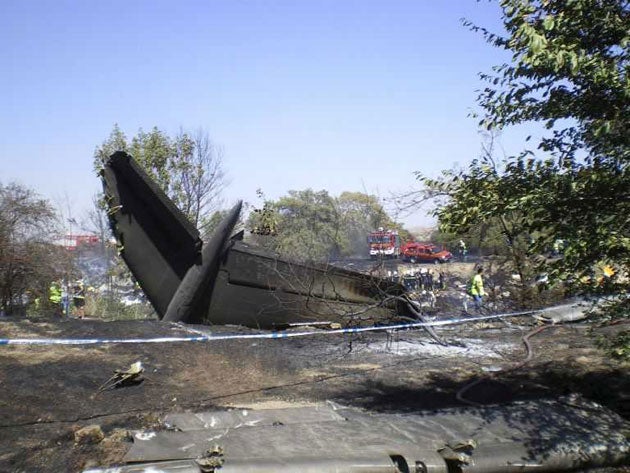
Angry relatives demanded justice yesterday as Spanish investigators combed through the wreckage of the plane that crashed in Madrid's airport on Wednesday, killing 153.
"I'll kill the bastards who did this" shouted one man outside the convention centre near the airport that has been set up as a temporary mass mortuary. Another bereaved and weeping relative, asked angrily: "If they knew the plane was faulty, why did they let it fly?"
The mass grief was deepened by the painfully slow process of identifying the badly charred bodies of their loved ones. By yesterday afternoon, only 39 bodies had been identified, mostly by fingerprints. A further 20 or so were expected to be similarly identified by the end of the day.
For the rest – up to 100 of the 153 who died when the Spanair flight crashed on take-off – the remains are so damaged that identification is expected to be possible only by DNA matches, which could take days.
"Those responsible say it will take two days at most to finish identifying people by their fingerprints," said Magdalena Alvarez, Spain's minister responsible for airports. "DNA identification will take a bit longer."
The list of the 166 passengers showed mostly Spanish names but the government said there were 11 nationalities aboard including people from Sweden, Germany, the Netherlands and Chile.
Officials at Spanair declined to comment on possible causes of the tragedy, saying it was too soon to speculate. They said they would co-operate fully with a judicial inquiry into the causes, which could take months.
But they said the first take-off of their flight JK5022 had been delayed when an air-intake gauge under the cockpit had detected overheating. Technicians turned it off, which the company said was standard procedure, and the plane was given the all-clear.
The 15-year-old McDonnell Douglas MD-82 then attempted a second take-off for Las Palmas in the Canary Islands. There was no "abnormality", Spanair's spokesman Javier Mendoza insisted. The left engine caught fire, the plane slewed off the runway and into a gully. It burst into flames as the fuel tanks caught fire, then broke up.
One victim wanted to get off the plane when he realised it could be in difficulty, but the aircraft staff would not let him leave. His wife received a phone text saying, "Love, there's something wrong with the plane". The woman called him to urge him to disembark, but her husband said, "They won't let me." The grieving relatives are in the Hotel Auditorium, where the airline offered lodgings. Psychologists, on hand to comfort and advise the families, said that the longer the identification process took, the worse it was, but that being together was therapeutic.
"Mostly, we can only listen and comfort," said Ricardo, a volunteer who had spent all night with the relatives. "What they really want, we can't give, and the longer it takes, the worse it is." The president of the Spaish pilots' union Sepla, speaking of the fire in the left engine, said pilots routinely practised taking off and landing in similar situations every six months. "It's been years since engine failure on take-off or a fire has prevented a flight from continuing," said Jose Maria Vazquez, a Spanair pilot.
Alberto Ruiz Gallardon, Mayor of Madrid, promised to organise a collective funeral next week, by which time it was hoped all of the victims would be identified.
More questions than answers
What we know
* The plane had undergone a full service in January and had been part of the Spanair fleet for nine years.
* Safety concerns had been raised about an air intake heating system before the plane began its second take-off attempt.
* Pilots decided to make a second attempt after engineers had examined the plane.
* Several witnesses have confirmed that the plane's left engine was ablaze during its fateful second take-off run.
* After reaching near maximum speed, the plane veered off runway four and ran into a dry river bed, breaking into pieces.
What we don't know
* It is not known why pilots aborted the take-off after the critical "point of no return", after which a full take-off must be attempted.
* Even a severely damaged plane can take off successfully. It is not known whether a mechanical fault or human error caused the failure of the second take-off.
* There have also been unconfirmed reports that a reverse thruster was deployed.
* Flight information stored on the plane's two black box recorders has yet to be accessed.
* Communications between the crew and ground controllers have not been revealed.
Join our commenting forum
Join thought-provoking conversations, follow other Independent readers and see their replies
Comments
Bookmark popover
Removed from bookmarks