Dictator's home town says goodbye Stalin as statue is torn down
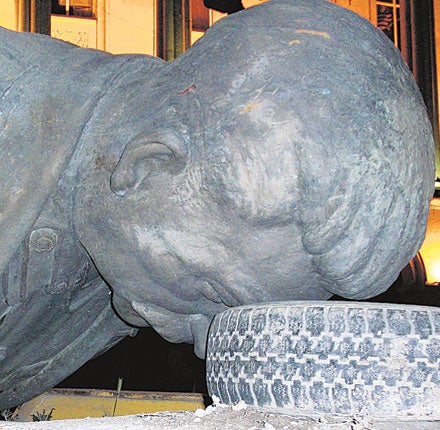
Georgian authorities have removed a massive statue of Joseph Stalin from the main square of his hometown, Gori, in a secret late-night operation underlining their determination to sever ties with their Soviet past.
Police sealed off the square in the early hours of yesterday morning as municipal workers struggled to remove the six-metre bronze statue of the Soviet dictator from its stone plinth. At one point, angle grinders had to be used to cut the metal ties that held the statue to its base. After three hours, one of the last remaining statues of Stalin anywhere in the world was finally toppled. Although Georgia's pro-Western government had long seen the statue as an embarrassment, and more than once voiced the idea of removing it, the final decision was completely unannounced.
A CCTV camera that streams live images of the square online was also covered up for the occasion, showing the government's unwillingness to risk a confrontation over the statue's removal.
"Georgian people are very emotional," said Tornike Sharashenidze, founder of the Georgian Institute of Public Affairs. "Some radical politician or party could have staged a provocation. That's why the government decided to remove the statue in the middle of the night. It should have been removed long ago."
The sudden move marks the end of a long-running debate in Georgia about what to do with the statue, which was put up in 1952, a year before Stalin's death. While most Gori residents were keen to keep it where it was, Georgia's liberal intelligentsia organised a well-planned campaign to have it removed.
Stalin will not be going far, though. The statue will be re-erected in the grounds of the Stalin Museum, a hagiographic exhibition dedicated to the late dictator, less than half a mile from the square. In his place, a new monument will be built in honour those who died during the war with Russia in 2008.
Georgia's relationship with its most famous son has changed markedly over the years. Since Georgia's independence in 1991, he has been increasingly associated with foreign occupation.
"We know that his roots are Georgian, we can't deny that," says Gigi Tsereteli, vice speaker of the Georgian parliament. "But we also can't deny the terrible things he did to Georgia."
Stalin is vastly more popular abroad than at home. In a 2009 TV show designed to find "The Greatest Russian", Stalin came third; in the Georgian equivalent, he was outside the top forty.
But some in Georgia still revere the Soviet strongman, especially in Gori, where residents laid flowers at the foot of the statue on Stalin's birthday. Georgia's tiny Communist Party is also outraged by the decision. Communist activist Giorgi Mokhigulashvili told The Independent that removing the statue was "a crime of global proportions". "What the government did is vandalism. It is a step taken by a fascist government," Mokhigulashvili said.
Georgia's government, however, says the statue's removal demonstrates its commitment to Western values. Addressing the nation, President Mikheil Saakashvili said it was inappropriate to have a monument to a man who enslaved his own country. He said the decision to move the statue to the Stalin Museum demonstrated "a civilised attitude to history".
Join our commenting forum
Join thought-provoking conversations, follow other Independent readers and see their replies
Comments
Bookmark popover
Removed from bookmarks