Does Lacoste want the grand designs of Pierre Cardin? <i>Non merci</i>
Locals revolt against the octogenarian fashion designer and his plans to turn their hill-top village into a 'cultural Saint Tropez'
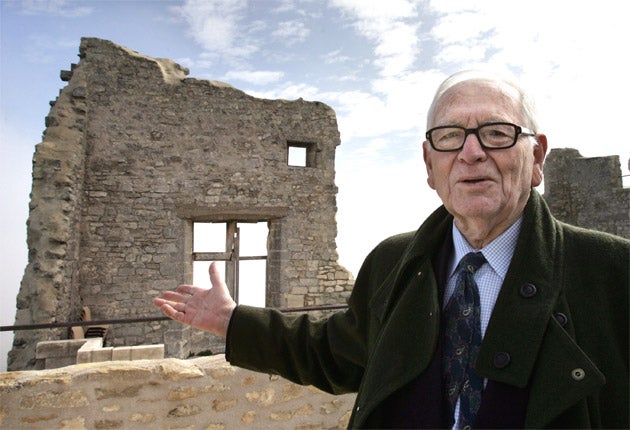
The villagers of Lacoste have turned on their would-be masters before. In 1789, they burned the village chateau which belonged to the family of the Marquis Donatien Aldonze François de Sade, later famous, or infamous, as the literary champion of violent eroticism. Two centuries and two decades later, the 400 residents of Lacoste, a picturesque village in the Luberon hills, are rebelling against another, globally celebrated resident of the chateau – the fashion designer, Pierre Cardin.
M. Cardin, 87, is accused, like his illustrious predecessor, of a kind of exquisite cruelty. He has been buying up the village house by house to turn it into an artistic mecca – or in his own words a "cultural Saint Tropez". He insists that he is rescuing Lacoste from decades of neglect and decline.
The villagers – not all of whom are French – say that he is crushing the true character and spirit of a small Provençal community to create an upmarket, fake rural idyll as a playground for himself and his Parisian friends. By offering to pay well over the market price, he has acquired more than 40 houses, including most of the main street which has come to be known as "Cardin's Champs Elysées".
He has started a summer music festival which, at €65 (£55) a seat for adults, is beyond the means of most villagers. Although Mr Cardin is a self-made man of Italian peasant origin, he is accused of treating the locals with the disdain of the pre- revolutionary aristocracy. "When he appears in the village, he inclines his head to imply 'don't dare talk to me'," said Colette Truphemus, one of his most determined local opponents. "What kind of man would come to a village like this and not want to say 'hello' to the local people?"
Margaret Mottram is an Englishwoman who has lived in Lacoste for 45 years. She is so completely integrated that she is known as the "queen" of the village. That does not make her royalty in the eyes of Mr Cardin. "As far as he is concerned, we are all les petits gens, the little people," she said. "He regards himself as a kind of feudal seigneur. No one else's opinion matters."
Lacoste is a hill-top village of warm, golden stones, close to the part of the Luberon hills made famous by Peter Mayle's book A Year in Provence. Other residents of the surrounding hills include the playwright Tom Stoppard and the actor and film director John Malkovich.
It is the fate – or good fortune – of many villages in the Luberon, and other picturesque parts of France, to attract wealthy and celebrated foreigners and outsiders. Although this does sometimes breed resentment when property prices soar, most villagers are content if the outsiders bring in new life and money.
"We are no different," said Mrs Truphemus. "We have always been welcoming to newcomers, if they appreciate our way of life and want to share it. Cardin is quite different. He says that he is saving Lacoste. But Lacoste did not need to be saved. He is killing Lacoste. When he and his friends are not here – like this week – their houses are boarded up. The place is dead."
In 2001, Mr Cardin bought the chateau overlooking Lacoste, which once belonged to the Sade family. Even his opponents praise the costly work he has done to restore the most celebrated local edifice. They complain, however, that his other projects – the music festival and his mass purchase of local businesses and houses – have been imposed without consideration of the views of locals.
Mr Cardin is dismissive of this criticism. Local people had done nothing for their village, he says: no sewers, no lights at night; no changes since the 1930s.
"I can't force people to sell me their homes," he told Le Monde newspaper. "They sell because they want to sell. I plan to make this village into a cultural Saint Tropez, without its showbiz side. I want to restore its authentic glamour, its truth."
By "authentic glamour" and "truth", locals complain, Mr Cardin means a scrubbed and homogenised, Parisian view of Provençal charm. He has bought local houses, they say, largely to accommodate artists and his friends during his summer festival. In the winter – even in parts of the summer – the village falls silent.
The main street, the Rue Basse, now has a two-star hotel, a bakery, a cafe – the Café Sade – a "panoramic" restaurant, and shops selling rare teas and hampers of Maxim's champagne and foie gras. All belong to Mr Cardin. (So does the Maxim's restaurant in Paris which the veteran fashion designer has turned into an upmarket food label.)
Mrs Mottram, now in her 80s, says that when she came to Lacoste in 1964 the village was almost defunct. "But that was no longer true when Mr Cardin came a few years ago. By that time, we had our own bakery, our own cafe (which Ms Mottram herself ran successfully for many years). Above all, the village was a true community. Mr Cardin is not interested in any of that. He just wants to impose his own vision."
The village also hosts an American art college, now called the Savannah College of Art and Design, which attracts students from all over the world. Relations between the college and village are good. Not so, relations between village and chateau.
Pierre, originally Pietro, Cardin, emigrated from Italy with his parents when he was two years old. He began as a tailor in the industrial town of Saint-Etienne and became an important figure in the Christian Dior fashion house before starting his own label in 1953. He was the first celebrated fashion designer to license his name to high-street stores – causing a scandal in the Parisian haute couture world but making so much money that others soon followed.
Even his local supporters in Lacoste (where he has invested an estimated €30m) are worried about one thing: his age. What will happen when the octogenarian Mr Cardin dies? The designer insists that his plans for the village are so solid that they will outlive him.
Opponents fear that this means that he is in a hurry to buy the whole village to turn it into a kind of "Cardinland": a monument to himself rather than to Provencal charm. "But some of us will never, never sell," Mrs Truphemus explains. "He can bang on our doors and offer all the money he likes. We are going nowhere."
Join our commenting forum
Join thought-provoking conversations, follow other Independent readers and see their replies
Comments