Don't expect Britain to back a new EU treaty, Cameron tells Merkel
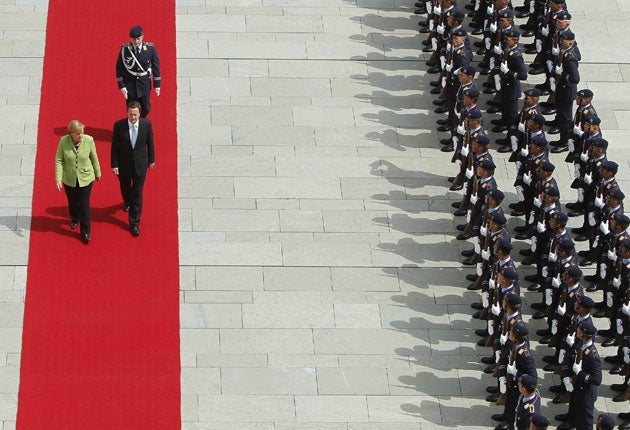
David Cameron flatly ruled out the idea of Britain agreeing to any changes to the European Union's Lisbon Treaty that might involve ceding powers from Westminster to Brussels yesterday, during his first visit to Germany as Prime Minister.
His two hours of talks in Berlin with Chancellor Angela Merkel followed a meeting with French President Nicolas Sarkozy on Thursday, and Mr Cameron was able afterwards to live up to his reputation in Germany as a staunch Eurosceptic by delivering a robust defence of Conservative Party policy on Europe.
Asked whether Britain might hold a referendum on Europe in the event of changes being made to the Lisbon Treaty to support the ailing euro, Mr Cameron said: "There is no question of accepting anything that would lead to a transfer of sovereignty from Westminster to Brussels.
"Britain is not a member of the euro nor are we likely to become a member of the euro, but we want a strong and stable eurozone because that is where 50 per cent of our trade goes. It is in our interest that that takes place," he said.
Ms Merkel stressed that she and Mr Cameron had also discussed the importance of a stable euro "for countries which don't belong to the eurozone".
Mr Cameron was treated to an elaborate welcoming ceremony outside Ms Merkel's modern glass-and-concrete Chancellery building, which Berliners refer to as the "washing machine". He was afforded full military honours by a German army guard unit and band in dress uniform.
German commentators, who in the past have focused on Mr Cameron's decision to remove Britain's Conservatives from the mainstream centre-right alliance in Europe and ally them instead with a Eurosceptic grouping, noted that he had chosen Paris and Berlin for his first foreign visits rather than Washington. They have suggested that he will be forced to temper his Euroscepticism because of his coalition with the Liberal Democrats.
Despite their obvious differences on Europe, the chemistry between the two leaders appeared to function. An embattled-looking Ms Merkel, who only hours beforehand had pushed Germany's controversial €148bn (£128bn) contribution to the euro rescue package through parliament, behaved as if she had been given a few hours off to entertain the new kid on the block. She joked about the fact that the two had opened their talks with discussions about coalitions. "These are something new in Britain, I believe," she said.
The German Chancellor also went out of her way to help Mr Cameron stand up for British interests in Europe by stressing that as Britain was outside the eurozone it could not be expected to sign up to measures or treaty alterations that would influence the single currency. However, the two clearly disagreed over Ms Merkel's unilateral decision earlier in the week to ban naked short-selling of certain financial instruments.
The move, which was carried out without consultation with Germany's other European partners, was designed to answer demands from opposition parties, the public and a hostile press for a clampdown on speculators. It caused near panic on the markets and drove the euro down to a four-year low against the dollar. Her actions have since provoked charges that she has lost control over the euro crisis.
Mr Cameron was asked whether Britain planned to imitate such a ban and neatly side-stepped the issue by stressing that any decision was subject to the Financial Services Authority. But the two clearly disagree on hedge funds. Mr Cameron rejected the German view that they were in part responsible for global financial turmoil, and insisted that the debate should instead focus on the "real causes" of the problems suffered by European economies, such as huge debts and banking system failures. "These have dragged our economies down," he said.
Ms Merkel, who snubbed Mr Cameron by refusing to meet him on a visit to London last April, said there was a lot of common ground between Britain and Germany and that she hoped for a "friendly relationship". Mr Cameron said he was sure that they would form a "strong and practical" partnership.
What next for the single currency
The good scenario
The best-case outcome is that the eurozone's political leaders can convince the financial markets of two things: first, that Greece has the political will, despite continuing social unrest, to push through the austerity programme it has agreed; and, second, that agreements on fiscal responsibility and closer budgetary co-ordination will ensure no single eurozone member's overspending jeopardises the currency's stability again. If – and it is a huge if – those ambitions are achieved, the euro will be stabilised, as speculators accept their hopes of sovereign debt defaults will be dashed. Over time, with economic convergence and improving public finances, the single currency could provide a model for prudent budgetary policy. Even David Cameron – in a second term – might be tempted to reconsider his opposition to Britain's joining.
The bad scenario
The more likely outcome is that Greece will prove unable to get on top of its borrowing. Though the bailout agreed a fortnight ago has bought it some time, the scale of its debt remains daunting and there appears to be little public or political determination to accept the challenge of repayment. A default is therefore likely, hitting banks across Europe that hold Greek sovereign debt and prompting calls for the country to be thrown out of the single currency.
The euro could, however, survive the exit of Greece. The country's debts are not sufficient to prompt widespread banking failures elsewhere in the single currency zone. Also, Germany would argue that with the weakest member of the euro no longer within the zone – and with new fiscal responsibility rules agreed for the remaining members – the single currency would be stronger going forward. That view might prevail, but not without further market volatility.
And the ugly scenario
The nightmare outcome is that a Greek default is followed by further failures in other indebted eurozone countries such as Portugal and Spain. That would trigger a severe banking crisis across the single currency area – as well as in Britain, where banks are heavily exposed to southern European debt – and possibly even the dismantling of the euro. Only a handful of the strongest member states would be able to continue within the bloc, with a collapse likely in the value of the currencies of those ejected from it.
The scale of the financial crisis would plunge the eurozone back into recession, with bank lending drying up. And since Britain depends so heavily on the eurozone as a trading partner – and with our own banks in trouble, too – the slump would also return to this country.
Join our commenting forum
Join thought-provoking conversations, follow other Independent readers and see their replies
Comments