EU divided over taking in detainees when terror camp closes
Stance on Guantanamo set to test relations with Obama administration
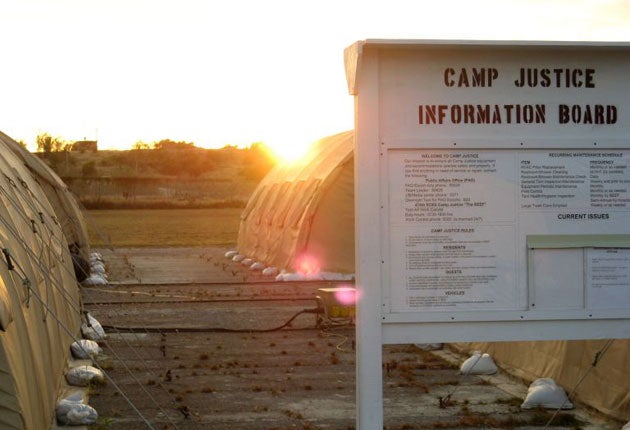
After bitterly denouncing the Guantanamo Bay prison camp as a legal black hole and a torture chamber, EU governments were facing charges of hypocrisy last night as they failed to agree on how to respond to Barack Obama's decision to close the camp within a year.
Foot-dragging in Europe about taking in detainees could create tensions with the new administration. The issue is seen as the first test of the EU's relations with the Obama government and its willingness to repair ties severed during the Bush administration's "war on terror".
At a meeting of EU foreign ministers in Brussels yesterday, only a handful of countries showed support for an expected US request to take Guantanamo inmates into their prisons. Most said they would only take prisoners that the US could show were not a threat.
"It's really up to the US to deal with this and give these detainees a fair trial. It's hugely complicated for us to do so," said the Dutch Foreign Minister, Maxime Verhagen, voicing widespread concern about the legal minefield of accepting those of indeterminate status. "Don't forget these inmates are not kittens – it's a risk for us to bring them into Europe."
The Foreign Secretary, David Miliband, in effect ruled out Britain accepting detainees other than its legal residents still at the camp.
Britain has taken back nine nationals and three foreigners with UK residency. Two cases are still being processed. "We feel that is already a significant contribution," Mr Miliband said. "We're happy to offer our experience to other European countries, as they think about what steps they want to make to help in the closure of Guantanamo Bay."
Some countries said the EU had a moral responsibility to play an active role. "We need to shake hands with the US. It is a new fresh start," said Alexander Stubb of Finland, which like France, Portugal, Spain, Ireland and Sweden is considering taking in inmates.
The German Foreign Minister, Frank-Walter Steinmeier, said chief responsibility for solving the problem lay with those who set up the camp. "But it is also a question of our credibility, of whether we support the dismantling of this ... camp."
France pushed for a fact-finding mission to the camp and for the EU to take in at least 60 of the 254 detainees. Its Foreign Minister, Bernard Kouchner, has floated the idea of a centralised system to check prisoner backgrounds but the plan received only a muted response.
Dozens of Guantanamo inmates would face abuse, imprisonment or death if returned to their homelands because of their alleged links to al-Qai'da or the Taliban. They come from Algeria, Azerbaijan Afghanistan, Chad, China, Saudi Arabia and Yemen. Over the past seven years, they were picked up in security sweeps in Afghanistan or Pakistan and detained at Guantanamo.
The Pentagon says 60 prisoners are ready for release but their files and those of other detainees are yet to be examined. The Pentagon also leaked that 61 former prisoners returned to terrorism after being released, a figure difficult to verify.
EU divisions mean the matter may have to be decided by countries individually but some Europe-wide legal framework is required as most countries are part of the Schengen area that allows border-free travel.
"It's an absolute nightmare to sort out what kind of laws would apply to which kind of detainees. The complexity of this is unprecedented," said one EU diplomat.
EU justice ministers will have to navigate through the minefield but there was little optimism of a quick fix. "This could take weeks, even months," said the Czech Foreign Minister, Karel Schwarzenberg.
Problem prisoners: Where will they go?
*Who is still imprisoned in Guantanamo Bay?
Since it opened in January 2002, the camp has held 779 detainees. Now, with 532 transferred out, either released or moved into the US penal system, just 247 remain. Those remaining include some who will be tried in the US for terrorism-related offences, some who will be returned to their home countries and 50 to 60 "hard cases", to whom America is not willing to grant asylum, but who cannot be returned to their homes.
*Why can't the rest just go home?
A small group are stateless individuals, others would almost certainly face persecution or torture in their homelands. The biggest single group of problem detainees are 17 Chinese Muslim Uighurs. They fled oppression in western China, were picked up in Pakistan and accused of undergoing terrorist training. Although the US has determined that they are no longer "enemy combatants", they cannot be returned to China.
*Why won't the US take them?
No official explanation has been given, but fears about the political consequences of having former Guantanamo inmates in their home states is one reason; the maintenance of diplomatic relations with the prisoners' home countries may be another.
*Will European governments take in some inmates?
France and Portugal argue that having called for the closure of Guantanamo, the EU must help in housing detainees. That group also includes Albania, Ireland and Finland. Britain supports them but says that taking Guantanamo's British citizens and residents constitutes a major contribution in itself. Italy, the Netherlands, Switzerland, Austria and Sweden see no political or national security benefit.
Archie Bland
Join our commenting forum
Join thought-provoking conversations, follow other Independent readers and see their replies
Comments
Bookmark popover
Removed from bookmarks