Europe struggles to keep reform plans alive after Irish reject treaty
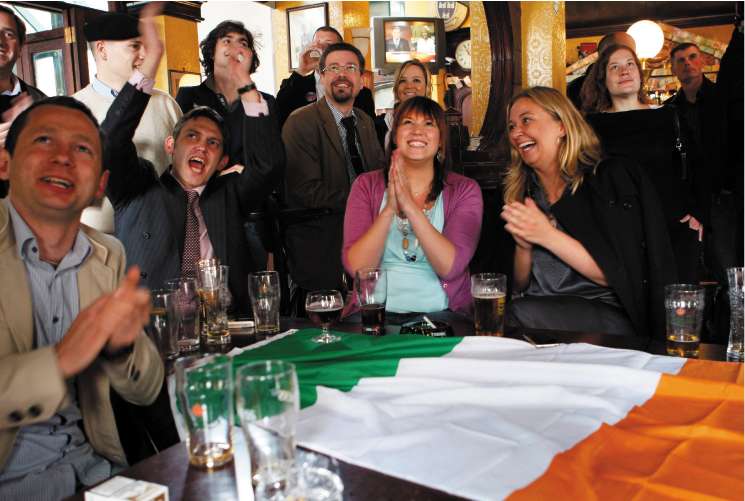
Political leaders across Europe were trying desperately last night to keep EU reform plans on track after Irish voters overwhelmingly rejected the Lisbon Treaty.
The French and German governments led calls for the other 26 EU nations to push ahead regardless with the ratification of the treaty. But senior officials in Brussels accepted that – unless Ireland could be persuaded to stage a second referendum next year – seven years of painful negotiations to simplify and streamline the governance of the EU had come to nothing.
The European Commission president, José Manuel Barroso, called on the Irish government to suggest possible "solutions" at an EU summit in Brussels next week. He said: "I believe the treaty is alive. Eighteen member states have already approved the treaty and the European Commission believes that the remaining ratifications should continue."
However, another senior European commissioner, speaking off the record, said: "There will be no repeat vote in Ireland. That means the treaty is dead. It's part of a general disenchantment with the EU. We would have had similar results if there had been referendums in other European Union states."
A group of countries, led by France, which assumes the EU presidency next month, is expected to try to minimise the importance of the Irish "no" vote. If other countries ratify the treaty, they argue privately, Ireland will be obliged to have a second vote.
Other countries could agree on declarations, they say, guaranteeing respect for Irish neutrality, or on Ireland's low business tax status. The Irish electorate might then in a second referendum vote "yes" as they did with the Nice Treaty in October 2002.
And if Ireland refuses? Legally, the new treaty must be ratified by all 27 member states to come into force. Officials in some capitals, notably Berlin, argue that Ireland, with 4 million people, is too small to be allowed to hold up the plans of governments representing almost 500 million people. Dublin would have to be bullied into accepting some kind of semi-detached European status, like that of Norway.
Officials in Brussels said they doubted whether that could work. In any case, they said, why should Ireland be menaced with de facto expulsion when France and the Netherlands escaped any threat after their popular "no" votes in 2005? Besides, the officials said, it would be dangerous to ride rough-shod over a popular vote.
EU capitals are confronted with a depressing conundrum. The peoples of the European Union – even those who have manifestly benefited from the enterprise such as the French and the Dutch and now the Irish – feel threatened, rather than inspired or protected, by their membership of the enlarged EU.
The Lisbon Treaty is not, as sometimes claimed, a blueprint for a federal united states of Europe. In some respects, it buried that idea for ever. The treaty is an absurdly complex attempt to try to make an absurdly complex system, designed for six countries, work better – or simply work – with 27 countries.
In truth, officials recognised, EU governments have only four options.
First, they can agree to renegotiate the treaty (again) to take account of the Irish electorate's disparate objections. This is practically a non-runner.
Second, they can press ahead with their own ratification processes. When 26 countries have signed up, they can turn to Ireland and ask for a second referendum. A few rhetorical concessions could be made to Dublin in annexes or declarations. Third, Ireland, as the only non-signatory, can be asked to leave the EU.
Fourth, the EU can forget the whole thing (for now) and continue with its existing rules.
There will be some voices – maybe including British ones – suggesting that the EU should now concentrate on practical problems which directly concern its citizens – climate, globalisation, immigration, terrorism – rather than continue to argue about itself.
This may be the de facto outcome, whatever governments say in the next days and weeks. Whether the old EU rules will permit any progress to be made on practical issues is open to doubt.
Brown vows to press on
Gordon Brown will reject pressure to halt the passage of the Lisbon Treaty through Parliament following Ireland's rejection of the blueprint.
The Irish "no" vote provides a headache for Mr Brown, who has adopted a low-key approach to ratifying the treaty in an attempt to avoid alienating public opinion and Britain's Eurosceptic newspapers.
Ironically, his "softly softly" approach had almost worked. The Bill implementing the reform of EU institutions is due to complete its passage through Parliament next week. But the Europe issue reignited again yesterday as the Tories and Liberal Democrats urged the Government to think again.
But ministers said the European Union (Amendment) Bill would receive its Third Reading in the Lords next Wednesday, and will receive Royal Assent.
What is The Lisbon Treaty?
*The Lisbon Treaty would replace the aborted draft constitution voted down by French and Dutch voters in 2005.
*The 50-article charter contains a list of well-established rights, including freedom of speech and religion. Britain and Poland obtained opt-outs.
*The EU would get a president and a foreign policy chief to control the EU's aid budget and its extensive network of diplomats and civil servants.
*The European Commission would be cut from 27 members to 18 as of 2014. Commissioners would be selected on a rotation system among the states, and will sit for five-year terms.
*The European Parliament would win more power to influence or reject EU legislation. MEPs capped at 751 members from the current 785.
*To streamline decision making for 27 states, decisions would be taken by majority rather than unanimous voting in 50 new areas including judicial and police co-operation; Britain and Ireland had negotiated opt-outs in these.
Join our commenting forum
Join thought-provoking conversations, follow other Independent readers and see their replies
Comments