Eurozone divided as time runs out for Spain
Bailout now 'inevitable' despite official denials
The eurozone sovereign debt emergency showed no signs of abating yesterday as the Spanish government desperately haggled over the terms of its expected bailout and the European Central Bank refused to ease monetary policy for the currency bloc, despite signs of stricken European economies sinking still deeper into recession.
Madrid's Economy Minister, Luis de Guindos, insisted once again he was not making any plans to follow Greece, Portugal and Ireland in requesting a bailout from the European Union and the International Monetary Fund. But, behind the scenes, Spanish ministers accept that an external rescue of the country's beleaguered banking sector is now necessary. Spain is trying to persuade its European partners to allow the European bailout fund to inject capital directly into its banks, rather than diverting the money through the state. Madrid fears that a full-blown national bailout would be accompanied by an onerous EU/IMF inspection system.
This idea, however, has met opposition from some senior German politicians, who have insisted that bailouts must be paid out to countries rather than financial institutions to guarantee full accountability. A possible compromise under discussion was a national bailout with minimal conditions.
Separately, Spain's public prosecutor's office opened an investigation into its fourth-largest lender, Bankia, yesterday. Bankia was formed through a merger of seven troubled smaller banks and many small shareholders, who were encouraged to provide the new lender with equity, have seen much of their investment wiped out. Bankia said it needs €19bn in new capital. The IMF is due to report next week on how much capital the rest of Spain's banking sector requires. Analysts say the full recapitalisation needs of Spain's banks could be more than €100bn.
There were also signs of increasing strain in the Spanish economy yesterday as figures showed industrial production falling at the fastest rate in more than two years. Spain is in a double-dip recession, with unemployment at 24 per cent, and the European Commission has forecast that Spain's economy will contract by 1.8 per cent over the course of 2012.
The European statistics agency Eurostat also confirmed yesterday that the eurozone as a whole escaped a return to recession by the narrowest of margins this year. It said output was zero in the first three months of 2012. Spain contracted by 0.3 per cent and Italy by 0.8 per cent. Both of those economies have seen their borrowing costs rise in recent months, pushing them closer to a potential bailout. Spain's 10-year borrowing costs were at 6.29 per cent yesterday, while Italy's costs rose to 5.69 per cent. On Tuesday, Mr De Guindos admitted the credit markets are "effectively shut" to his country. Madrid is set to attempt to sell a further €2bn in bonds today.
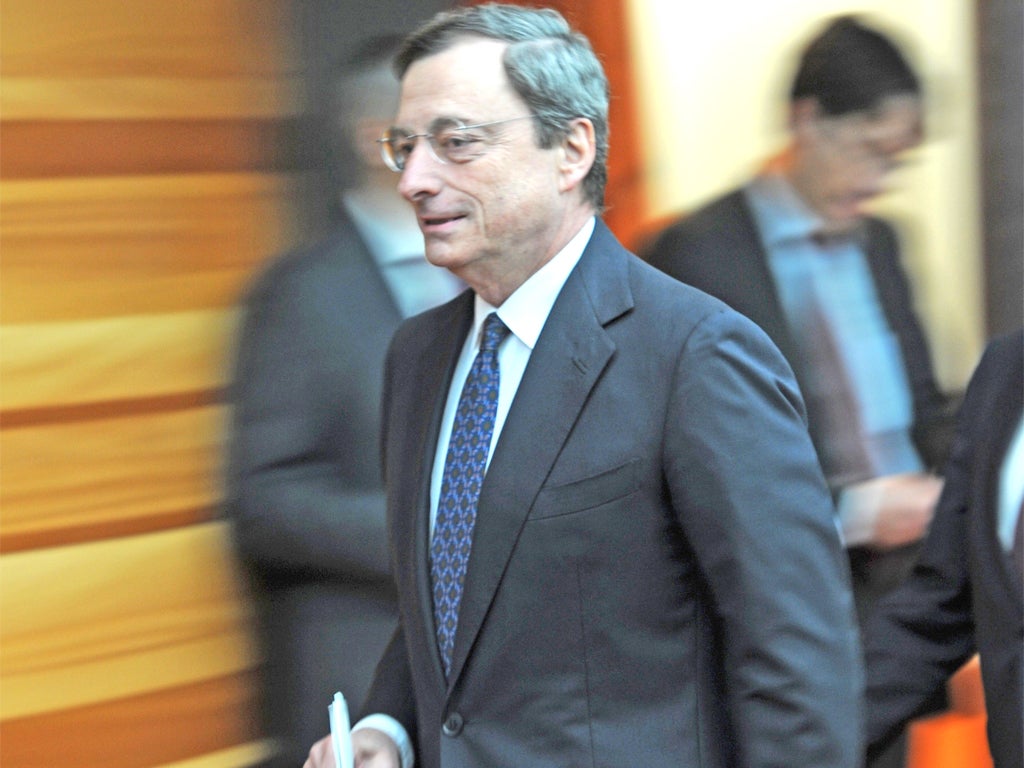
Meanwhile in Frankfurt, the European Central Bank held interest rates at 1 per cent. And the ECB's president, Mario Draghi, disappointed markets by downplaying hopes of another mass liquidity operation for Europe's banks, or a restart of the ECB's sovereign-bond buying operation. The ECB cut its forecast for the eurozone over 2012 from 0.1 per cent growth to a 0.1 per cent contraction.
Mr Draghi said the ECB could not be expected to make up for the shortcomings of European politicians in tackling the crisis. He said: "Some of these problems in the euro area have nothing to do with monetary policy... and I don't think it would be right for monetary policy to fill other institutions' lack of action." Last week, he urged European leaders to establish a banking union to restore the confidence of savers across the Continent, who have been pulling deposits out of banks in the periphery.
European leaders are set to discuss proposals for a banking union when the meet in Brussels on 28-29 June, although that meeting is likely to be dominated by the aftermath of the Greek parliamentary elections, which will be held on 17 June. At the moment, the polls suggest that the anti-bailout Syriza party and the pro-bailout New Democracy are neck-and-neck. Many expect a victory for the former to see Greece ejected from the single currency.
The European Commission yesterday unveiled plans to protect European taxpayers from the costs of banking failures by imposing losses on bank shareholders and creditors. The internal market commissioner, Michel Barnier, said: "We must equip public authorities so that they can deal adequately with bank crises. Otherwise citizens will once again be left to pay the bill". But the earliest any such legislation could come into effect would be 2014. Spain's banking crisis will need to be resolved before then.
Danger zone: How debt crisis is making itself felt
Spain A crushing property slump has left the economy on its knees. Losses linked to the real estate debacle are now threatening the banking system – which in turn has raised the prospect of a bailout for Spain as it struggles to prop up its lenders. The crisis took a new turn yesterday when the anti-corruption unit of Spain's public prosecutor's office opened an investigation into part-nationalised Bankia, one of the country's largest lenders.
Germany Profligacy on Europe's southern fringes may be the proximate cause of the debt crisis but its impact was felt in Germany when Moody's lowered its credit ratings for six of the country's banks. The move was "driven by the increased risk of further shocks emanating from the euro area debt crisis", the agency said, underscoring the vulnerability of the German economy, despite strong exports and low unemployment.
Greece The recent elections failed to deliver a government. The country will go to the polls again later this month – and the result could determine whether it remains in the eurozone. The far Left wants a change in the conditions attached to the Greek bailout – an idea that Germany, for one, is vehemently opposed to. The country, meanwhile, remains in mired in the recession.
Portugal Lisbon has already had to be bailed out. But another rescue could be in prospect, amid surging unemployment. Although Portugal cleared one of the performance reviews under its rescue package earlier this week, its jobless rate of more than 15 per cent is the third highest in the eurozone, after Greece and Spain.
Cyprus With all eyes on Greece and Spain, it is easy to forget about Cyprus, which is racing to save Cyprus Popular Bank. The lender is heavily exposed to Greek bonds – and if investors aren't willing to supply the €1.8bn needed to shore up the bank, President Dimitris Christofias, below, will have to step in. The fear is that the country will struggle to find the cash (10 per cent of its economy), paving the way for an international bailout.
France Paris is also under pressure to rein in its finances. Analysts fired a warning shot earlier this year, when the country lost its prized AAA credit rating. Now, the focus is on its banks – and their exposure to troubled economies. Yesterday, Moody's lowered its ratings on the Greek arms of Crédit Agricole and Société Générale, piling further pressure on two of France's biggest lenders.
Join our commenting forum
Join thought-provoking conversations, follow other Independent readers and see their replies
Comments
Bookmark popover
Removed from bookmarks