Exclusive: The unseen photographs that throw new light on the First World War
A treasure trove of First World War photographs was discovered recently in France. Published here for the first time, they show British soldiers on their way to the Somme. But who took them? And who were these Tommies marching off to die?
The place, according to a jokingly chalked board, is "somewhere in France". The time is the winter of 1915 and the spring and summer of 1916. Hundreds of thousands of British and Empire soldiers, are preparing for The Big Push, the biggest British offensive of the 1914-18 war to date.
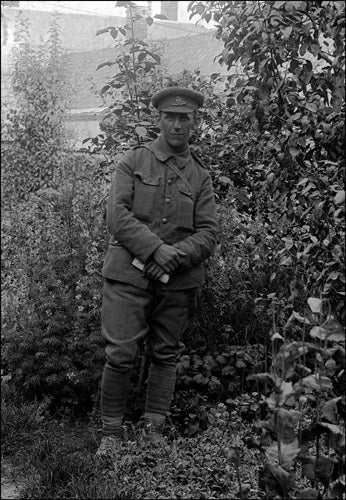
A local French photographer, almost certainly an amateur, possibly a farmer, has offered to take pictures for a few francs. Soldiers have queued to have a photograph taken to send back to their anxious but proud families in Britain or Australia or New Zealand.
Sometimes, the Tommies are snapped individually in front of the same battered door or in a pear and apple orchard. Sometimes they are photographed on horseback or in groups of comrades. A pretty six-year-old girl – the photographer's daughter? – occasionally stands with the soldiers or sits on their knees: a reminder of their families, of human tenderness and of a time when there was no war.
Many of the British soldiers are wearing rough sheepskins over their battle-dress: a tell-tale sign of the great overcoat shortage of the winter of 1915. The sheepskin-clad "Tommies" look, bizarrely, like ancient warriors or Greek or Yugoslav partisans.
Within a few months – or days, most probably – many of the soldiers were dead. The "somewhere in France" where these pictures were taken was a village called Warloy-Baillon in the département of the Somme. Ten miles to the east was the front line from which the British Army launched the most murderous battle of that, or any, war, which lasted from 1 July to late November 1916 and killed an estimated 1,000,000 British empire, French and German soldiers.
More than 90 years later, at least 400 glass photographic plates preserving the images were found in the loft of a barn at Warloy-Baillon and cast out as rubbish. In recent months, the plates, some in perfect condition, some badly damaged, have been lovingly assembled and their images printed, scanned and digitally restored by two Frenchmen.
Together, they form a poignant record of the British army on the eve of, or during, the battle of the Somme: the smiling, the scared, the scruffy, the smart, the formal, the jokey, the short, the tall, the young and the old. There is even an image of a 1914-18 war phenomenon which was rarely photographed and scarcely ever mentioned: a black Tommy in artillery uniform, with two white comrades.
The Independent Magazine publishes a large selection of the images here for the first time. More of the collection, including a few images of French civilians and soldiers, and possibly the photographer and his family, can be seen on The Independent website.
Who are these British and British Empire soldiers? Who was the photographer? Who was the little girl? From internal evidence in the pictures it is possible to identify the period and some of the military units – The Northumberland Fusiliers, the Tramways' Battalion of the Glasgow Highlanders, the Royal Leicestershire Regiment, the Royal Army Service Corps, the Royal Flying Corps, the Royal Engineers, a few Australians, a South African, a lone New Zealander.
The identity of the soldiers is, and may always remain, a mystery. They are, in a sense, a photographic parallel to the 400 unknown British and Australian soldiers now being excavated from eight mass graves near Fromelles, 50 miles to the north. Including the figures in the group photos, well over 400 unknown Tommy faces come back to us through the mists of time and battle.
Most First World War photographs show smart soldiers before leaving home for the front or exhausted soldiers during or just after combat. Here we see the clear and often modern-looking features of soldiers at rest, either before – or in some cases, it seems – just after fighting in the trenches to the east.
Many of the images show medical orderlies. Warloy-Baillon was the site of a large hospital, taken over by the British Army. Other soldiers were evidently photographed while in reserve, or engaged in behind-the-line tasks, or after recovering from minor wounds.
There are several gems. Who is the "black Tommy"? There was already a small black community in Britain in 1914 – in Cardiff, in Liverpool and in the North East. Black men are known to have volunteered and fought in the trenches, but very few photographs of them exist.
Who, also, is the giant of a British soldier, possibly as much as seven feet tall, sitting in front of two standard-sized comrades? Who was the Tommy who asked the photographer to take a picture of his back, which has been elaborately tattooed with the faces of the British royal family? Why is one group of soldiers holding a large rag doll?
Click here to help us answer these questions and more.
The survival of the images is owed to two local men: Bernard Gardin, aged 60, a photography enthusiast; and Dominique Zanardi, 49, proprietor of the "Tommy" café at Pozières, a village in the heart of the Somme battlefields.
M. Gardin was given a batch of about 270 glass plates by someone who knew of his hobby. He approached M. Zanardi, who has a collection of Great War memorabilia, including a football dug up 12 years ago inside a British soldier's rucksack. M. Zanardi, it turned out, already had 130 similar plates which he had gathered from other local people.
"About three years ago, someone bought a barn near Warloy-Baillon," M. Zanardi said. "They found the glass plates in the loft and just threw them out as rubbish. Many of them were picked up and taken away by passers-by. I started collecting them and had reached over 100 when M. Gardin turned up with this great batch of 270. They must also, originally, have come from the same source. There may be many more out there which we have not yet been found."
M. Gardin and M. Zanardi have had prints made, at their own expense, from the original plates. M. Gardin describes these as "9 x 12 centimetre glass plates, of the kind used at the time by amateur photographers. A professional would have used a camera with bigger plates, 18 centimetres x 24."
Amateur or not, the quality of many of the images turned out to be excellent. Some plates, however, had been damaged. M. Gardin scanned the prints into a computer and set about digitally restoring the images. "If it's just a question of filling in a wall or part of a uniform, it's quite easy," he said. "Faces, and especially eyes, are very tricky."
Prints of more than 100 of the unknown soldiers have now been framed and exhibited in M. Zanardi's café in Pozières. Others will join them when they are ready.
M. Zanardi's attempts to identify the photographer and the images of French civilians, and a handful of French soldiers, have got nowhere. "My belief is that he lived close to the barn where the plates were found," he said. "He may have been a farmer. The plates were just stacked up after he printed photographs from them and then forgotten for more than 90 years."
M. Gardin told me: "We think that they form an important, and moving, historical record. Our motive in restoring them was not financial. It was a tribute to all the British soldiers who fought here and also to an unknown photographer."
Identical copies of these images must have been sent home to mothers and wives and sweethearts in late 1915 and the first half of 1916. Will someone out there recognise their Great Grandad or their Great Uncle Bill?
Although some research has been conducted into the photographs, much hard work is yet to be done. Such compelling images must have a story attached; and with your help we hope to uncover as much of their fascinating history as possible. Click here to see how you can help.
View all comments that have been posted about this article.
Offensive or abusive comments will be removed and your IP logged and may be used to prevent further submission. In submitting a comment to the site, you agree to be bound by the Independent Minds Terms of Service.
- Print Article
- Email Article
-
Click here for copyright permissions
Copyright 2009 Independent News and Media Limited


Comments
Can't someone pull it down?
Lloyd George in the meantime like any good politician, turned his hand to writing his memoirs, which is the foundation of the "Lions led by Donkeys" myth, where he effectively shifted the blame for decisions which caused such huge casualties from him and his war cabinet, onto Haig. Indeed, other commanders who had felt slighted by Haig during the war or were jealous because he was promoted over them, colluded in the Lloyd George scapegoating of Haig.
Haig was (amazingly) Britians most successful ever field commander, winning an unbroken string of 117
straight victories after the disaster of the Kaisers battle in 1918 (The final German offensive). It was the British Army that won the war in 1918, despite popular propaganda overstating the role of the Americans, who in reality did little more than bolster a severely weakened French Army, and further had to be almost fully equipped by the French, from Aircraft to Machine Guns. Under Haig the British killed and captured more Germans than the other two allies combined, and broke the German Army.
Lloyd George went on the become involved in cash for honours scandals and became an admirer of Hitler. I urge people to read proper history and not the stylized version.
If you want to pull any statues down, pull down that of Lloyd George.
Shortly after war broke out in 1914 he was called up and given a PoW camp to look after near Fareham. Why he was asked to abandon his profession to look after a load of German officers when he would have been much more use patching up people with damaged mouths, beats me. I believe that was not that unusual in that war.
Within 18 months, my mother had been born in the governor's quarters, and there are family photos of her being bounced on many a German officer's knee right up to the end of the war when she was nearly 3. She claims that it made them 'much more civilised' as it reminded them of home. She also claims that the PoW's had the best teeth in any camp, as my grandfather set up a surgery and took the opportunity to advance dental practices - i.e. the Germans were very willing guinea pigs.
William J. H. Boetcker
What is truer than truth? The story.
Jewish Proverb
Naturally, every age thinks that all ages before it were prejudiced, and today we think this more than ever and are just as wrong as all previous ages that thought so. How often have we not seen the truth condemned! It is sad but unfortunately true that man learns nothing from history.
Carl Gustav Jung (1875 - 1961)
I've sent you a message about requesting hi-res image examples. Do let me know if I can help.
Kind regards,
Matilda
Seems to me that there should have been something that could have been done for folks like him. But then again, maybe such festering long-term mental wounding just becomes such a part of you that, if it's not addressed quickly with good mental healthcare (of the sort that just wasn't widely available until long after both world wars) it can't be got rid of.
Even today, academics still cannot explain why and how World War One started. Of course, we are told Archduke Franz Ferdinand of Austria's assassination ignited the powder keg, but on closer examination, that as a plausible reason does not really stand up to scrutiny. In an era of the horse and buggy, and with aerial warfare still not invented, it was a very long way from the Balkans (where it took place) to the fields of Belgium. Especially so when you learn that it was in fact Germany (Prussia) who had been keeping the peace in Europe since circa 1870.
@hitch2
No. 46 has a black guy?
Don't be so disrespectful, thousands of colonial troops were butchered during the abattoir that was the western front.
I agree with your motives, but I'm not sure cutting off relief to ex-servicemen will serve your goals very well. The Haig poppy is a great symbol reminding us that wars should never again be entered into lightly (if at all). The sad thing is that politicians often fail to see the symbol for what it is.
http://www.flickr.com/groups/greatwar/
http://www.flickr.com/groups/greatwarar
http://www.flickr.com/groups/world_war_
http://video.google.com/videoplay?d
NONSENSE-it was correctly believed that such were far warmer than a Greatcoat, and without the Greatcoat's skirt that went down to the knee's (and below) far more practical in the mud of the trenches. Soldiers would hack the skirt off the Greatcoat if worn in the trenches. The wool (and goat) skin jerkins also allowed greater movement of the upper body. Were replaced in 1916 by the equally effective, comfortable and totally practical, but far cheaper Leather Jerkin (based on the 'Donkey Jacket' of British Dockyard workers) - a item still being used by the British Army up to the 1990's, I still use one for gardening.
Cavalry wore the Mounted Troops Greatcoat, which in its modern version "The British Warm" you can still buy on the High Street.
Soldiers of the Great War did not wear Battle Dress (that came in in 1938) they wore Service Dress.
G.A.MACKINLAY
The remaining subject headline reads: "Foul Language is Out of Place Here; Why Has the Independent Not Deleted It?" was actually authored by me, and it was posted at 23 May 2009 at 06:01 pm (UTC)
I was responding to someone using the moniker "hitch2" {a moniker which, oddly, has since been removed from view by the Moderator} who wrote the following on Saturday, 23 May 2009 at 10:19 am (UTC)
No. 46 has a black guy? Is this an English regiment? I knew the BNP were full of [**foul language inserted at this point**]
I wrote my response in order to request the moderator to remove hitch2's comment as his use of foul language and his direct attack on a political party, was entirely inappropriate, disrespectful, and slanderous.
The Independent has done so, and I am grateful.
Unfortunately, instead of playing with a straight bat, and deleting the entire 3 x comment thread--an action they had taken against another short thread earlier in the day--they have this time 'played games'.
They have deliberately left the thread looking as though the last commenter, corporeal4now, had authored what was my heading, when responding to my comment. The libellous implications of this ruse are clear. Therefore, this comment has been posted, for the record, to expose a behaviour which has greatly demeaned this Newspaper.
I have read Passchendaele' (1917) by Philip Warner (Pen and Sword' 1987 that contains so many eye witness reports of the battle for Passchendael Ridge' where the courageous Australians,New Zealanders,Canadians and British `Tommies' were all heroes to a man.
Captain H Dearden a Medic with the Field Ambulance wrote of `Passchendale'
`Dead bodies ,everywhere,men and horse laying like sleepy children ,side by side and limbs asprawl...
Hands and legs stick out in the most uncanny way from heaps of earth and sandbags ,and in the wind which flutters their muddy sleeves,they almost seem to be waving a greeting or calling for help'
These photographs are absolutely priceless..
Cllr Patrick Smith-LBWF
I was immensely struck by their almost uniform regal pose, the pride expressed in their posture, their clear and firm gaze, their lack of effeminate afflictions.
Almost without exception, they all look like REAL men; not the shifty eyed, limp-wristed-handshake types that seem to be the 'norm' for our society today.
I am greatly pained by the realization that these millions of men died such horrible deaths, in the mud and cold and in the prime of their lives, so that we today may wallow in immorality, vice, and corruption, yet still find the arrogance to call it 'progress.'
Rickerby Memorial Park was a gift to city by Carlisle Citizens League acquired for the public . Opinions are split with Cenotaph and nearby Memorial Suspension Bridge crossing River Eden as city centre much smaller and more recent WW2 memorial now attracts parades to lest we forget... as some do.
Re: Cumberland Newspapers. News & Star. Topic: Rickerby Park. Carlisle MP Eric Martlew calls for ban on Sheep. Indie Newspapers Article subject reading/viewing for reality check.
Thanks 'Mr John Lichfield. Well timed find of historic data. War is horrid no matter where.
' "Great Britain ... Best country in World for Farming" and Love of Animals' My Farmer GGFather after returning from USA after loss of his wife in late 1800's.
Send the word, send the word over there--
That the Yanks are coming,
The Yanks are coming,
The drums rum-tumming
Ev'rywhere.
So prepare, say a pray'r,
Send the word, send the word to beware.
We'll be over, we're coming over,
And we won't come back till it's over
Over there."
I was taught you Brits were in disarray and exhausted when we Americans saved you butts. The soldier you poms really screwed blue were the Aussies. They were hung out and left to dry under a Turkish sun. Lucky for us Yanks, we refused to submit to British commanders who couldn't tell a boot from a windscreen.
As to these pictures, they show the fantasy side of men and war. This is the playing dress up in cool looking military attire part of the story. This is the marketing side of wars. You too, can become an hero.
Also, should we not refer to the two World Wars as: "The Great European Civil War, parts 1 and 2"? For that, apart from the separate struggle between the Americans and Japanese in the Pacific, is really what it was.
The cause of the start of the First World war was the Kaiser's overwhelming ambition to conquer France.
Historian2
With the exception of Japan ((who were invited to attack Pearl Harbour by Roosevelt so America would have an real excuse to sell to a sceptical American public thus enabling Washington to enter the war)) both conflicts were fratricidal.
There is a huge amount of information (facts, analysis, documents) that have been kept from public view--including of course the ex-Soviet archives, which have only recently been opened up to scrutiny--that has been kept from public view and our educational system. Therefore, the vast majority of ordinary folk have had their understanding of both conflicts built upon completely distorted and inaccurate information. Indeed, a significant proportion of this inaccurate information has actually been constructed from deliberate disinformation and lies, designed to cover up who was really responsible.
As for your last paragraph, this surely cannot be correct. Most of us living in the West have been bombarded with anti-German literature and hate propaganda for longer than most can remember. To carry on blaming the Germans for both wars might please a small minority that has embedded itself within our establishment, but it will never satisfy the test of truth. Therefore, to simply attach fault to the German people for either war, to the exclusion of all other evidence, is utter humbug.
Following the Treaty of Vienna (1864), the Austro-Prussian War of 1866, and the establishment of the German Empire in early 1871, it was in fact the Germans (Prussians) who had been keeping the peace in Europe. You should never make wild assertions like "The cause of the start of the First World war was the Kaiser's overwhelming ambition to conquer France" without providing solid evidence.
Both the British people and British newspapers alike never cease to make themselves look ridiculous by continuing with this bellicose and childish anti-German tirade, that is played out (almost daily) by endless references to the Nazis and Hitler. This obsession prevents most of us from getting to the real truth. So there is a viable motive for you already.
The causes of the Franco-Prussian War are rooted in those events surrounding the aftermath of Napoleon Bonaparte's grab for universal power. The Franco-Prussian War pitted the Prussians and a confederation of small German states against the Second French Empire, under Napoleon III. During the Siege of Paris in 1871, the North German Confederation along with its south German allies, formed "The German Empire" with the proclamation of the Prussian king Wilhelm I as German Emperor. This proclamation took place in the Hall of Mirrors at the Palace of Versailles.
If you care to widen your reading, then I am confident you will find that Germany attacked France in 1914 only to pre-empt a planned invasion by both France and Russia, who had already allied themselves and were preparing to simultaneously attack the German Empire on both (i.e., eastern and western) fronts.
The Franco-Russian Alliance was a military alliance between the French Third Republic and the Russian Empire that was signed in 1892 and continued right through until the Bolshevik (October) Revolution of 1917.
Germany offered peace terms to Britain in 1916, but we rejected them; preferring instead to insinuate America into the war. Learning about which groups lobbied the loudest and longest for this rejection will open your eyes to the real truth of who was behind both world wars.
The location of king Wilhelm I's proclamation is why, in 1919, the Palace of Versailles was selected for issuing an economically but not militarily defeated Germany with uncompromising peace-terms (the Treaty of Versailles); the harsh injustice of which led directly to the collapse of the Weimar Republic (1929 to 1932), a declaration of war against the German people (in 1933) by World Jewry (based in New York City), and the subsequent start of World War Two in 1939.
In short ... had there been no French Revolution, and no Napoleon Bonaparte, there would never have been a 1914-18 world war. So why not blame the French?
Although some research has been conducted into the photographs, much hard work is yet to be done. Such compelling images must have a story attached; and with your help we hope to uncover as much of their fascinating history as possible. Click here to see how you can help.
Now I need the help for you. Please donate freely as this is for the wars veterans of the pre wars and the after wars. The catch is simple. Buy one get the second free.
I thank you
Firozali A.Mulla
How sad it made me to see your faces,
Searching for your souls,
Impoverished in garment but still, having your stubborn pride,
Lonely but amongst friends, forever, even after all these mystic years,
I don't know you by name or flesh,
but I wish I knew,
What happened to you,
where did you go,
why,
WHO and WHAT made you to become a black and white image of our guilt, forever,
How can I forget them, and forget YOU,
With the greatest respect:
I did not blame the German people for starting the First World War, I blamed the Kaiser. The people did what they were told.