French foreign minister 'took cash from African dictators'
Author accuses Kouchner of showing favouritism towards notorious leaders
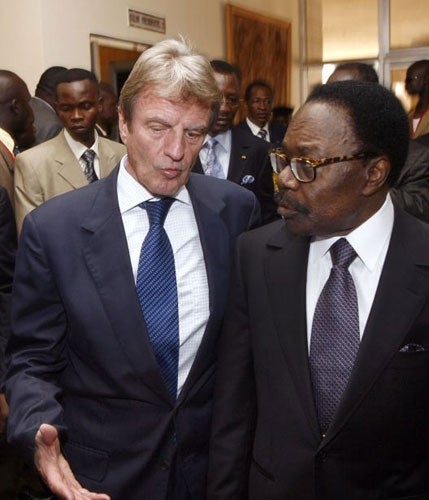
The French Foreign Minister Bernard Kouchner yesterday dismissed claims that he had mingled humanitarian activities with paid work for African dictators as "grotesque" and anti-Semitic.
The allegations against M. Kouchner, co-founder of Médecins sans Frontières, are contained in a vitriolic book published yesterday to a divided response from the French political establishment. Its author is one of France's most experienced – and most controversial – investigative journalists.
The book, which critics contend relies on innuendo and is fatally flawed by the biases of its author, claims that M. Kouchner ignored a conflict of interest between his humanitarian work and payments he was receiving as a consultant on health matters from two African dictators, President Omar Bongo Odimba of Gabon, and Denis Sassou Nguesso of Congo-Brazzaville. It alleges that, as Foreign Minister last year, he intervened to get rid of a junior minister who had angered the two African leaders. The book also claims that M. Kouchner, 69, took advantage of legal loopholes in the regulations of the European Parliament to bump up his travel expenses when he was a Euro MP.
Former colleagues on the French left took the opportunity to embarrass M. Kouchner, who jumped ship to join the Sarkozy administration in May 2007. Politicians of the centre-right mostly – but not entirely – flew to M. Kouchner's defence.
In an emotional statement to the national assembly yesterday, Mr Kouchner dismissed the book as being full of "confusions and insinuations". He pointed to "insidious" passages which accused him of being a "cosmopolitan" and representing an "anti-France". M. Kouchner said this was a "disturbing" revival of language from the 1930s.
The word cosmopolitan has long been used by the French far right, and sometimes the far left, as a code word for "Jew". M. Kouchner's father was Jewish but he was brought up as a Protestant.
The book, Le Monde Selon K, by Pierre Péan, is an aggressive re-examination of M. Kouchner's life's work as a doctor, humanitarian campaigner and politician. M. Péan, usually regarded as a man of the left, makes no secret of his dislike for M. Kouchner's politics. He suggests he is someone who has always been influenced by the American or "Anglo-Saxon" world view, and has sought to denigrate French influence.
Much of M. Péan's book is an attack on M. Kouchner for trying to improve French relations with the Tutsi-dominated regime in Rwanda. This is hardly a central plank of Kouchner-Sarkozy diplomacy, but it is a theme dear to M. Péan's heart. The investigative author's previous, equally controversial, book argued that the Tutsis were more guilty than the Hutus of murderous crimes in the genocidal civil war of 1994 – an argument rejected by almost all African scholars.
M. Kouchner therefore suggested yesterday that he was the victim of a "double revisionism" – "that of yesterday [in other words, anti-Semitism] and that of today, those who want to rewrite the history of the Tutsi genocide in Rwanda."
Political controversy has erupted in France, however, mostly over a relatively short passage in the book which examines M. Kouchner's activities in Africa between 2002 and 2007, just before he infuriated his fellow Socialists by joining the Sarkozy administration.
During this period, M. Kouchner was working on African health policy as president of Esther, a pressure group aiming to improve international hospital standards. At the same time, according to M. Péan, he was working as a paid consultant for two French companies which had €4.6m worth of contracts with Gabon and Congo-Brazzaville to advise on health policy.
M. Péan suggests – without conclusive proof – that M. Kouchner intervened to make sure payments on these contracts were honoured after he took office as foreign minister. The book alleges that M. Kouchner moved to have the development minister Jean-Marie Bockel sacked after he annoyed presidents Bongo and Sassou Nguesso by saying publicly last year that the old tradition of "Francafrique" – close collusion between Paris and authoritarian African leaders – was "dead".
Another chapter in the book says that M. Kouchner, as a Euro MP, had declared his principal residence to be Corsica, rather than Paris. Under the parliament's rules, he was then entitled to claim travelling expenses from Corsica to meetings in Brussels and Strasbourg.
M. Kouchner yesterday rejected all these allegations. He told the magazine Le Nouvel Observateur: "I never signed a single contract with an African state... I was a consultant for a French company in an area that I know, medicine and public health. In three years of work, I earned about €6,000 a month, after tax."
He rejected any suggestion that there was a conflict of interest with his humanitarian work. But the fact that he admitted earning €72,000 a year after tax from consultancy work in two of Africa's poorest countries caused eyebrows to be raised.
M. Kouchner has made many friends and many enemies. After helping to lead the May 1968 student revolt, he volunteered as a doctor in the Nigerian civil war and founded Médecins sans Frontières in 1971.
Join our commenting forum
Join thought-provoking conversations, follow other Independent readers and see their replies
Comments