From Sarajevo to Hollywood: Life under siege
Bill Carter, an American, didn't know much about the war in Bosnia, but somehow he ended up in Sarajevo, the city under siege for almost four years. Liam Neeson and Orlando Bloom are to play lead roles in his film about his experiences there. By Peter Popham
Bill Carter was a confirmed American drifter and when his girlfriend Corinna died in a car crash, his response to the pain was to go back on the road. He had already covered a lot of ground in his life, from China to the Amazon. The difference now was that he had this grief to cart around, and he couldn't find a place to put it down. "I travelled to Trinidad and stayed there for a year, I went to Venezuela and Colombia, I was in a spin for a year and a half and I didn't know how to get back to earth," he says.
This was the early 1990s and the war in Bosnia had just broken out. Carter didn't know or care much about that; he was not looking for a mission or a job or any of the meat-and-potatoes ways we try to make sense of our lives. But he had a very good friend in Split, the city in Croatia, who was working for a humanitarian relief organization there "and I thought it was a good thing to do". So that was where he directed his steps next. Once in Split one thing led to another, and he found himself in the besieged city of Sarajevo. He didn't know Radovan Karadzic from a hole in the wall but he stayed.
His life and strange times in Sarajevo – how he wound up there, what he found and how, via satellite links to U2's European concerts, he brought the horror of the siege to hundreds of thousands of rock fans – is to be the subject of a new feature film, directed by Andrucha Waddington, the Brazilian of The House of Sand fame, and starring Orlando Bloom (who is also a producer) and Liam Neeson.
Carter himself is writing the script, based on his 2004 book, Fools Rush In, itself the product of his frustration at failing, over 10 years, to get a film on his experiences in Sarajevo kick-started. "I couldn't put it all together, I couldn't get money, I couldn't get actors," he said. "Eventually I said – it's not going to work, I'm gonna write a book."
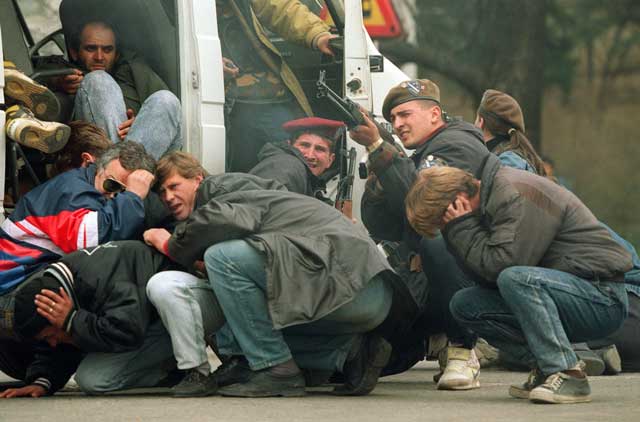
But now, with Radovan Karadzic gazing balefully at his accusers in the Hague, and East-West history suddenly going into reverse, perhaps the time is ripe to examine how the West allowed something as hideous as the siege of Sarajevo – it lasted from April 1992 to February 1996, leaving 12,000 people dead and 50,000 wounded – to happen, in the most civilised city in the south Balkans.
"I read the script and the very human story at the very core of this film spoke to me very clearly," said Bloom on a recent trip to Sarajevo. The star of Pirates of the Caribbean and Lord of the Rings spoke of his departure from the Hollywood blockbuster triology formula, and his hopes for a local flavour. "We would very much like to make the film here," he said. "To come here and shoot would be just wonderful."
When Carter landed in the Balkans – in Split – he tried to get a job, any job, with one of the aid agencies but failed miserably. Then one day at a UN security briefing he ran into an Englishman called Graeme Bint. "The briefing was full of professionals from the NGOs asking questions about the war," Carter says. "And then I spotted this freak with spiked orange hair, earrings and a bomber jacket. We got talking, about how I had landed here for no particular reason and then about his humanitarian circus, called the Serious Road Trip."
Bint was with a group of English guys who had decided that "what they were doing with their lives was worth giving up for something bigger", and who had ended up running lorries loaded with tons of food into starving Sarajevo. Carter began working with them. "I liked Bill from the outset," says Bint. "He seemed ill prepared, which suited our ad hoc organisation. He seemed to have no reason for being in Bosnia, but this didn't trouble me: for many people, especially aid workers, you enter a war zone first, then find the reason ... Our friendship strengthened the more we kept nearly getting killed together. I realised Bill had a driving force behind him, but I didn't know just what. But it was strong, it had to be, as one doesn't take such immense risks without one."
"I didn't know what was going on," says Carter. "It's only a one-hour drive from Split to Sarajevo, but I had no idea what that drive was going to be like." That's what Yugoslavia was like in the early 1990s for anyone blundering into the war zones. Four decades of peace, and the postcard-pretty south Balkan countryside, were no preparation for the realities of these pitiless civil wars, fuelled by all the region's long-buried grudges – buildings pulverised by artillery, snipers haunting the rooftops, and towns evacuated by all but the decrepit and the crazy.
But, as Graeme Bint noticed, Carter had found what he was after. He and his girlfriend had agreed, Carter says, that whatever happened they would never commit suicide; but after her death he considered himself free "to push it all the way to the edge. If I die and it's nature's mistake, then I win."
A grievous loss can lead to fearlessness, because the worst has already happened. "There have been times," Carter told an interviewer for U2's website, "when people threatened my life, and my natural reaction was, 'OK, go ahead.' I get very relaxed. The more [danger] gets closer, the more I calm way down ... which is a bit weird."
Being in the war zone, he said, "did help heal me. You're in a city of grief, which gives you in many weird ways great comfort." But he was still a tourist in Sarajevo, and an ignorant tourist at that: as was brought home when a local said: "You come all the way from America and you don't know who Karadzic is?" But something told him to stay, to dig himself in. "I got hold of a video camera and began shooting what was happening, I forged documents and got a press pass." This was the spring and summer of 1993, some of the worst months of the entire siege. And then he made friends with two people who were his ticket to the inside of the city.
"They were two sisters, aged 17 and 18, they lived on the other side of Sniper Alley, and they took me into their home," he says. "They took me in, and they were fun and smart, their parents were great, they had pride, and being funny was to do with their pride. They only had a couple of crumbs to eat but they shared it with me and they acted as if it was a real feast." Through the sisters Carter finally learnt what sort of a city he was in: they introduced him to their friends, who were poets, musicians, surrealist artists, "all with this very black Sarajevo humour. I got very involved with my friends. You'd be having a cup of tea with these people and talking about Frank Zappa and King Crimson, and outside the window someone is throwing himself off the top of a building because the war has got to him ... It was really surreal."
Then one day Carter caught U2 talking on MTV about their upcoming Zoo TV Tour of Europe and the concept behind it, which was the idea of a united Europe. That spurred "a little bit of anger", he says, because Sarajevo under siege was the most blatant proof you could find of Europe disunited. He faxed a reality check to U2's management in Dublin, suggesting a chat with Bono about what was happening in his corner of Europe. Bono agreed, and what Carter said reduced Bono to tears. He wanted to fly with the band to Sarajevo at once to play there. It was out of the question, of course, because of the danger. Instead the band agreed to punctuate every date on their European tour with satellite links to people of Sarajevo – hand-picked by Bill Carter – to tell U2's fans the way it was.
And that's what happened. It didn't stop the siege – indeed finally the abuse of politicians and media descended on U2's head for the initiative. But people who knew nothing and cared less about Sarajevo got a bit of a jolt. When the band played Wembley Stadium in August 1993, a Bosnian woman told the crowd over the satellite link: "I am glad you are listening to wonderful music. You should enjoy yourselves. But I want to ask one question: what are you going to do? Excuse me but, I think, nothing."
It was to be another two years before Nato bombing forced the Serbs to lift the siege.
Join our commenting forum
Join thought-provoking conversations, follow other Independent readers and see their replies
Comments
Bookmark popover
Removed from bookmarks