Gays defy Polish traditionalists for EuroPride march
15,000 turn out in Warsaw for the first staging of the premier event east of former Iron Curtain
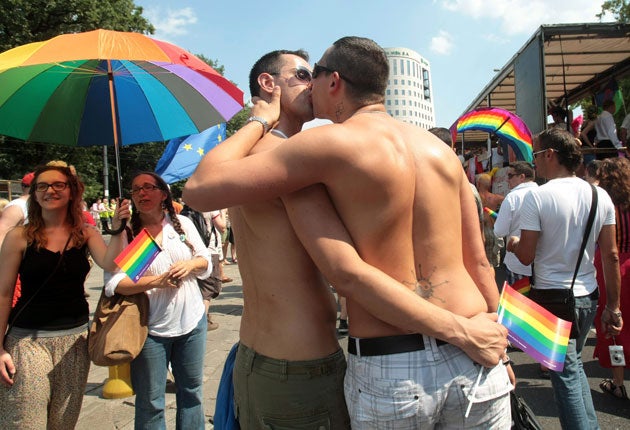
To anyone who pictures Warsaw as a cold, grey, conservative city, yesterday offered an antidote: a 15,000-strong, all-singing, all-dancing gay pride parade partied its way through the Polish capital. As if to underscore the reversal of stereotypes, they did so in blazing sunshine and 34C heat. The parade was the culmination of EuroPride, a two-week festival of parties, films and debates – Europe's largest gay rights event. First held in 1992, in London, this was the first time it had taken place east of the former Iron Curtain.
But despite its ostensible success, the festival highlighted an East-West divide in attitudes to homosexuality across Europe, and a rift within Polish society. For this was also the first time that EuroPride has gone without the official patronage of its host city's mayor. The programme featured encouraging words from London's Boris Johnson, but nothing from Warsaw's Hanna Gronkiewicz-Waltz. Conveniently, she was on holiday last week, her centre-right Civic Platform party desperate to maintain its Catholic credentials. The city's archbishop, Kazimierz Nycz, had said: "No one can force us to support, promote or sponsor this parade."
Warsaw's city hall received 4,000 letters and a petition with more than 55,000 signatures – some of them from well-known figures – calling for a ban. The late president Lech Kaczynski notoriously did ban gay pride marches in Warsaw five years ago. But in 2007, the European Court of Human Rights ruled that he had acted illegally. "That's why we were awarded EuroPride this year: as a prize for enforcing the law in Strasbourg," explained co-organiser Agata Chaber. Legally obliged to authorise the event, the authorities gave every impression of running away from it. After several minutes of weaselly procedural excuses, city hall spokesman Tomasz Andryszczyk finally admitted: "You can point to the background in attitudes within the cultural sphere; the role of the church here is different; history is different..."
Mr Kaczynski's sudden death in April revived support among Poles for his traditionalist outlook. His twin brother, Jaroslaw – a man who once declared "The affirmation of homosexuality will lead to the downfall of civilisation" – scored 47 per cent in this month's presidential election. Bronislaw Komorowski, who won, is hardly a gay rights advocate himself.
And so, one of the highest-profile political figures marching yesterday was Britain's Police minister, Nick Herbert. Mr Herbert is the most senior gay Tory MP, and the Conservatives are seeking to quell criticism of their European alliance with Mr Kaczynski's Law and Justice Party. But even if Law and Justice had wanted to send a gay MP to join Mr Herbert on the march, it couldn't have: not one member of the Polish parliament is openly homosexual.
Polish far-right groups are using that kind of pressure from the West to argue that homosexuality is an unwanted foreign import. The main counter-demonstration on Saturday posed as a commemoration of the battle of Grunwald, where, exactly 600 years ago, Poland and Lithuania defeated the Teutonic Knights (ie, the Germans). "We feel that the situation today is similar," said Robert Winnicki, organiser of the Grunwald march. "EuroPride is some kind of ideological aggression: the knights from the West want to force us to think that gayness is normal."
Most Varsovians would dismiss the likes of Mr Winnicki as crazy extremists. But a visit to mass at St Jacek's revealed more typical attitudes among conservatives. "This march is not about tolerance; it's about exhibitionism," said Tomasz, a middle-aged mechanic. "Heterosexuals don't make a parade of their sexuality." Monika, a student, initially agreed. But she then conceded that heterosexuals don't need to parade because they already have the right to marry. In Poland, civil unions are a long way off. A recent poll showed nearly two-thirds of Poles still disapprove of gay pride rallies, although that is 15 per cent less than in 2005.
To Ms Chaber, the politicians' attitude was predictable. "That no one could find even 10 minutes to come and cut the ribbon at Pride House is a disappointment, but an expected one."
Visitors from abroad said they'd come specifically because they'd heard the situation for gays in Poland was bad. "I wouldn't go on a gay pride march in Brussels," said Jérémie from Belgium. "But we've been having a great time here."
What pleased Ms Chaber most was the numbers. Far fewer than at recent events in Madrid and Zurich, of course. "But this is Poland! Normally we get 6,000 people, max. And it's not just the foreigners. Because it's EuroPride, more Poles are coming. They don't want to be seen as homophobic."
Join our commenting forum
Join thought-provoking conversations, follow other Independent readers and see their replies
Comments