Georgia bows to might of Russia
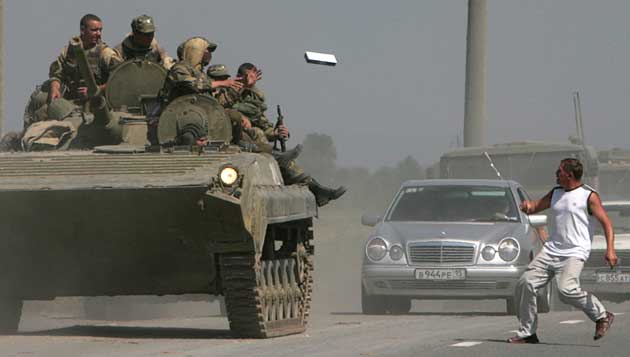
Georgia's appeal for a ceasefire seemed to have fallen on deaf ears last night as Russian jets expanded their bombardment, targeting the capital, Tbilisi, for the first time. As the world's diplomats hurried to contain the violence and prevent the conflict engulfing the wider Caucasus region, Russia made clear it no longer considered Georgia's President Mikheil Saakashvili a partner, prompting accusations from his main ally, the United States, that Moscow was resisting peace and wanted regime change.
Georgian Interior Ministry spokesman Temur Yakobashvili said Russian tanks tried to cross from South Ossetia into Georgia-controlled territory but claimed they had been forced to turn back by its forces. The tanks were apparently trying to approach Gori, a city of about 50,000 that sits on Georgia's only significant east-west highway, he said. Thousands of people were said to be fleeing ahead of the Russian advance.
Russia has made no secret of its dislike for Mr Saakashvili, his alliance with Washington, his attempts to join Nato and his oft-repeated pledges to bring two separatist provinces back under Tbilisi's control – a pledge he tried to make good on Thursday by sending troops into South Ossetia.
The Russian Foreign Minister, Sergei Lavrov, condemned the Georgian leader last night, saying: "A man who issued orders to commit war crimes which resulted in thousands of deaths of peaceful civilians cannot be viewed by Russia as a partner."
Underscoring the magnitude of the problem facing Georgia, Moscow-backed separatists in its other breakaway region, Abkhazia, declared they had opened a second front. Maxim Gunjia, the separatists' deputy foreign minister, said his tiny air force was bombing Georgian positions in the contested Kodori Gorge and that about 1,000 troops had also been deployed. "We have started operations because we saw the Georgian attack on South Ossetia and knew Abkhazia would be next," Mr Gunjia said from the Abkhaz capital, Sukhumi, a town of ramshackle beach bars, palm trees and buildings gutted in a 1992-93 war of independence against Tbilisi's forces.
Tbilisi accused Moscow of shipping 4,000 soldiers to the port of Ochamchire in Abkhazia. But Abkhaz officials insisted they were fighting on their own.
Georgia announced that it had pulled its troops out of South Ossetia and Mr Saakashvili said his government had been trying "all day" to contact Russia to discuss a ceasefire. "Georgia expresses its readiness to immediately start negotiations with the Russian Federation on a ceasefire and termination of hostilities," a statement said. Mr Saakashvili said he believed Russia intended to take over his country to secure energy supply routes from central Asia. Russian planes were reported last night to have dropped bombs near a British-operated oil pipeline south of Tbilisi, although it was not damaged.
Russia said it was sceptical of the Georgian claims of a withdrawal. "We must check all that. We don't trust the Georgian side," said Russia's Deputy Foreign Minister, Grigory Karasin. Moscow wants Georgia to rule out using force in future.
Georgia's ceasefire came on a day of claim and counterclaim, but a day when the military might of an angry Russian bear was on full display. As well as the bombing in and around the Georgian capital, including one explosion just metres from the main runway at Tbilisi airport, there were reports of explosions in the western town of Zugdidi. Meanwhile, dozens of Russian tanks and military vehicles headed for the two-mile Roki tunnel, which leads from Russian-held North Ossetia into the separatist South.
Russia's navy also entered the conflict, deploying a flotilla off Georgia's Black Sea coast. There were reports that they would mount a blockade, snuffing out supply lines for weapons, oil and wheat – a charge denied by Moscow. Unconfirmed reports late last night said the Russian war ships had sunk a Georgian vessel.
In the South Ossetian capital, Tskhinvali, the human suffering in the wake of the Georgian attack and Russian counter-attack was horrifyingly evident. Corpses were dotted about the city, burnt-out tanks littered the roads, and every other building showed bomb or mortar damage, with many simply smouldering ruins. Where once 10,000 people had roamed, there was barely a soul. Many residents have fled across the border into North Ossetia, and those left were the walking wounded, some heavily bandaged, others limping along on crutches.
Russian television spoke of a "humanitarian catastrophe" in South Ossetia, with more than 2,000 people dead and thousands homeless. President Dmitry Medvedev – who has largely taken a back seat to the Prime Minister, Vladimir Putin, who sped from Beijing to North Ossetia on Saturday – termed the Georgian action a "genocide" and ordered officials to document the crimes.
A Georgian government source said 130 Georgian civilians and soldiers had been killed and 1,165 wounded, many by Russian bombing inside Georgia. Russia denied attacking civilian targets.
Mr Gunjia said Georgia had sparked a "chain reaction" by attacking South Ossetia. "It's no longer possible to listen to Georgia talk about a peaceful solution in South Ossetia or Abkhazia, or offer us autonomy. Georgia has shown its real face."
Join our commenting forum
Join thought-provoking conversations, follow other Independent readers and see their replies
Comments
Bookmark popover
Removed from bookmarks