Germany approves bailout fund – now Barroso wants to create a federal future
Europe hopes it has taken a major step towards stability but EC President calls for more
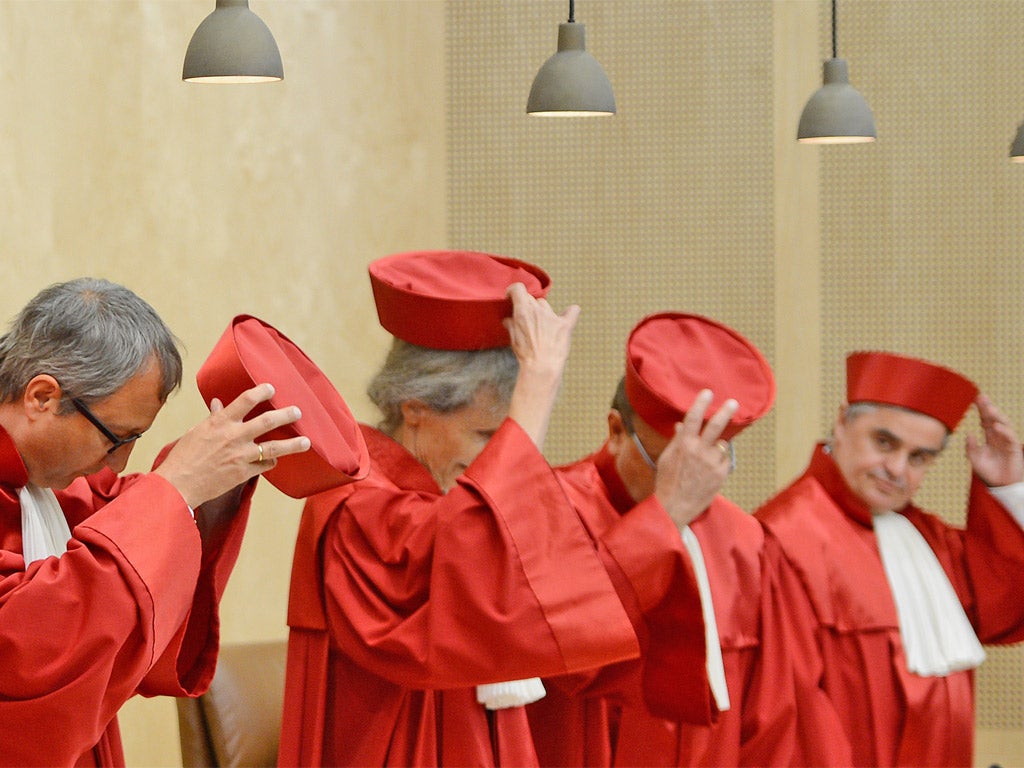
Ambitious proposals for a federal Europe were spelt out yesterday by the European Commission President, José Manuel Barroso, in a controversial speech which argued that deeper political and fiscal union were the only ways of preventing future crises in the eurozone.
In an impassioned address to the European Parliament in Strasbourg, delivered only minutes before Germany's constitutional court approved the eurozone's permanent bailout fund, Mr Barroso attempted to counter Eurosceptic criticism by insisting that he was not calling for a "European super-state".
However, the head of the EU's executive arm added that "we will need to move towards a federation of nation states. This is our political horizon. This is what must guide our work in the years to come." Although he admitted that such a shift could only be completed under a new EU treaty, Mr Barroso blamed the euro crisis on the lack of political cohesion within the European Union, which he said had served only to undermine the currency bloc's credibility among Europe's citizens and on the financial markets.
The crisis, he concluded, had revealed the need for a "leap forward" in political integration to complement current moves to harmonise EU economic and fiscal policies. Europe, he insisted, needed a "democratic federation of nation states that can tackle our common problems, through the sharing of sovereignty in a way that each country and its citizens are better equipped to control their own destiny".
At the same time Mr Barroso unveiled proposals for unified EU banking supervision of some 6,000 banks across the Continent under the auspices of the European Central Bank. He said that such a move would be a "quantum leap" towards a full banking union. Mr Barroso said he would submit ideas for the notoriously difficult process of European treaty change before the next EU elections in 2014 to enable a full and wide-ranging debate on Europe's future.
His calls for a federalist Europe were a significant policy switch for the former Portuguese Prime Minister who until yesterday had taken a cautious line on the ideological issue of how closely EU member states should integrate and how much national sovereignty they should cede to Brussels.
His speech appeared certain to provide ammunition for Eurosceptic groupings in Europe, not least the Conservative Party in the UK, which remain deeply opposed to the idea of devolving more power to Brussels. Martin Callanan, leader of the European Conservatives and Reformists, described the speech as "more of the same old tired approach" and said it was " the knee-jerk reflex of the European elite".
Guy Verhofstadt, the leader of the Alliance of Liberal Democrats, also criticised Mr Barroso, saying that the EU first needed to deepen the structures it already had. "No, no, no, no federation of nation states. That's more of the same. That's more of what we have already," he complained.
However, in a reference to the European debt crisis, Mr Barroso said: "Many will say this is too ambitious and that it is not realistic – but let me ask you this – is it realistic to go on like we have been doing?"
The Commission President was optimistic about prospects for Greece staying in the EU. The Athens government is under the scrutiny of the so-called Troika – inspectors from the International Monetary Fund, the European Commission and the ECB – who are assessing Greece's progress in implementing financial reforms.
"I truly believe that we have a chance this autumn to come to a turning point," he said.
Mr Barroso's proposals for a banking union are an attempt to tackle one of the most pressing issues in the eurozone crisis, not least in the case of Spain, where weakness in the banking sector threatens the wider economy.
"The Commission is presenting legislative proposals for a single European supervisory mechanism," he told the European Parliament. "This is a quantum leap – a stepping stone towards a banking union."
The proposed banking union is expected to involve three steps: the European Central Bank would first be empowered to monitor the activities of all eurozone banks, and others within the European Union which agree to such a process. A fund would be set up to finance the closure of failing banks, and this would be coupled with a scheme to protect deposits across the eurozone.
Italian anger over claims of City mis-selling
Several banks based in the City of London have been accused of mis-selling financial products to Italy. Nomura, UBS and Deutsche Bank are among those alleged by Italian prosecutors to have mis-sold £28bn of derivatives to the country's cities and regions.
One source of anger is that the Italians believe the UK Financial Services Authority was aware of the allegations, but failed to follow them up and indeed asked a whistleblower to stop contacting it.
In the 10 years after 1997, Italian regions borrowed about £111bn from the banks with deals that offered what seemed to be attractive rates of repayment. But the repayments were dependent on the performance of complex swap derivatives which ended up costing the Italians far more than they expected.
BBC's Newsnight claims that the FSA was aware of the mis-selling allegations.
Claudi Gatti, an investigative journalist with Il Sole 24 Ore, told the BBC: "The banks didn't provide sufficient information to local authorities on the risk they were taking."
The banks declined to comment, noting that the issue is now before the Italian courts.
Dutch poll tests austerity fears
Dutch voters went to the polls yesterday to pick a new parliament in a test of the support for stringent austerity measures which are set to influence the way Europe tackles the debt crisis.
The election has boiled down to a race between the VVD party of Prime Minister Mark Rutte, and Labour, led by Diederik Samsom.
While Mr Rutte is an ally of the German Chancellor Angela Merkel and supports her austerity agenda, Mr Samsom is closer to French President François Hollande. AP
Join our commenting forum
Join thought-provoking conversations, follow other Independent readers and see their replies
Comments
Bookmark popover
Removed from bookmarks