Is the secret of Ikea's thrifty founder out of the box?
The empire set up by Ingvar Kamprad is accused of siphoning billions into a tax haven
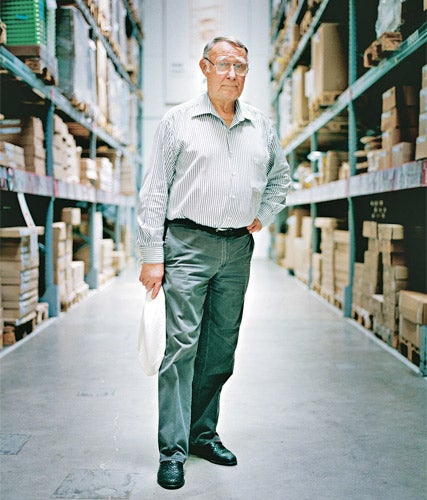
He is one of the world's wealthiest men with a fortune estimated at $23bn (£14bn), yet he drives a 15-year-old car, flies economy class and encourages the thousands of staff in his global empire to use both sides of company notepaper when writing letters.
Ingvar Kamprad, the 84-year-old founder of Ikea, has a legendary reputation for thriftiness, despite being the 11th-richest person on the planet. But Swedes have been shocked by recent revelations which suggest that Mr Kamprad may have taken his parsimony a step too far. It is alleged that he has been secretly running his empire via a Liechtenstein foundation, which is alleged to help Ikea avoid millions in tax. It is perfectly legal.
Mr Kamprad, who now lives in Switzerland, has insisted that he and his family no longer have any control over Ikea. But a television documentary by Sweden's SVT channel alleges that he "secured control and power over Ikea and... created a foundation in one of the world's tax havens – Liechtenstein".
SVT claims in its two-part programme that there are two faces to Ikea – one public, the other. It maintains that Inka Holdings, the company that runs Ikea's 280 stores around the world, is the corporation's public face. The other, it claims, is a Liechtenstein-based holding called the Intergo Foundation, which was set up 20 years ago.
The documentary claims that Intergo and its Luxembourg-based subsidiary, Inter Ikea Systems, own the royalty rights to every single product the furniture giant sells. "Inter Ikea is the real Ikea," the SVT programme insisted. It is alleged that 3 per cent of all Ikea sales were siphoned off to the Liechtenstein foundation in royalties which had allowed the concern to amass funds totalling 100bn Swedish kronor (£9.7bn). Mr Kamprad declined to be interviewed for the documentary. However, just before the programme was aired last week, he issued a statement admitting that he still had some control over Ikea via the foundation, whose existence had hitherto been unknown. He insisted that the foundation was run by an independent board.
"Its mission is to invest in expansion and business deals and to secure the long-term survival of Ikea," Mr Kamprad said. He flatly denied allegations that the foundation's aim was to avoid tax and insisted that Ikea paid all required taxes. "However, we have always looked at taxes as a cost, just as any other cost that comes with doing business," he said.
Insisting that there was nothing wrong with trying to be tax-efficient, Mr Kamprad concluded in his statement on the Ikea website: "An optimised tax structure gives us the possibility of flexibility in using our assets that have already been taxed in one market. They can be used in new markets for further business development without the additional burden of double taxation."
In Sweden, the allegations have dented the image of one of the country's best-known companies, which had enjoyed a reputation for scrupulous corporate responsibility. Questions are being asked about why Ikea has resorted to using a notorious tax haven like Liechtenstein.
And it is not the first time that Mr Kamprad has faced embarrassing disclosures about his activities. In 1994, Swedes were shattered to discover that their iconic business entrepreneur had been a member of the country's wartime pro-fascist New Swedish Movement, which raised funds and recruited members until 1945. The allegations emerged after the publication of letters written by the Swedish fascist Per Engdahl, who died that year. Mr Kamprad remained a friend of Mr Engdahl until the early 1950s. In a letter to Ikea employees in 1994, Mr Kamprad described his membership as "the greatest mistake in my life."
He is thought to have acquired his youthful fascist leanings from his widowed German grandmother, who came from the formerly German-speaking Sudetenland region of what is now the Czech Republic. She regarded the Nazi annexation of Sudetenland as a liberation.
When Mr Kamprad was only a boy, he started selling matches to neighbours from his bicycle. He subsequently sold fish, Christmas tree decorations, pencils and ballpoint pens. When he was 17 his father gave him some money for passing his exams and he used it to set up Ikea, with the family farm as his base.
The company's name is made up of the initials of Mr Kamprad's name, the name of the family farm, Elmtaryd, and the nearby village of Agunnard. But Ikea's low prices undercut the Swedish cartel of the time and the company was boycotted. Mr Kamprad turned to Polish producers for inexpensive furniture components that could be assembled at home from flat packs. The Ikea as we know it was born.
With 280 stores and 127,000 employees in 38 countries, Ikea has become a global empire. Company doctrine is enshrined in Mr Kamprad's The Furniture Dealer's Testament, which many refer to as the "Ikea Bible". The tome is peppered with maxims such as "wasting resources is a mortal sin at Ikea" and "only when sleeping does one make no mistakes".
A study London University released last week provides a revealing insight into the Ikea doctrine. It found that the vast maze-like interiors of Ikea stores were deliberately designed to confuse customers, who were therefore more likely to make irrational snap purchases of the household items they came across.
Mr Kamprad moved to Switzerland in 1976 to avoid Sweden's punitive wealth taxes. He drives a 15-year-old Volvo 240, rarely wears a suit and is known to haggle for bargains in his village near Lausanne . He even admits to popping into Ikea stores to get a "cheap meal".
The miserly reputation is, in part, a deliberate attempt to enhance Ikea's value-for-money image. Less known is the fact that Mr Kamprad owns a large country estate in Sweden and a vineyard in Provence. He also drove a Porsche for several years.
Company savings policies are what drives his determination to always fly economy class. "How the hell can I ask people who work for me to travel cheaply, if I travel in luxury?" he once asked in an interview. "It's a question of good leadership."
The history of Ikea
* Born in southern Sweden in 1926, founder Ingvar Kamprad was running a small business buying and selling matches for a profit by the age of seven.
* At 17, Kamprad founded Ikea. He chose the name of the company by taking his initials and adding them to the first letters of Elmtaryd and Agunnaryd, the farm and village where he spent his childhood.
* In 1948, having originally sold pens, picture frames, jewellery and even nylon stockings – Ikea introduces its first furniture range supplied by local manufacturers from nearby forests.
* After removing the legs of a store table to fit it into a car, an Ikea worker had the bright idea to make and market flat-pack furniture in 1956.
* Thousands of people queue for the opening of the largest ever flagship Ikea store, which opened in Stockholm, Sweden and covered 31,000 square metres.
* The first UK Ikea store opened in Manchester in 1987.
Join our commenting forum
Join thought-provoking conversations, follow other Independent readers and see their replies
Comments