Is this the beginning of the end for bullfighting?
As Catalonia's ban comes into force, Alasdair Fotheringham reports on Spain's changing attitudes to a divisive tradition
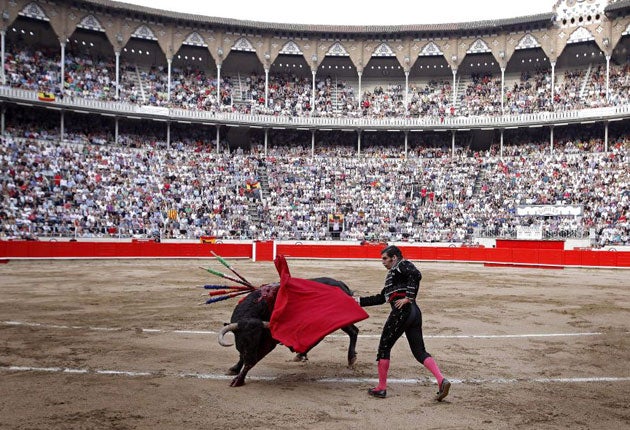
It was once thought to be as ingrained in Spanish culture as tapas and flamenco, but Catalonia was yesterday due to hold its final bullfight, becoming the first mainland region to outlaw the spectacle and – animal rights activists hope – signalling the irreversible decline of the corrida.
Nearly 20,000 people were due to pack into Barcelona's one remaining ring, the El Monumental, last night for a final sold-out corrida featuring the top matadors Jose Tomas, Juan Mora, and Serafin Morin ahead a ban coming into force in 2012.
Once championed by the likes of Ernest Hemmingway and Pablo Picasso, the bloody pastime is now victim of not only a growing sympathy toward the long-suffering bull, but a recession-hit populace with little money to spend on bullfighting tickets and indifference among the young to the age-old tradition.
And while critics of the ban claimed that the packed stalls in the 97-year-old ring indicated that support for bullfighting is far from dead, statistics would suggest they are fighting a losing battle.
Recent polls show that more than 60 per cent of Spaniards now express a dislike for bullfighting, although only half of those are in favour of outright prohibition. There has also been a drastic drop in the number of bullfights, figures reported by the El Pais newspaper show. Even in the bullfighting heartland of Andalusia, the number of fights fell by 50 per cent between 2007 and 2010.
"It's a big step forward. It doesn't just give us hope we can widen the ban across Spain, either: bullfighting bans are now in force in parts of Venezuela, too," said Antonio Moreno, president of the animal rights association CACMA who defended the ban in a Catalan Parliamentary commission in 2010.
"There hasn't been a single city in Spain this year that hasn't seen an anti-bullfighting demonstration. Logically, though, as Catalonia is the most European and modern of Spanish regions, this is where it [the ban] has happened first."
Indeed bullfighting supporters argue that the Catalonia ban – passed in the regional parliament in 2010 – does not in fact reflect a growing nationwide distaste for the spectacle, but a wish by local nationalists to differentiate themselves from "traditional" Spain. The only other ban in force is in the Canary Islands, where the spectacle has been outlawed since the early 1990s.
Legislation for the Catalonia ban got under way after a petition signed by 180,000 Catalans was brought to their parliament in 2009, although the region has had a long anti-bullfighting tradition. Back in 1909, Spain's first ever bullfighting protest was held in Barcelona, and by 2004 over 80 per cent of Catalans were reported to be against the practice. Just two bullrings remained in use in Catalonia before the ban, but only El Monumental was fully operational.
Critics of the ban point out that other bull games such as the Catalan correbous, where bulls have candles or fireworks tied to their horns and are let loose in the streets, remain firmly on the fiesta programme in Catalonia, although new, tougher, anti-cruelty legislation is currently pending.
But whilst an attempt for a petition to reverse the Catalan prohibition looks unlikely to succeed – it has
so far only collected 60 per cent of the half million signatures needed before a 1 November deadline – Catalonia's ban has hardened politicians' attitudes in favour of bullfighting in more conservative areas of Spain.
Madrid's government, as well as the cities of Salamanca, Valencia and Valladolid, have announced plans to declare bullfighting an activity of cultural interest, complicating further prohibitions. Meanwhile, in rural Spain and in the northern city of Pamplona, other more controversial bull games, such as bull-running, show little signs of dying out.
Earlier this month around 40,000 spectators gathered for the annual spearing to death of a bull in the village of Tordesillas. The man whose lance this year proved fatal for a 608kg bull, named Afligido, claimed later, to "feel like [the Real Madrid star] Cristiano Ronaldo." The bull took 20 minutes to die, finished off, some reports said, with a screwdriver.
Such games remain popular among bullfighting fans in recession-struck Spain partly because they are far cheaper than the formal corrida, with tickets this September for a bull that has slain two spectators and gored five in bull runs reportedly costing €2.5 compared with €40 for the cheapest seats in Seville's bullring.
Bans apart, what may provide the estocada – as the killer blow is called – for bullfighting is its fast ageing fan base. A survey in 2009 showed bullfighting to be most popular amongst the over-45s. And with youth unemployment running at over 40 per cent, few of Spain's cash-strapped younger population are likely to have spent the €300 or more demanded by touts for Barcelona's last bullfight.
Fernando Galindo, secretary of a bullfighters' trade union, recognised in El Pais last week that "we have not known how to capture a new public".
"The danger is not a bullfighting ban in Catalonia; it's in simplistic, pro-animal rights slogans," he said.
As for the very young, the times when the only Spanish TV entertainment on interminable hot weekend afternoons was either a mawkish South American soap opera or bullfighting are long gone. Spanish state television, TVE, stopped showing bullfights in 2006, before formalising the ban in 2009 because, as one TVE source said, "it was considered too bloodthirsty for children to watch".
CACMA's president, Mr Moreno, who went regularly to corridas until he had a change of heart at 35, agrees that if bullfighting is no longer part of day-to-day culture for younger Spaniards, this may well bring about its ultimate disappearance.
"In my generation, it was inculcated into us that the bull was bad and the people surrounding it were good," he told the Catalan parliament in 2010. "We saw this as normal."
As for the future of the El Monumental building itself, proposals for its use include a street market, luxury flats, a green space, or even – according to newspaper El Mundo – the third largest mosque in the world.
Killer bull's last show
* It was not only Catalonia's bullrings heading into retirement last night. Seven years after he first shot to fame in bull-taunting festivals, the half-tonne killer bull named Raton – "mouse" in Spanish – put on his last, incident-free performance yesterday morning.
In his previous appearances in his home region of Valencia, Mouse, pictured above, has killed two spectators, the first in 2006 and the second last August, and gored five others.
However – perhaps to the secret disappointment of some of the 1,500 spectators – this time there were no such incidents. Security guards ensured that only four professionals trained in bull-taunting gained access to the ring for Mouse's final show, held in the same village of Canals where he started his career in 2004.
Before he entered the arena, a biography of Mouse (at 11 years old, he is long past the usual retirement age for bulls) was read out, and a spectator who was injured by Mouse in his debut performance in Canals seven years ago saluted the crowd.
It is not yet clear what retirement holds for Mouse, but considering his fame, he is likely to live out the rest of his years in comfort.
Alasdair Fotheringham
Join our commenting forum
Join thought-provoking conversations, follow other Independent readers and see their replies
Comments