Malta's bitter divorce debate comes to a head
The result of yesterday's poll is too close to call, but the real issue runs far deeper
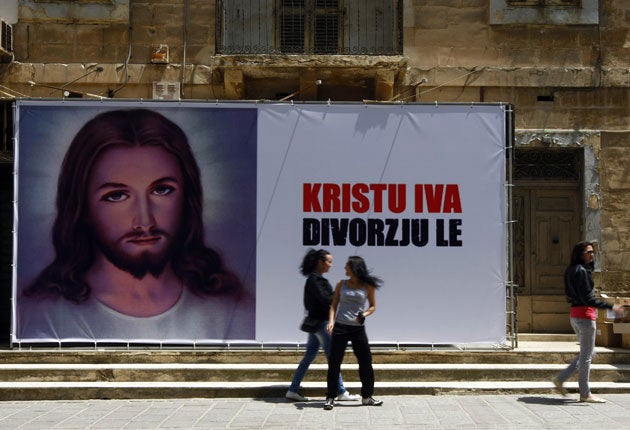
Malta, the world's last bastion of Catholic domination outside the Vatican, is today riven by bitter hostility as it awaits the results of a fiercely contested referendum on divorce.
The crowded little archipelago halfway across the Mediterranean was left as the last European country to forbid divorce when the Irish Republic reformed its marriage law in 1995; today it is the last in the world except for the Philippines.
Divorce has been a burning issue on Malta for decades. Supporters of reform say that 30 per cent of marriages in the country end in separation, and that great and unnecessary suffering is caused when couples are unable to marry again because their previous, failed marriages cannot be dissolved. Nearly one-third of children are born out of wedlock.
"The opponents of divorce say the figure for marriage breakdown is 22 per cent," says Jeffrey Pullicino Orlando, an MP with the ruling Nationalist Party and a dentist, "but 8 per cent have their marriages annulled" – a declaration by the Church that the marriage was never valid. "That's ridiculous, especially when a married couple has kids, but it's the only way to separate legally."
Mr Orlando is himself separated – his estranged wife now sits on the opposite benches as a Labour MP – and it was his demand for a debate on divorce that precipitated the poll which took place yesterday. The government refused to table a debate and proposed a referendum instead. But if they thought this was a way to kick the issue into the long grass, they were badly mistaken.
Instead this country the size of the Isle of Wight, with a population of 412,000, has for months been racked by its most divisive argument for decades. As voting went on yesterday, projections showed the result was too close to call. Opponents of reform have invoked the Blessed Virgin and raised the spectre of Maltese society falling apart. Tonio Fenech, the finance minister and a Nationalist Party MP, wrote on a local news website recently: "I am sure Our Lady is very sorrowful that Malta is considering divorce."
"Vote No" billboards bearing the image of Jesus have sprouted across the archipelago. Two weeks ago, Mario Grech, the Bishop of Gozo, the most conservative of the archipelago's islands, denounced reformers from the pulpit and said they did not deserve to receive Communion. "Beware the wolf in sheep's clothing," he said. "And the wolf is now saying he is Catholic. This is falsity, deceit. I am ready to dialogue with everyone, but do not be false, do not lie. If you are not in communion with Christ's teachings, you are not in communion with the Church and you cannot receive Communion.
"To be politically correct and not say things as they are will lead us to be sorry," he went on. "There are brigands among us who are utilising every means possible to lead the flock astray. They are going after marriage, and then other things will follow."
The attempt by the "no" side to claim a monopoly on morality has infuriated the reformers. "The absence of divorce has not prevented marriage breakdown in Malta," pointed out leading "yes" campaigner Martin Scicluna. "To keep children or adults in wretched, abusive or lonely relationships is not the proper role of a state that takes its moral responsibilities seriously."
In the rest of the world the argument that marriages should be dissoluble, despite the vows, was fought and won long ago. Why has it taken Malta so long to catch up? Malta today remains Catholic to a degree that would startle even an Italian, with 95 per cent adherence to the Creed and half the population going to Mass every week. It is Catholic to its fingertips – one reason being that the Islamic world crowds so close around.
The six islands have been colonised numerous times in their long history, and for more than a millennium it has been on the front line between Christianity and Islam. It was invaded by Arabs in AD 870 and ruled by them for two centuries; their principle legacy was the Maltese language, which bears many Arabic traces to this day. The Arabs were expelled in 1224, but with the expansion of Muslim Turkey, Malta's strategic harbours again became a cherished prize: for four months in 1565 a huge Turkish fleet laid siege to Malta, until the Knights of St John saw it off.
Valletta, today the nation's capital, was built after the lifting of that siege and was designed to be an impregnable fortress. The power of the Knights tailed off, but culturally Malta remained a proud bastion of the faith. It gained independence from Britain, its colonial master for a century and a half, in 1964, but independence from Rome seems as remote as ever.
Yet, as in Ireland, Malta's rejection of secularism has not saved it from the Catholic church's modern plague, the abuse of vulnerable minors by priests and nuns. On the contrary, the power of the Church, in particular the fact that ecclesiastical tribunals take precedence over civil family courts, has made it extraordinarily difficult for the victims of this abuse to obtain justice.
Pope Benedict, right, has endorsed the Maltese Church's battle against divorce. When he visited in April last year he said: "Your nation should continue to stand up for the indissolubility of marriage as a natural institution as well as a sacramental one." Yet to the outside world, the most significant event in that two-day trip was an emotional encounter with eight Maltese men who claimed to have been sexually abused by four priests at a Catholic orphanage – his first face-to-face meeting with abuse victims.
"Everybody was crying," one of the men said at the time. The Pope's spokesman said: "[The Pope] prayed with them and assured them that the Church is doing, and will continue to do, all in its power to investigate allegations, to bring to justice those responsible for abuse and to implement effective measures... to safeguard young people in the future."
Benedict's subsequent words and deeds suggest that his pledge was sincere; very belatedly the Church is taking a stand against abusers. But in Malta the victims' pursuit of justice has been stalled by the Church's own overweening power. In January, almost nine months after their meeting with Benedict XVI, seven of the eight men wrote jointly to him to complain that the priests who abused them had yet to be sanctioned. Although the priests admitted the abuse back in 2003, and the Vatican concluded the allegations were well founded, they continued as priests.
"In Malta," they wrote, "the church, political power and the judiciary are all the same thing. For example, a government minister came into court to testify on behalf of the priests. Few people, even among the [political] opposition, are on our side. People here are very religious and are frightened of accusing priests... we are very disappointed that these priests are still going about in clerical clothes."
The referendum has become a plebiscite on the Maltese status quo. That is why passions are running so high. "The 'no' campaign has been disgusting," said Mr Orlando, who set the referendum ball rolling. "Old ladies who said they would vote for divorce have been barred from taking Communion. An old electoral roll has been used, which means that 2,800 youngsters who are entitled to vote will not be able to. Lay Catholic organisations and 5,000 priests and nuns have also gone door-to-door campaigning. Limitless funds have been offered to the 'no' side." Voting "yes" has been declared a mortal sin from the pulpit."
The reason the debate has been so intense is that it is only ostensibly about divorce; the real issue runs far deeper. "A vote for 'yes'," said Karl Stagno Navarra, a senior journalist in Valletta, "is a vote to break the network of the friends of friends who control this country."
Join our commenting forum
Join thought-provoking conversations, follow other Independent readers and see their replies
Comments
Bookmark popover
Removed from bookmarks