Marseille: Europe's most dangerous place to be young
Away from its glamorous tourist centre, 15 men have died this year as the city's drug war spirals out of control. John Lichfield reports
To understand Marseille catch a bus – bus number 30 from the Bougainville metro station. The route starts at the northern terminus of the metro system, five kilometres from the city centre. It winds past motorways, factories, unofficial rubbish tips and a 10th-century monastery.
France's second city sprawls for another 10 kilometres over ridge after ridge of limestone hills. Each is crowned by a white citadel gleaming in the Mediterranean sunshine which, as the bus approaches, turns into a group of shabby tower blocks.
Up to the 1960s, these were the scrubland and the hard-scrabble villages of the Marcel Pagnol novels set in the early part of the century. Fragments of the Provençal villages can still be seen. The "garrigue", or scrub, survives on the jagged mountains which crowd in from the east. But Marius, Jean de Florette and Manon des Sources and their descendants have long gone. My fellow passengers on the 45-minute ride to La Savine, one of the northernmost estates, are a blend of North Africans, Africans, Asians and Roma.
The bus passes through the poorest districts of the poorest city in France. Almost 40 per cent of people who live here are below the poverty line, compared to 26 per cent in Marseille as a whole and 15 per cent nationally. In the richer, mostly white, areas south of the city centre, the risk of dying before the age of 65 is 23 per cent below the national average. In north Marseille, it is 30 per cent higher than the French average.
If you are a teenage boy or young man from northern Marseille, you risk dying long before the age of 65. Fifteen young men, mostly from the city's northern districts, have been shot dead this year as part of a war for the lucrative franchise to sell drugs – mostly cannabis and cocaine – to the people from the wealthier parts of the city and the suburbs.
In fact, there have been almost as many killings of young men in the first nine months of 2012 as in the whole of last year. Proportionally, Marseille (population 800,000), now has almost as many drug-related murders as New York (population 8,000,000). Eyeing the issues, the French government has announced emergency action this month to stop the city, which will be the "European capital of culture" from January, from claiming title of the European capital of youth murder.
At the end of the bus ride to La Savine, I met Rachida Tir, leader of the estate's resident's association. "For seven years now we have been losing our young men," she said. "This is not just about drug trafficking. That alone cannot explain the killing."
"There is a suicidal instinct, a desperation in some of these boys. It starts with failure and rejection at school and the lack of jobs. They see no future. They live for the present, in a world of easy money and, now, violence."
Earlier this month, Samia Ghali, the mayor of the 15th and 16th arrondissements of Marseille, which embrace most of the poor northern districts, detonated a verbal bombshell. She said that the drug-related violence in northern Marseille had become so extreme that only the army could defeat it. She called on the government to deploy troops to confiscate the cheap automatic weapons flowing in from the Balkans and North Africa and to interrupt a drug trade which is, she says, conducted with impunity.
Ms Ghali, a child of northern Marseilles like Zinedine Zidane and Eric Cantona, admits that her proposal was mostly a "cry of alarm". "I was born and grew up here. I know what I'm talking about," she said. "I can no longer stomach seeing children that I have known since they were born drilled with holes. I cannot forget the distress of the girlfriend of [a recent victim] who found him shot 30 times. It is time to stop the massacre." Ms Ghali, a Socialist, berates the attitude of some politicians and commentators – including the centre-right mayor of Marseille Jean-Claude Gaudin - who dismiss the murders as "règlements de compte" ("tit-for-tat killings" or "a turf war"). "By using that kind of language, you're saying that these murders – and murder is the right word – are separate from polite society or the law," she said. "You are saying, 'let them kill each other'." Back in the busy, friendly centre of Marseille – a different planet from Bougainville and La Savine – I met Laurent Gaudon, a lawyer who has represented families of the victims. He also disputes the phrase "turf war". "Often it is not clear why these kids are dying," he said. "In one case I had last year a boy of 17 was shot because he had been disrespectful to another young man. The killer wanted to prove that he was tough enough to be in a drug gang." Marseille has always had gangland killings, Mr Gaudon said. "This is the city of the French Connection. All the organised crime of the Mediterranean basin passes through here – Corsicans, Sicilians."
In the late 1990's the police dismantled the biggest of the old crime gangs. Since then the kids in the poorer estates have gradually taken over the local drugs trade. "The old gangsters had a code of honour but not the new ones," Mr Gaudon said. "The kids can buy guns for next to nothing and they use them for next to nothing."
Ms Ghali's call for military intervention was dismissed as absurd by local and national politicians of Left and Right. It was, all the same, hugely successful. Within days, the government had drawn up an action plan to "rescue Marseille". The interior minister, Manuel Valls, and justice minister, Christiane Taubira, were in the city last week to set up a new "priority security zone" in the northern districts. There are to be 230 extra police officers and – for the first time in any French city other than Paris – a proper city police chief or "Prefect de Police". The Prime Minister, Jean-Marc Ayrault, has also promised the city the political and economic weight it needs to become a thriving "mediterranean metropolis".
The population within the city boundary is relatively poor. Many richer people – the great grand-children of Jean de Florette and Manon des Sources – have moved out to the suburbs. This is the reverse of the usual French pattern where the cities are well-heeled and the inner suburbs poor and troubled.
Mr Ayrault this week appointed another Prefect with the Herculean brief to dissolve local political jealousies and create a single, political and economic agglomeration, reconnecting Marseille with its rich satellite towns. He might begin by trying to dissolve the boundary between first and third worlds which begins at Bougainville metro station. "We have been abandoned. Forgotten," said Rachida Tir. "Most people here want to live decent, legal lives. But what choices do they have?"
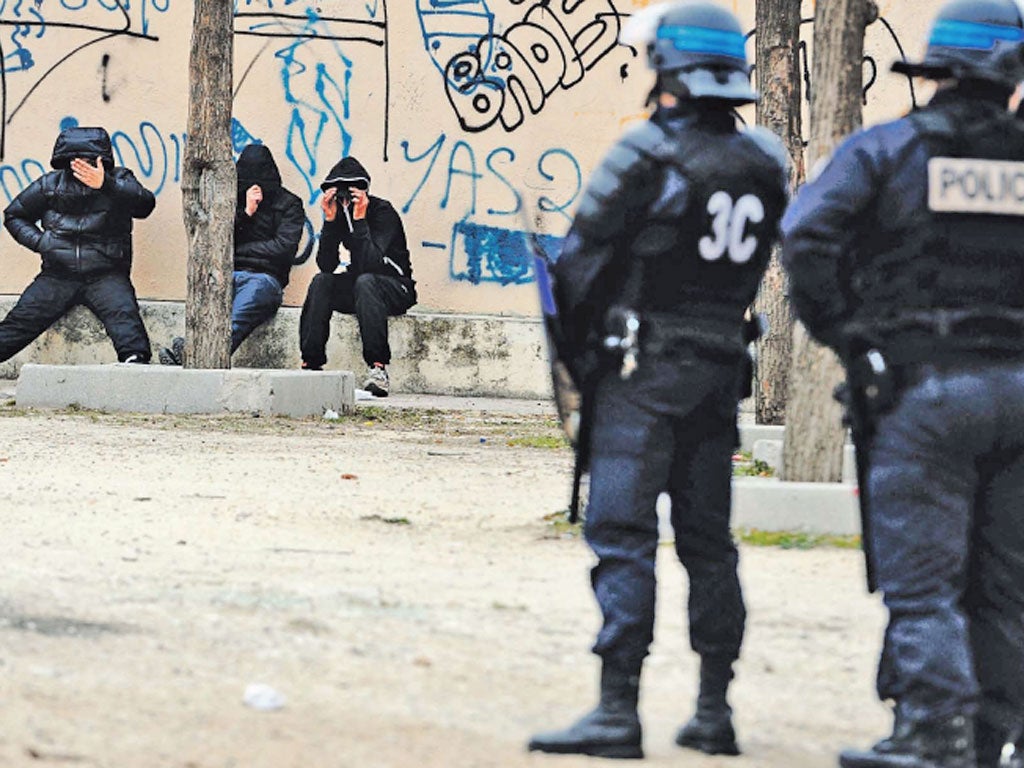
A local mayor said that the drug-related violence was so extreme only the army could defeat it
Drug war in numbers
26: Percentage of people in Marseille who live below the poverty line, against 15 per cent nationally.
15: The number of men, mostly from northern districts, shot dead in the city's drug wars.
300: The number of Kalashnikovs reportedly intercepted in Marseille this year.