Mosley case on privacy laws 'is being fast-tracked'
European Court set to give public figures chance to gag press on damaging stories
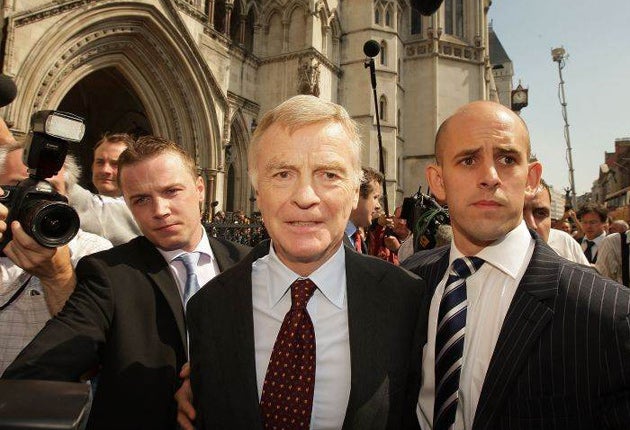
It could spell the end of the kiss and tell: public figures might, within 18 months, have the power to stifle bad news stories before they are published, a senior lawyer has warned.
The European Court of Human Rights (ECHR) is currently fast-tracking a landmark case, brought by Max Mosley, to tighten UK privacy laws. Mark Stephens, a lawyer acting for a group of media and free speech organisations opposing Mr Mosley in court, believes that the extraordinary pace with which it is proceeding suggests that the judges are about to rule in the former Formula One boss's favour.
That would mean a change in the law that would force the press to contact anyone that they are intending to run a story about to warn them if it could potentially breach their privacy, giving public figures a chance to gag newspapers before publication.
With rules like those, readers may never have learnt about Sven-Goran Eriksson and his then-boss Mark Palios having affairs with Faria Alam, an FA secretary; or Rebecca Loos' alleged fling with David Beckham.
Mr Stephens said: "These cases generally take three or four years to reach a conclusion but this one seems to be moving much more quickly than that.
"I have been asked to provide my response to one set of documents sent to me by the court within a matter of days, where normally I would have weeks. It is also my professional judgement that this case was admitted on a surprisingly fast timetable. It looks like it could be over in 18 months or so.
Mr Stephens, a partner with the London-based law firm Finers Stephens Innocent, pointed out that normally, relatively few cases are admitted to court. When they are, he said, it is usually on the basis that the judges believe there is something to be debated. "However, this case is proceeding more quickly, which suggests that they accept most of Mosley's points. It is on a fast track," he insisted.
Mr Mosley brought the case against the UK last year, claiming the country's privacy laws were out of step with the European Convention on Human Rights. The High Court awarded him £60,000 in damages in July 2008, ruling that stories about his sex life, published in a Sunday newspaper, invaded his privacy. Mr Mosley believed the damages did not go far enough and took his case to the ECHR demanding that, since Article 8 of the Convention protects the right to privacy and family life, the UK be forced to amend its laws.
The ruling, if delivered in Mr Mosley's favour, could herald one of the most fundamental changes to the freedom afforded journalists who have long operated according to the maxim: "publish and be damned" – a phrase coined by Arthur Wellesley, 1st Duke of Wellington in the 19th century.
The principle allows newspapers to publish the stories they choose, and challenges them to defend themselves against claims of defamation or invasion of privacy later. However, some believe that, by the time the court reaches a judgment, the damage has already been done.
Mr Stephens argued that the revelations about Mr Mosley's sex life, published in the News of the World, are not covered by Article 8. He added: "There should be no injunction preventing publication. What Mosley is doing is trying to drive a coach and horses through the rules and get injunctions against newspapers prior to publication. This could be the end of 'publish and be damned'. Are we really saying that next time we want to write a story about a public figure, we should give them 48 hours' notice?"
John Kampfner, the chief executive of the press freedom group Index on Censorship and author of Freedom for Sale, said the organisation viewed Mr Mosley's fight as "extremely dangerous". He added: "There are some legitimate concerns around intrusions on people's privacy, particularly that of people who have never invited publicity, and they need to, and are, being looked at. However, these privacy concerns are being used as a battering ram against good and legitimate investigative journalism. And if Max Mosley succeeds, it will produce a licence to stifle that good investigative journalism."
Join our commenting forum
Join thought-provoking conversations, follow other Independent readers and see their replies
Comments
Bookmark popover
Removed from bookmarks