Now Britain and Iceland go to war over the mackerel
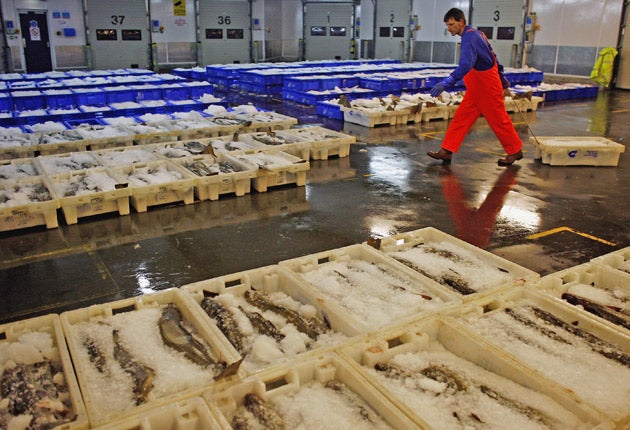
The European Union could impose trade sanctions against Iceland or stop its ships from entering EU ports in an emerging "mackerel war".
In an echo of the 1970s "Cod War" when British gunboats were sent to ward off Icelandic trawlers in disputed waters, the EU has warned it will take "all necessary measures" to protect its fishing and economic interests.
The rising tension follows Iceland's unilateral decision to catch three times as much mackerel this year as the EU considers reasonable, prompting a similar move by the Danish-owned Faroe Islands. Together with the amounts traditionally taken by the EU and Norway, the quotas would exceed the sustainable catch by a third and threaten a success story in European fishing, which has been dogged by political dithering and national self-interest.
Iceland – which traditionally has a reputation for good stewardship of fish – insists it has the right to catch any fish it wants within its 200-mile territorial limit, established during the Cod War. The Federation of Icelandic Fishing Vessel Owners defended its behaviour as "legal and responsible".
After failing to resolve the dispute – which Brussels says threatens to wreck international fishing agreements, Fisheries Commissioner Maria Damanaki said on Monday the EC would be sending a "very clear message" to the two states demanding a sustainable deal.
She added: "However, should the current anarchic situation in the mackerel fisheries continue with unreasonable positions being maintained by parties, then the Commission will contemplate all necessary measures to conserve the mackerel stock and safeguard EU interests."
The EU, which suspects Iceland's decision is being driven by the parlous state of its economy, says it will consider abandoning all fishing agreements with the states – which could spell chaos to efforts to conserve stocks such as cod. Another possibility is trade sanctions, or preventing Icelandic boats from landing their fish in EU ports.
In a sign of its anger, Norway has already banned fish processors from accepting any mackerel landed by Icelandic or Faroese boats.
Tempers are also running high in Scotland, where mackerel is more valuable than haddock or cod. Last week 20 fishermen from Peterhead and Fraserburgh used vans and cars in a bid to prevent the Faroese vessel the Jupiter from unloading 900 tonnes of mackerel at Peterhead.
In a further reverberation, the UK, Norway and other fishing nations might seek to damage Iceland's hopes of joining the EU, or use negotiations to encourage it to back down. The Scottish Fisheries Secretary, Richard Lochhead, said yesterday: "I am greatly encouraged by the commitment being shown by the EU on this and hope that these matters will be at the fore of Iceland's EU accession negotiations."
With co-operation between interested fishing nations and consumer demand buoyed by advice to eat oily fish, mackerel had been hailed by the Marine Stewardship Council as an example of a good fishery. For 10 years, the EU, Norway and the Faroe Islands had a trilateral agreement, apportioning fixed shares of the total catch recommended by scientists. But two years ago – arguing that shoals were moving north due to climate change – Iceland began large-scale fishing and set a catch of 115,000 tonnes for 2009.
Reykjavik increased that to 130,000 tonnes this year, when scientists were recommending a decline in the total overall catch. The Faroe Islands, which had a 4 per cent share of the deal with the EU and Norway, announced it would take 85,000 tonnes, a 16 per cent share. Assuming all the parties catch their expected quotas, 772,000 tonnes will be caught this year, 35 per cent more than the 570,000 tonnes recommended by the International Council for the Exploration of the Seas.
Accusing Iceland of "piracy", Bertie Armstrong – head of the Scottish Fishermen's Federation – said: "We would classify that as the abandonment of rational fisheries management."
At Westminster, UK Fisheries Minister, Richard Benyon, was more diplomatic: relations between Britain and Iceland are already strained due to Labour's decision to freeze the assets of the Landsbanki bank during the financial crisis two years ago.
Mr Benyon said: "Mackerel is one of the most sustainable fisheries, due to the action that EU member states have taken in successfully managing the stocks. This is being put at risk by the setting of arbitrary quota.
"I do not want to see this issue cause a deterioration in the otherwise good relationships between our respective industries and I urge both Iceland and Faroe Islands to reconsider their actions."
The 1970s Cod War
Iceland has always jealously guarded its fishing rights, so much so that a row that erupted in the 1970s almost brought Reykjavik and London to the brink of military action.
The "cod war", a more serious version of an earlier row over fishing rights that took place between the two states in the 1950s, began in 1972 when Iceland announced a unilateral extension of its fishing rights from 13 miles off its coast to 50 miles. Ostensibly the reason was to reduce over-fishing, but it hit British boats catching cod and other whitefish in the same waters and London protested the move. Iceland's coastguard began cutting the nets of British trawlers straying into its new, enlarged waters. As a result, Prime Minister Edward Heath sent Royal Naval warships and tug-boats to protect British fishing crews. There were some incidences of boats being rammed.
With the row still simmering, in 1975 Iceland extended its fishing rights again, to 200 miles. Britain protested again – but Iceland laid down its trump card by threatening to close the Keflavík Nato base, crucial for defending the Atlantic Ocean from attack by the Soviet Union. Iceland finally got its way and, after 1 December 1976, Britain agreed its ships would not fish within 200 miles of Iceland.
Since the "war", the two countries' fishing industries have fared very differently. Iceland – which is thought to have stayed out of the EU in order to protect its fishing industry – is acknowledged to run fisheries responsibly, allowing other species caught by accident to be traded between boats and landed, rather than thrown back into the sea.
By contrast, the EU Common Fisheries Policy, which Britain joined on its accession to the Common Market in 1973 – is considered to have been a disaster. A third of all fish are thrown back dead from boats, either because they are the wrong species, a legal but imperfect size, or the quota has already been met.
As a result, cod in the North Sea has plunged to 3 per cent of its natural abundance, despite a recent recovery. And much of the cod sold in Britain now comes from Iceland.
Join our commenting forum
Join thought-provoking conversations, follow other Independent readers and see their replies
Comments