Ossetians warm to Moscow's embrace
A year after Georgia and Russia fought over the tiny territory, fears of a land grab are not unfounded. Shaun Walker reports
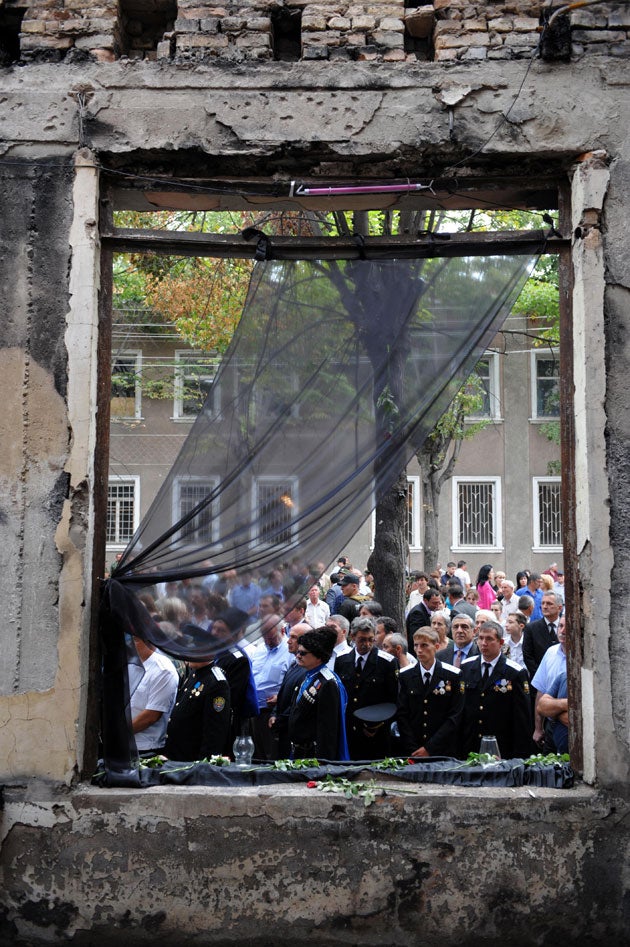
Ayear on from last August's war, the evidence on the ground shows that despite claims to the contrary, tiny South Ossetia has effectively been absorbed into Russia, adding fuel to Georgia's claims that Russia's aim in the war was to annex Georgian territory.
Thousands gathered in the South Ossetian capital of Tskhinvali this weekend to mark a year since Georgia launched an attack to regain the breakaway territory. Alongside remembrance of the roughly 200 Ossetians who died in the war, there were also celebrations of the territory's "independence", officially recognised by Russia in the aftermath of the conflict.
Residents of Tskhinvali gathered in the town's main square late on Friday night for a concert that started at 11.35pm, roughly the time that the Georgian assault on South Ossetia began. Tragic musical compositions were interspersed with moments of silence, as the crowd was played images of last year's war on a big screen. Alongside shots of those who died was footage of Georgia's President, Mikheil Saakashvili, and the then US Secretary of State, Condoleezza Rice. Russia and South Ossetia have accused Washington of encouraging Georgia to launch its attack last year.
Shortly after midnight, the breakaway state's President, Eduard Kokoity, took to the stage, adorned with a huge South Ossetian flag on one side and a Russian flag on the other, and addressed the crowds. "Thanks to the bravery of Ossetian and Russian soldiers, the evil plans that were hatched not just in Tbilisi but over the ocean were thwarted," he said. "South Ossetia is now a free and independent country."
Despite the fact that the unpleasant history between the two ethnic groups means that Ossetians do not want to be part of Georgia, the idea of South Ossetia as a genuinely independent state is absurd. Analysts say that Abkhazia, the other statelet that claims independence from Georgia and was recognised by Russia after last summer's war, may have more of a chance of existence as an independent state – it has a Black Sea coastline, a tourist industry and a small agricultural sector.
South Ossetia is a different story. The territory is tiny, the population is no larger than 70,000, and there is no local industry, infrastructure, currency or airport. The only real option for South Ossetia, if it is not to be part of Georgia, is for it to become part of Russia. The Ossetians are a distinct ethnic group that speak a Farsi-related language, and the majority of them live in North Ossetia, which is part of Russia. There is a long-standing desire among the people to unite the two Ossetias. The Russians, while happy to exercise de facto control over the territory, do not want South Ossetia to join the country formally, as this would suggest that the war last year was indeed about annexation, not liberation.
Shortly after last year's war, Mr Kokoity said that South Ossetia would join Russia, only for Russia's Foreign Minister, Sergey Lavrov, to come out and say that South Ossetia "doesn't want to join with anyone" and that journalists must have misunderstood. Last week, Mr Kokoity again expressed his opinion that one day his territory would be assimilated by Russia, only to deny this later, presumably after a phone call from Moscow.
But despite the carefully worded denials from Moscow, South Ossetia is, in effect, already part of Russia. Ninety-eight per cent of the population have Russian passports; everybody speaks Russian; the rouble is the currency; and most of the budget comes from Russian aid. The Russians have built a new military base on the outskirts of Tskhinvali, and officially have 800 troops in the territory. The real figure is thought to be up to 4,000.
In the new, Russian-controlled South Ossetia, there is no space for the thousands of ethnic Georgians who once lived here. A short drive north from Tskhinvali is the village of Tamarasheni. Before the war, this was a Georgian enclave, controlled by the Tbilisi government and populated with Georgian families. There was a bank, a school, and all the infrastructure of a functioning Georgian town. In the days after the Georgian army was flushed out of South Ossetia, Tamarasheni was torched and looted, and now there is not a soul living there.
On land just past one edge of the village, however, some of which was formerly occupied by the gardens and vineyards of Georgian houses, a new property development is being built, one of the few construction projects in South Ossetia to be realised since last year's war.
The Moskovsky development, funded by the Moscow city government, will provide luxury housing for 800 families. Moscow's controversial mayor Yury Luzhkov has been actively purchasing property and investing in both South Ossetia and Abkhazia – , so much so that, three years ago, the name of one of Tskhinvali's main thoroughfares was changed from Tbilisi Street to Luzhkov Street. (The town's three main roads are now named after the intriguing troika of Lenin, Stalin and Luzhkov.)
All across the territory of South Ossetia, ethnic Georgian areas have been destroyed as the Russian influence grows. The Ossetian village of Dnenisi is just a few miles from Tskhinvali, further along the border with Georgia proper. It's a simple village of a few hundred people, and the scene this week was of an almost Tolstoyan peasant reverie – women carrying scythes and bundles of hay, and walking through the village among the livestock; men working in the fields. But beneath the calm exterior, emotions here run high.
Between Dnenisi and Tskhinvali was a Georgian village, Eredvi. This village was controlled by Tbilisi until last summer, and there were hundreds of Georgian families living there. The residents of Dnenisi say that in order to get to Tskhinvali they had to take a circuitous route of over 50 miles, because the Georgian guards standing watch over their exclave wouldn't let them through. When the war came last August, say the Ossetians of Dnenisi, 800 Georgian soldiers swept through their village. Most were able to escape in time, but four elderly residents who stayed behind were killed.
Afterwards, Ossetian vigilantes from Dnenisi and elsewhere in Ossetia burnt neighbouring Eredvi to the ground, and now the villagers can drive to Tskhinvali in just a few minutes, past the collapsing shells of the houses that once belonged to their Georgian neighbours.
"Of course it's sad to see the houses in ruins, but the Georgians brought it on themselves," says Teiran Bestayev, a 50-year-old Dnenisi resident. "For 20 years there has been no real life here. They treated us like dirt. Now we finally have an independent Ossetia and don't have to be humiliated."
There is no doubt whom the villagers thank for this. "All our lives Russia has been saving us," says Mr Bestayev. "It's down to Russia and Vladimir Putin that we're still alive. We'll always be together with Russia, and if there was a referendum we'd all vote to formally join up with Russia; we'd be running to the ballot boxes to vote!"
Less than 20 miles from Dnenisi is the Georgian city of Gori, which was heavily bombed and briefly occupied by Russian forces as part of its blistering military response to the Georgian attack on South Ossetia. On Friday, President Saakashvili was giving his own speech to mark what the Georgians claim was the start of the war – a Russian invasion of South Ossetia.
He vowed that Georgia would one day regain control of its breakaway territory. "Our future will not be written in a hostile, faraway, frigid capital," he told a crowd of thousands, who had come to mark the date despite the heavy summer rain.
Unfortunately for him, the reality in South Ossetia suggests that this is exactly what has happened.
Join our commenting forum
Join thought-provoking conversations, follow other Independent readers and see their replies
Comments
Bookmark popover
Removed from bookmarks