Ratko Mladic calls genocide charges 'monstrous' lie
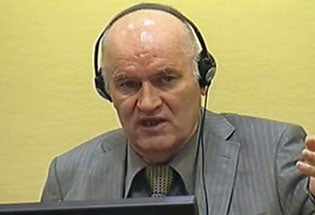
Former Bosnian Serb army commander Ratko Mladic faced the UN war crimes tribunal today as a defiant general who never lost a battle, denying the charges against him as "obnoxious" and "monstrous".
Wearing a military forage cap, which he later removed, Mladic began the hearing with a brief salute.
"The whole world knows who I am. I am General Ratko Mladic," he said at the end of his first appearance.
"I defended my people, my country ... now I am defending myself," he told the court and a rapt public gallery.
"I just have to say that I want to live to see that I am a free man."
As expected, he declined to enter a plea and the court set his next hearing for July 4.
Mladic told Judge Alphons Orie he was gravely ill and "in a poor state". He said indignantly that he did not want to hear "a single letter or word of that indictment" read out to him.
He shook his head in denial as Orie, reading a summary, described the slaughter of 8,000 Muslim men and boys at Srebrenica in July 1995 of which he is accused.
"He showed no remorse, he mocked the court," said Ramiza Gurdic whose two sons and husband were killed by Mladic forces.
"It took him only three days to kill thousands of our loved ones and now he says he needs two months to read the indictment," she said as she watched Mladic on television in Sarajevo.
Once a burly and intimidating figure on the battlefield, Mladic appeared older than his 69 years. His mouth seemed to droop slightly at one corner and his words were slightly slurred, the possible result of a stroke.
After making the basketball hand signal for a "timeout" to his lawyer Aleksandar Aleksic, Mladic obtained a 10-minute private session with microphones turned off, to discuss his health problems.
Afterwards he told the court he had been treated with "fairness and dignity" since his arrest, but had one request.
"I don't want to be helped to walk as if I were some blind cripple. If I want help, I'll ask for it," he said.
Mladic is also charged with crimes against humanity for the 43-month siege of Sarajevo from 1992 to 1995 in which some 12,000 people were killed.
Orie cited a charge that Bosnian Serb forces carried out a sustained campaign of "sniping and shelling to kill, maim, wound and terrorize" the people of the Bosnian capital.
Dressed in a grey striped suit with a gray shirt and sober black checked tie, Mladic frequently wiped his cheeks and mouth, stroked his chin and placed his hand on his forehead.
He listened intently to the judge, occasionally nodding or shaking his finger.
Mladic was arrested last week in a Serbian village and extradited by Serbia on Tuesday, to become the tribunal's biggest case. His capture came nearly 16 years after The Hague issued its indictment against him.
A career soldier, he was branded "the butcher of the Balkans" in the late 1990s for a ruthless campaign to seize and "ethnically cleanse" territory for Serbs following the break-up of the Serb-dominated Yugoslav federation of six republics.
Serb nationalists believe Mladic defended the nation and did no worse than Croat or Bosnian Muslim army commanders, as the federation was torn apart in five years of conflict that claimed some 130,000 lives, destroying towns and villages.
Ending years of anxious waiting to see him to brought to justice, relatives of victims watched Mladic in court.
"I came here today to see if his eyes are still bloody," said Munira Subasic, whose 18-year-old son and husband were both killed by Serb forces in Srebrenica.
"In 1995 I begged him to let my son go. He listened to me and promised to let him go. I trusted him at that moment. Sixteen years later, I am still searching for my son's bones."
The International Tribunal for former Yugoslavia, set up in 1993, expects to wind up its work by 2014. It has issued 161 indictments and has now accounted for all but one fugitive.
Serbs say the fact that two-thirds of them were Serbian is proof of the court's bias. Hague prosecutors say it is a reflection of which side carried out the biggest war crimes.
The court has also been criticised for the slowness of its trials which can take up to four years.
"That is the bigger concern - whether they will finish this process," said lawyer Axel Hagedorn.
For most of his years at large, Mladic managed to live discreetly and safely in Belgrade, relying on loyal supporters who consider him a war hero, not a war criminal.
But as pressure mounted on Serbia to arrest him or watch its bid for European Union membership wither, his network of support dwindled, and at the end he was captured alone.
Join our commenting forum
Join thought-provoking conversations, follow other Independent readers and see their replies
Comments
Bookmark popover
Removed from bookmarks