Return of Dante: the Guelphs and the Ghibellines
The city of Florence has issued a pardon for the poet, 700 years after it sentenced him to death for his political beliefs. Peter Popham reports on the man who turned Italian into a literary language
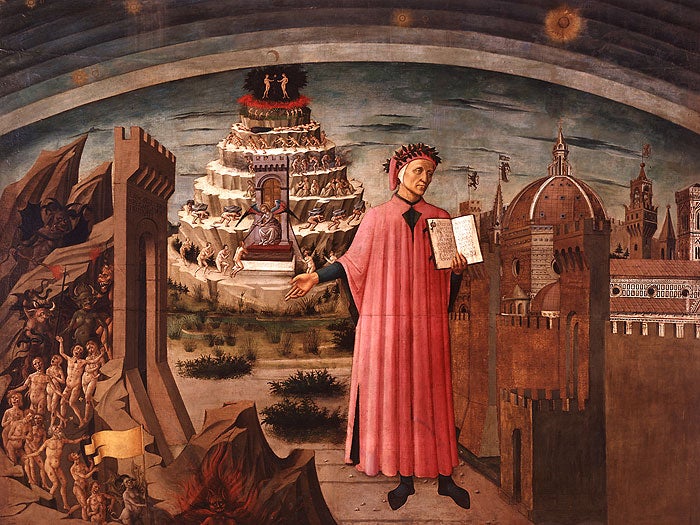
Dante Alighieri led two separate lives. As the author of The Divine Comedy he was the genius whose evocations of hell, purgatory and heaven have held readers in thrall ever since, who created literary models for the rest of Europe to follow and brought Italian into being as a great literary language.
But Dante was also a politician, and if, as Enoch Powell once said, "all political careers end in failure", Dante's came crashing down when he was still remarkably young. Checkmated by the cunning Pope Boniface VIII, he was put on trial in Florence for taking bribes, and when he failed to show up to answer the charges he was condemned to be burnt at the stake. He went into exile and never saw his native city again.
All that happened 706 years ago, so it may seem a little late to do anything about it. But this week Florence's cultural committee decided by 19 votes to five publicly to revoke the poet's exile and confer the city's highest honour, Il Fiorino D'oro (the Golden Florin) on his heirs by way of compensation.
"It's not a cultural rehabilitation," explained Dario Nardella, the city's cultural commissar, "because that happened centuries ago: the city long ago took Dante back in its heart. Rather it's an act of civic rehabilitation, a way to re-establish the links between the city and the poet's family, a gesture of esteem to erase the last remnants of hostility between Dante and Florence – a symbolic act of homage."
The idea did not meet with unmixed delight when it was debated by the committee. "Many of my colleagues thought it was ridiculous," admitted Enrico Bosi, the councillor with Silvio Berlusconi's House of Freedom party who proposed the idea. "They said it was superfluous, meaningless in today's world. Five councillors voted against, and many others didn't show up – we were only quorate by one vote."
Giovanni Varrasi, a councillor with the Green party, was one of the opponents. "Dante didn't ask to be rehabilitated," he pointed out. "If he had asked for it while he was alive they would probably have granted it. So the fact that he didn't ask for it means that he had accepted his exile and his relations with Florence were at an end. So he's probably turning in his grave at the idea.
"The whole thing is a manipulation of history – and the idea of honouring the aristocrat who is Dante's living heir [Conte Pieralvise Serego Alighieri, a wine maker in Valpolicella] is abnormal. The whole thing's a stunt, probably connected to that aristocratic family," Mr Varrasi added.
Dante deeply resented his exile and plotted for years to get home. His bitterness found vent in Canto XVII of Paradiso:
"As forth from Athens went Hippolytus,
by reason of his step-dame, false and cruel,
so thou from Florence must perforce depart ...
Thou shall abandon everything beloved
Most tenderly, and this the arrow is
Which first the bow of banishment shoots forth.
Thou shalt have proof how savoureth of salt
The bread of others, and how hard a road
The going down and up another's stairs.
And that which shall most weigh upon thy shoulders
Will be the bad and foolish company
With which into this valley thou shalt fall..."
Dante Alighieri was born in Florence around 1265. His was an important family in the city, allied to the Guelphs, one of the two main political factions into which the city was divided, the other being the Ghibellines.
Broadly speaking the Ghibellines backed the Holy Roman Empire, that amorphous medieval union of central European territories "neither holy, nor Roman, nor an empire" finally killed off by Napoleon. The Guelphs backed the power of the popes in the struggle for hegemony in the peninsula. But as the recent history of Italy has demonstrated, Italian politics has an infinite capacity for fibrillazione or splintering, and in Florence the Guelphs duly broke up into "black" and "white" factions.
The White Guelphs, among whom Dante counted himself, were the Liberal Democrats of their time. They strove to sit on the fence. They were for the pope, but not very much for him. They thought he should have power, but not too much power.
Dante's political moment came in 1295 when the old aristocracy of the city was banned from holding power and the rising middle class to which he belonged was given its head. He was given a succession of political posts, including ambassador to San Gimignano in 1300 and then in the same year was appointed "prior", one of the 100 leading citizens who ran the city in rotation. It was Dante's bad luck that his rise to political power coincided with the papacy of Boniface VIII, born Benedetto Caetani, "a mysterious man," as the papal historian Eamon Duffy describes him, "proud, ambitious, fierce" – and also exceedingly wily.
Boniface VIII showed a keen instinct for the Church's advantage. "It was Boniface," writes Duffy, "who declared the first Jubilee or Holy Year in 1300, when tens of thousands of pilgrims converged on Rome to gain indulgences, adding enormously to the prestige of the papacy and the spiritual centrality of Rome." All who visited St Peter's or St John Lateran cathedrals that year after confessing their sins were promised "full and copious pardon": the exercise "caught the imagination of Europe", and so enriched Rome's churches that the sacristans "had to scoop in the pilgrim offerings with rakes".
It was Boniface, too, who in his bull of 1302, Unam Sanctam, laid matters clearly on the line: "It is absolutely necessary for salvation that every human creature be subject to the Roman pontiff."
Dante had no hesitation in bowing to the pope's spiritual authority, but he and his fellow White Guelphs were strongly against the pope throwing his temporal weight about in Florence. When Boniface's envoy came to the city, Dante skillfully thwarted his efforts to bring the city to heel. But then he subsequently cracked down on militants in his own White Guelph ranks, sending their leaders (one of them among his dearest friends) into temporary exile, estranging his closest political allies, and setting in motion his own downfall.
When Boniface sent another two-faced envoy to Florence – another supposed peace-maker, whose actual remit was to conquer the place for the Church – Dante agreed to go to Rome with two other ambassadors of the republic. And while he was away, enemies at home cooked up charges against him of baratteria, making illicit profit from public office. When he twice failed to return to answer the charges – Boniface detained him in Rome – he was sentenced to death.
Dante began his wanderings. First stop was Verona, where Cangrande I, one of the leading Ghibellines, became his host – "the mighty Lombard" as Dante wrote in Paradiso, whose home was his "earliest refuge" and "earliest inn", and where his heirs have remained ever since. From there he moved restlessly on to the courts of other mighty lords of central and northern Italy, heaping venom on "the most wicked" Florentines but continuing to dream of going home.
But finally the years of frustrated hopes hardened his heart: in 1315 he was offered an amnesty, and friends and relatives wrote urging him him to come back. He rejected them all, and in return was once again condemned to death, this time in company with his children. He died in Ravenna in 1321.
Join our commenting forum
Join thought-provoking conversations, follow other Independent readers and see their replies
Comments