Ruling parties the winners despite record low turnout
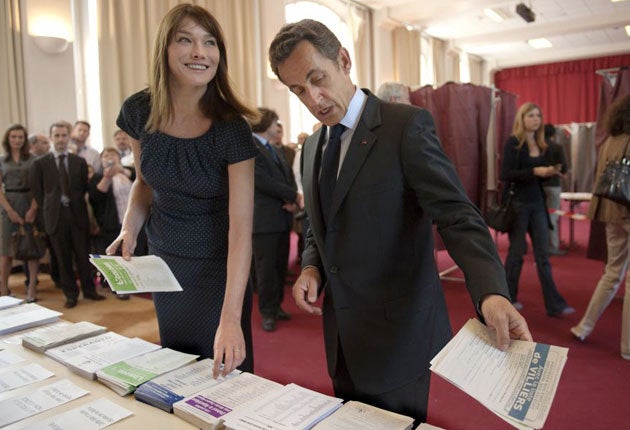
Leaders of most of the large EU countries escaped the fate of Gordon Brown and last night topped their national polls despite a miserable turnout in the European elections.
Chancellor Angela Merkel of Germany comfortably defeated her Social Democratic coalition partners, making her the runaway favourite to win national elections in September. President Nicolas Sarkozy in France also scored a comfortable victory. Prime Ministers Silvio Berlusconi in Italy and Donald Tusk in Poland were on course to win their national polls easily when the counting is completed today.
In Spain, the opposition conservative People's Party notched up its first nationwide victory in nearly nine years. "Today a new majority of Spaniards has expressed its desire for change. We've opened a new cycle that will lead to a PP government in Spain," said the party's leader Mariano Rajoy. However, it was not the hoped-for landslide, with the Socialist prime minister Jose Luis Zapatero suffering only a narrow defeat, 21 seats to 23.
But governing parties in Ireland, Greece, Slovenia, Bulgaria, Finland and Malta were given a severe kicking by their electorates.
Turnout across the EU fell to a record low of 43.39 per cent down from 45.7 per cent in 2004. Otherwise, clear patterns were hard to discern.
There was no Europe-wide wave of protest. Governing parties looked likely to get a battering in Hungary, Latvia, Slovenia and Malta, but they were set for a somewhat limp endorsement from voters who bothered to turn out in Germany, France, Italy, Poland, Belgium, Romania and Luxembourg. Extremist and populist parties did well in Austria, the Netherlands, Finland and Hungary but lost ground in Poland, France and Belgium. In Belgium, the Flemish far right registered its worst performance for years. In Hungary, the extreme nationalist anti-gypsy and allegedly anti-Semitic Jobbik party won three of the country's 22 seats. And in Sweden, the new Pirate Party netted a surprising 7 per cent.
Overall, the trend was towards the centre-right, reflecting the muddled state of many centre-left parties in Europe. Both the French Socialists and German Social Democrats fell to historically low scores.
The great victor in France, other than M. Sarkozy, was a hirsute figure from the past: Daniel Cohn-Bendit, 63, the leader of the French student revolution of May 1968, came third in the French polls after running an unashamedly pro-European campaign for his Green coalition.
Across Europe as a whole, the Greens improved their showing, up four seats on their 2004 performance with results still to come in. Although this was a pan-European election to a European parliament – the only transnational election of its kind – Europe scarcely figured in the campaigning in most countries. The election, like most of the six previous , had turned into a series of mid-term tests for national governments on national issues, against the background of global recession.
After an initial scramble to get their positions in line, EU governments have mostly looked for national solutions to the global crisis. This has been especially true of the largest and most powerful European economy, Germany, and Chancellor Merkel's "Germany first" approach seemed to have met with approval from an increasingly euro-indifferent German electorate.
Other supposedly euro-enthusiastic governments, like that of M. Sarkozy, campaigned mostly on hot-button national issues, such as law and order, which had nothing to do with the EU. The exception was the French president's insistence on raising – only to reject – the possibility of Turkish membership of the EU: something not likely to become a live issue for more than a decade.
M. Sarkozy's centre-right party, the UMP, was forecast to top the polls in France with 28.5 per cent of the vote, followed by the Parti Socialiste with a miserable 17.5 per cent. This is a severe rebuff for the new leader of the Socialists, Martine Aubry, daughter of the former European Commission president, Jacques Delors. The once-powerful French far right, the National Front, took only 6.5 per cent. The other great loser in the French poll was the former centrist presidential candidate, François Bayrou, beaten into fourth place with only 8.7 per cent.
The election was expected to leave the mainly Christian Democratic European People's Party as the largest single group in Strasbourg with well over a third of the 736 seats.
Pirate power: A Swedish surprise
*A surprise new entry into the European Parliament is the Pirate Party who scooped up 7.4 per cent of the vote in Sweden. That was well above the 4 per cent required to win a seat in Brussels and a huge improvement on its 0.6 per cent showing in national polls three years ago. Founded in 2006 with the aim of legalising file-sharing of music and films on the internet, the party's support rocketed after April's conviction of four men from The Pirate Bay website for copyright violations.
Join our commenting forum
Join thought-provoking conversations, follow other Independent readers and see their replies
Comments
Bookmark popover
Removed from bookmarks