Russia finally admits to its hidden heroin epidemic
Surge in abuse blamed on West's failings in Afghanistan, but addicts go untreated
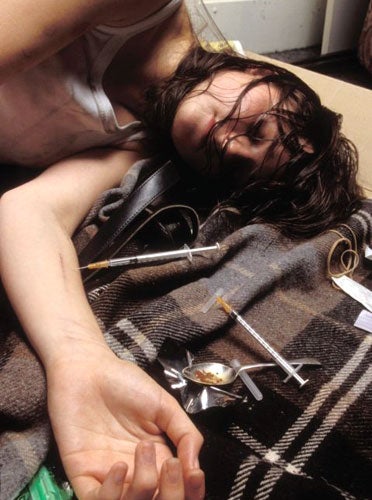
At a playground just off the busy Prospekt Mira thoroughfare in central Moscow, there aren't any children playing on the swings. The slide is covered in dirty snow, the sandpit is strewn with empty vodka bottles and, on close inspection, a few used syringes. Mothers whisper to each other that the playground is the home of narkomany – drug addicts – and wheel their pushchairs swiftly past.
It's just one small sign of a vast hidden epidemic of heroin use that Russian officials and civil society groups say threatens the very existence of the nation. "It's a threat to our national security, our society, and our civilisation itself," said Viktor Ivanov, Russia's top drugs official, at a meeting with reporters recently. He estimated that there are more than two million drug addicts in Russia, which amounts to one addict for every 50 Russians of working age, a level that is up to eight times higher than in EU countries.
Most of these people are addicted to heroin which transits from Afghanistan, through central Asia, and across the long and porous border from Kazakhstan into Russia. There are people addicted to heroin across Russia's 11 time-zones, and the country's anti-drugs body says that Russia now uses more heroin than any other country in the world.
Mr Ivanov, a former KGB operative and a close associate of the Prime Minister, Vladimir Putin, said the foreign occupation of Afghanistan and the "war on terror" were the main factors behind Russia's drugs epidemic, and compared Russia's drug problem to the situation in China in the 19th century, when British traders brought opium to China and vast swathes of the population became addicted.
Mr Ivanov will travel to Vienna today, where he will address a special UN session on drugs and call for increased international co-operation on finding solutions for Afghanistan. He will also demand that Russia be included in the decision-making process on Afghanistan –which he described as the "shame of the international community" – and said that Russia was in favour of simply spraying Afghan poppy fields with pesticides to kill the crops.
"Ninety per cent of those who are addicted to drugs in Russia use Afghan drugs," said Mr Ivanov. "It's a simple equation – if there are no poppies, there is no drugs traffic. Thank goodness politicians in the West are beginning to admit the whole war on terror was ill-judged. We've heard Barack Obama and David Miliband come out and say that it was a mistake. The level of Afghan drugs production now is 44 times higher than it was in 2001."
Both government and public health officials agree that the epidemic of heroin addiction in Russia has reached terrifying proportions that could in the long run prove devastating. But while the government hints that the Western intervention in Afghanistan is the root cause of Russia's drugs woes, its critics claim that Russian government policy on drugs is responsible for worsening the epidemic.
"The Russian strategy is to stifle serious debate about the problem and demonise drug users," said Dasha Ocheret, of the Eurasian Harm Reduction Network in Moscow. "The goal is not to help people suffering with addiction but to identify them, and then punish them. No country in the world has ever been able to deal with its drug problems in this way."
Any addict who seeks medical help for his or her addiction is immediately put on the state "narcological register". This information is available to police, who can have the drug user arrested and put in prison, and causes huge problems for people if they kick their habit and want to reintegrate into society.
A report by Human Rights Watch claimed that Russian policy decisions on treating drug users were outdated and "deliberately ignore the best available medical evidence and recommendations".
Substitution therapy using methadone is banned in Russia, and needle and syringe exchange points are regarded as highly controversial. "Task number one for any drug user is to hide away from everyone," said Ms Ocheret. "They worry that if they go to get clean needles and syringes they will be arrested and sent to prison."
This in turn drives other devastating epidemics in the country, such as hepatitis C and HIV/Aids. Russia has one of the fastest-growing HIV epidemics in the world, with more than one million people thought to be HIV positive in the country. Ten years ago, the epidemic was mainly spread within the drug-using community, but now more than half of new cases are sexually transmitted, as the disease spreads across the population at large.
Whatever the reasons behind the epidemic of drug use, there is one thing on which everyone is agreed. More than 30,000 people die from drug use every year, and in a sparsely populated country with a shrinking population, it's a statistic that the country cannot afford.
Join our commenting forum
Join thought-provoking conversations, follow other Independent readers and see their replies
Comments