Sarkozy stands firm as pension protests escalate
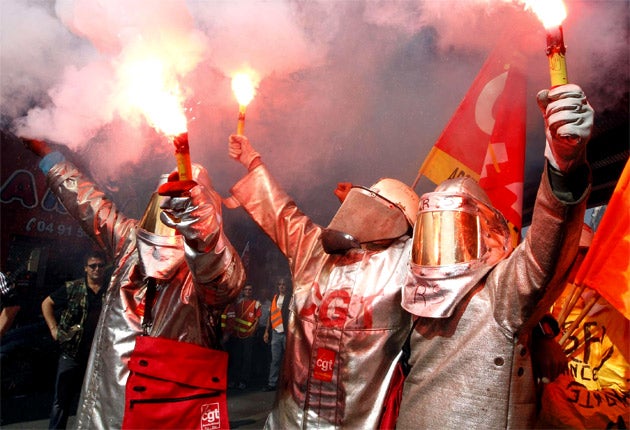
President Nicolas Sarkozy could face the greatest challenge of his presidency in the next few days as a month-old protest against pension reform swells towards outright confrontation.
More than 3 million demonstrators – one in 20 of all French people – marched yesterday against the President's plans to raise the standard retirement age from 60 to 62. Tens of thousands of students joined the marches for the first time, threatening to radicalise the protests and broaden them into a rebellion against a deeply unpopular presidency.
Militant union branches in the railway and oil-refining industries were pushing last night for a showdown with Mr Sarkozy, who has made reform of the loss-making state pension system the make-or-break issue of his final 20 months in office.
After a series of largely theatrical 24-hour strikes in the past six weeks, militant workers were expected to vote last night and this morning for the kind of open-ended stoppages in strategic industries which have overturned previous attempts to reform the French social system.
It remains to be seen, however, how much support open-ended strikes would receive. Moderate, national union leaders fear that extended railway, Metro or oil refinery strikes could fizzle out or alienate public opinion – either way presenting Mr Sarkozy with a victory.
Rail and air services were severely disrupted yesterday. Many schools and government offices, and even the Eiffel Tower, closed. Eleven out of the nation's 12 oil refineries were wholly or partially closed in what local union branches threaten could become an indefinite stoppage "to topple the pension reform". The state railway company, the SNCF, warned last night that it expected widespread cancellations today.
Workers in the Paris Metro voted to prolong their strike into a second day but relatively few had stopped work yesterday. The city's bus and underground train services were close to normal.
Mr Sarkozy has staked his reputation as a tough and reforming president on the pension issue and will not easily back down. He says that pension change is unavoidable – and a test case for France's willingness to rescue its "social model".
The state pensions budget is already €32bn (£28bn) in deficit. With people living longer and fewer young people in the workforce, the annual losses will more than double in the next 20 years.
Up to 3.5 million people were estimated by unions to have joined raucous protest marches in beautiful autumn sunshine in more than 300 French towns and cities yesterday. The Paris demonstration, choking large parts of the Left Bank, comfortably exceeded the numbers who joined three previous marches in the last month.
Tens of thousands of lycée (sixth-form) and university students joined the marches for the first time. Young people in their teens and early twenties may seem to have little immediate stake in pension reform. The government even argues that reform is in their best interests. The burden of paying the vast state pension deficit would, if left unreformed, fall unfairly on today's students and schoolchildren, it says.
The young, mostly leftist marchers interviewed yesterday made it clear that they were "sick to the teeth" with Mr Sarkozy's presidency generally – and especially his campaign against Roma immigrants.
But they also insisted that the pension reform could make it harder for them to find jobs by forcing older people to stay in the workforce for two more years.
Jeremy Gomez, 18, a lycée student from the Seine et Marne department, said: "We are sick of everything Sarkozy stands for, especially his authoritarianism and xenophobia. But this pension reform is not just about old people. It will hurt us too."
Some moderate trade union leaders, and even some centre-right politicians, say that Mr Sarkozy will be delighted to face – and maybe face down – prolonged strikes and street protests. They say that he wants to go into the next presidential election as the man who – unlike centre-right governments in 1995 and 2006 – forced through social reforms and did not cave into the "conservatism of the left".
But the Elysée Palace is known to be worried that extensive student protests, like those which destroyed plans to change youth employment laws in 2006, could prove combustible and impossible to contain.
Moderate union leaders point out that an apparently "soft" pension reform disguises many hardships. The Sarkozy plan would raise the standard pension age from 60 to 62 and the age of a guaranteed "full" pension from 65 to 67.
To qualify for a "full" state pension at 62, workers would have to pay into the system for 41-and-a-half years, instead of 40. Many women, who suspended their careers to raise families, or people who entered the workplace late after prolonged studies, would not qualify for a full pension until they are 67.
France's Growing anger
14 April 2010 Employment minister Eric Woerth presents outline reform plan to reduce deficits in state pension fund. Minimum pension age would increase from 60 to 62. A full pension is guaranteed at 67, not 65.
27 May First nationwide protest against reform attract one million people, according to unions.
24 June New marches attract nearly two million.
7 September Reform law presented to parliament. Nationwide public sector 24-hour strike. Demonstrations attract 2.7 million, say unions.
23 September Nationwide 24-hour strike. Marches draw nearly three million.
2 October Marches break three-million barrier.
12 October Threat of rolling strikes on railways. Students join marches swelling numbers to 3.5 million, unions say.
Join our commenting forum
Join thought-provoking conversations, follow other Independent readers and see their replies
Comments
Bookmark popover
Removed from bookmarks