Sarkozy's Louis XIV moment
Parliament summoned to Versailles to hear President
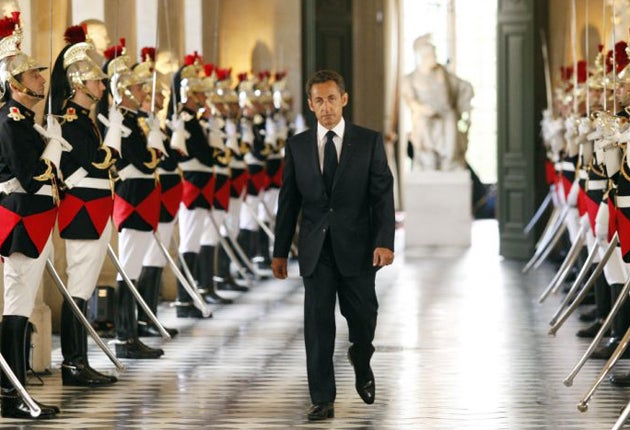
Nicholas Sarkozy yesterday trod where no French president for 161 years has dared, or chosen, to tread when he spoke to parliament.
After a constitutional change, completed a few hours before, M. Sarkozy addressed both houses of parliament gathered in the Palace of Versailles to explain his vision of the future of France and of the world.
Presidential Question Time it was not. The parliamentarians were forbidden to intervene while the President was speaking. They were forbidden to ask questions. The President's 50-minute speech was followed by a debate but M. Sarkozy departed before it began.
As a result, Green and Communist parliamentarians boycotted the speech. Socialists listened in silence but boycotted the debate. President Sarkozy's centre-right supporters gave him a rhythmic standing ovation.
The whole event – transporting both houses of parliament, the government, the Republican Guard and Carla Bruni-Sarkozy to Versailles – cost the French taxpayer €400,000. One Green deputy suggested that it was "the most expensive press conference in history".
In his speech, President Sarkozy attempted a brilliant balancing act. The man who had been elected two years ago to impose "rupture" on French politics said the global recession had demonstrated that the "French model" was the best in the world. However, he said, this did not mean that "radical" reforms were no longer needed.
Despite the explosion of the indebtedness of the French state, he said there would be no tax rises and no "policy of austerity". Instead there would be a new form of "state loan" – but only for productive investment.
He took a few minutes aside from the macro-politics to address a burning headline issue of the day. The French government is split on whether or not there should be a ban on the burqa, or full-body Islamic veil. President Sarkozy said that the burqa was not a religious symbol but a "symbol of servitude". He supported proposals for a parliamentary inquiry, without saying specifically that he supported a legal ban.
French presidents have been barred constitutionally from addressing parliament since 1875. None has done so since 1848. President Sarkozy pushed through a constitutional change last year, requiring the president to speak to both houses of parliament at least once a year, in the name of "transparency" and the "modernisation" of the French state.
Despite the modesty and humility of these aims, the event rapidly became clothed in monarchical trappings. Satirists and opposition politicians had a field day. President Sarkozy was portrayed by French cartoonists yesterday in the long wig and robes of the absolutist Roi Soleil, King Louis XIV.
President Sarkozy entered the chamber alone, the parliamentarians were forbidden to sit in their political groups. They were seated alphabetically. A debate followed but only after the President had departed. There was no official reply from the Prime Minister, François Fillon.
Opposition politicians and commentators said the event marked the further humiliation of M. Fillon and the prime ministerial office, marginalised by M. Sarkozy's frenetic activity since he became President two years ago.
A lightly reshuffled government – Fillon 2 – will be announced tomorrow. Rather than making wholesale changes, President Sarkozy has decided to do little more than replace two ministers – Rachida Dati (Justice) and Michel Barnier (Agriculture) – who are going to the European Parliament. One government deputy said: "Why bother to reshuffle the government when everyone knows that the real government is the Elysée Palace?"
Burqas and budgets: What he said
In his speech to both houses of the French parliament, President Sarkozy came close to anticipating the result of the planned parliamentary inquiry on the full-length Islamic veil. "The burqa is not welcome on the territory of the [French] Republic," he said.
"The problem of the burqa is not a religious problem. It is a problem of women's liberty and dignity. It is not a religious symbol. It is a symbol of servitude and humiliation."
Among other proposals in his speech, President Sarkozy said that any person made redundant in France should be given one year's salary and training. Despite record borrowing of 7 per cent of GDP, M. Sarkozy said there would be no tax rises or steep spending cuts.
View all comments that have been posted about this article.
Offensive or abusive comments will be removed and your IP logged and may be used to prevent further submission. In submitting a comment to the site, you agree to be bound by the Independent Minds Terms of Service.
- Print Article
- Email Article
-
Click here for copyright permissions
Copyright 2009 Independent News and Media Limited


Comments
Can you imagine the furore, if Sarkozy condemned prostitution and pimping, declaring whore-house as degrading for women, and freeing the the young teenage sex slaves trafikked into France ?
Double Standards dare I say ?
Don't get me wrong mate; there are some real deviants amongst Muslims too; but how about addressing the crimes against humanity during the French genocide against the Muslim women and children of Algeria, where women were stripped of their burkas and raped by French soldiers in front of their families, why is our hero Sarkozy silent on this recent French history ?
Burqas, however, are forced on women--for if you have been to Saudi Arabia or other Moslem nations, those women whom elect to discard them are beaten publicly, and an Islamic man can divorce a woman if she disobeys him and refuses the burqa.
Those who condemn prostitution, etc. do so sanctimoniously, seldom speaking with the women (and men) who perform this service by choice. And when they do, their profession cannot always easily be determined by their clothing, but the burqa is easily recognized and wrongly sets them apart.
It is true that the French are responsible for many war crimes, but The Hague had not yet been established, and one cannot make laws retroactively. We cannot dig up Napoleon and try him for his crimes based on 20th century standards. We can forbid the wearing of burqas by a people who come to a nation without the willingness to blend into the general society.
You have made very valid points; most of which I cannot deny.
However you a mistaken on three points.
1) There is no injunction anywhere in the Koran which states or demands that women cover their faces; in fact it is the opposite; women should have their faces exposed. And there was a valid reason for this; at the time women who were part of actions pertaining to a criminal/ immoral nature were often fully covered either voluntarily or by their "pimps"; and sadly this is sometimes still the case (not in all instances)
2) The worst attrocitities commited in Algeria by the French was from 1954 to 1961, and I believe there was an International Court of Justice in The Hague at the time; in 1954 the court was presided by a Muslim called Sir Zufrallah Khan who did try to have the persons involved in the Algerian Genocide indicted but in those heydays of colonial rule it was easily put aside. So the deaths of 2 million Algerian Muslim women and children was condemned to a forgotten chapter in history.
3) In 1961 the Algerian demonstrators in Paris were murdered and buried in hidden graves, the responsible police officer Maurice Papon was never charged.
So it is purile to claim that the crimes are not relevent and indictable; the perpetrators are still living; are these crimes an less hideous than those commited by the hunted Nazis ?
What has our little Greek - Hungarian friend and now naturalised Frenchman Sarkozy to say about his countries recent history ?
The burqa is not directly required in the Koran, but its scholars and religious students (especially the Taliban in Afghanistan) have long argued for it based on select mistranslated/misread passages. This is what the Quran says:
"Tell the faithful women that they must keep their gaze focused below/on the ground and cover their sexual organs. They must not put their beauty and their jewellery on display. They must hide their breasts behind a purdah. They must not exhibit their beauty to anybody except their husbands, brothers, nephews, womenfolk, servants, eunuch employees and children. They must not move their legs briskly while walking because then much of their bodies can get exposed." (Sura Al Noor 24:31)
"Oh nabi, please tell your wives and daughters and faithful women to wear a covering dress on their bodies. That would be good. Then nobody can recognise them and harrass them. Allah is merciful and kind." (Sura Al Hijaab 33: 59)
Most "full coverings" are "purdah"--and it developed based on legends, especially about Mohammad. In the early Islamic period, Prophet Mohammed started the practice of covering the feet of women. Within 100 years of his death, purdah (Purdah means covering the entire body except for the eyes, wrist and feet) spread across the entire Middle East.
2. The crimes of the 1950-1970s are legendary and have not been punished because of collusion with totem governments. Thus Henry Kissinger had the CIA assassinate Alleande in Chile to support the dictator Pinochet. Alberto Fujimori rose with the blessing of the USA and UK, while Ronald Reagan had Donald Rumsfeld install Saddam Hussein as the leader in Iraq--but few spoke out. Algeria 1954-1961 was in civil war because of its extreme right hardliners. Many argue that the war was religious--initiated when about 100 Christians were killed--in turn they were joined by Jews who massacred thousands of Moslems. The Moslems founded the FLN to retaliate. On Nov 1 the Moslems attacked 70 French holdings. Jacques Soustelle attempted to restore peace--but with the Moslem rising in the Philippines and elsewhere and subsequent attacks on Christians, the French government surrendered to the inevitable: civil war. That is why no international trial took place, as it would have had to indict and try not only French but Algerians who were equally guilty of atrocities.
3. You are wrong on Papon. He was charged, tried, convicted and sentenced to prison. He was not released until October 1997. The full trial record, including conviction, etc. is easily found at http://www.justicetribune.com/index.p
4. Sarkozy has always been a barbarian, and much like the Italian "president" (would be dictator) Bersculoni--womanizing. Both have had token trophy wives. Both have been pathetic creatures in politics--but the far right is reaching more aggressively for power--and will achieve it as the liberal left has become soft and unwilling to work to free society of these parasites.
Does Sarkozy have anything to say about the "Spy Princess" - Noor Inayat Khan; the Muslim girl who gave her life so that the French could endure freedom ? Sadly she was tortured and kicked to death by the German Gestapo after being betrayed by the French resistance.
With the massive support of the rotten classes (to which he belongs) and his steady undermining of France's democratic institutions, we can have a fascist regime by 2017.
Mr Lichfield rather leaves the reader to believe that prior to 1848, French presidents were in the habit of making addresses to parliament. In fact there has only been a French President in the period !848 to 1852, and from 1871 to now. You may as well say that no Speaker of the House of Commons elected by secret ballot has, since 22 June 2009 declared his intention to implement an agenda for reform. It's true, but doesn't have a great deal of content.
Yup, interfering with women's basic human rights "in their own best interests" is a fantastic idea.
Henri
Not until women are free and equal with men, enjoying the same benefits and having the same obligations (such as doing equal work for equal pay, serving [and dying] on the battlefields, etc) as men, people will not be free and society divided. The burqa and its mythology must go.
You might also want to ponder the phrase "open and free society", and what happens to that concept when you start legislating on what certain groups of people can and cannot wear.
Until Moslem women are given an opportunity to conduct inquiry into the history of the burqa they will use it; it is imperative that scholars address this issue with calm reasoning and recitation of facts with citations.
Muslim women should be empowered to choose what they wish to wear. Forcing a decision upon them is not empowering them.
While I am for the right of choice in all matters, it does not make sense to permit the burqa in a classroom where the wearer will stand out and not merge into the group--and at the same time it forces upon others a sense/psychology of separation that is not healthy to the conduct of inquiry. Also, when this difference appears, it leads to hostility and attacks which further lessens the degree of learning, and as seen on the streets of London and Paris, attacks upon the wearer as the psychology of gangs is that a noticeable difference must be singled out to provide cohesion within the gang (society, classroom, etc). Thus the KKK in the USA found a common ground wearing white sheets that were originally robes for clergy in Catholic Spain, but hiding beneath these white sheets the KKK was able to exact a blood price from Blacks, gays, Jews, etc. Unfortunately this is not a world where difference is welcomed. Rather it leads to violence, thus mainland China adopted a uniform for all--as is still the case in North Korea, Roman Catholic and other private schools around the world, the various military, etc. Individuality has seldom been welcomed (thus the term "livery" and its use in the UK and elsewhere). The burqa merely solidifies and amplifies a seething distrust and hatred that is not explained. Freedom of choice is fine as long as it does not include shouting "fire" in a crowded room or being noticeably different in an environment where the difference is not welcomed. Unlike sexual orientation or fetal evolution (if not broadcast), clothing does set people apart.
I don't have a strong opinion on individuals wearing symbols of their faith but I do have strong opinions about women being mislead into believing that to show her face, to communicate openly, to be treated equally, somehow defiles her.
I also believe, having worked as an advocate for female victims of domestic violence for some years, that if many women were allowed to make an informed decision about wearing the burka, most wouldn't. In my experience, they do it under the threat of violent disapproval from the husband and because they are told any other way brings shame on the male members of the family.
The burka IS inforced in some countries and women still face the death penalty if seen un veiled by a man who is not her husband. For that reason, the burka will always be a sign of female oppression and one that should not be readily accepted in a society that purports to defend women's rights. It's nice to see someone confront this issue instead of sticking their head in the sand and pretending it's not a women's rights issue. If similar legislation were to be introduced here, I would support it wholeheartedly on behalf of all the women I've worked with who voices are not yet heard.
The original burqa was known as purdah. First it was applicable to only the wives of the holy men, and later it was extended to all Muslim women. Purdah means covering the entire body except for the eyes, wrist and feet. The current concept is absurd in covering the entire body, but it was so required because Taliban feared that woman was the source of evil, arousing base passions in men who should not look at a woman even during sex. The burqa/purdah is without question the greatest debasement of womankind and should be outlawed since few will take time to study its antecedents and history.
I stand corrected on Papon; you are indeed correct; so there was some justice, albeit too late for the victims.
Generally you have the overall feel of correctness in the position of the Koran about the recommended attire for women.
The Prophet Muhammad did actually state that women should be covered modestly and only show "these" and "these", whilst pointing to the face and hands. So it is actually "forbidden to cover the face and hands.
What has to be realised is that in many so called "Muslim" countries, there is an undesirable law and order situation which runs along the lines of "might is right"; forcing the poorer members of society to seek safety and refuge by appearing "invisible"; namely hiding ones wealth from the stronger members of society for obvious reasons, this includes both material wealth and covering the female members of their families to prevent awkward situations where their wives and daughters become targets..........not very different from the old master-peasant feudal systems of years gone by or as is the current case in the tribal communities of so called Islamic countries; the reality is that it is nothing to do with Islam and everything to do with power-abuse.............................