Scandal of the deadly diabetes drug subsidised by French state
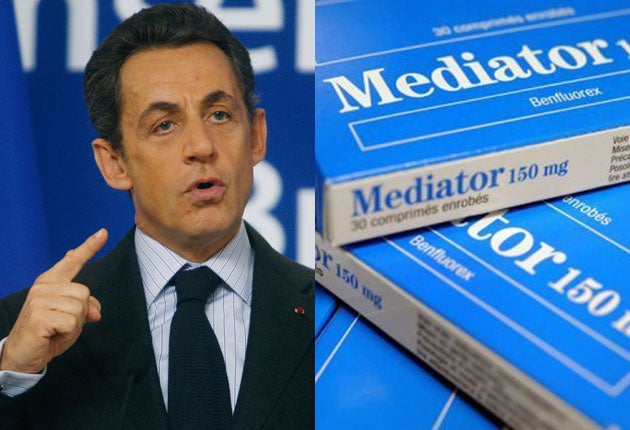
French politicians of both the right and left are facing severe embarrassment and legal recriminations with the forthcoming publication of an official report on what could become the worst health scandal in the country's history.
President Nicolas Sarkozy has promised "the most complete transparency" on how a drug which is now suspected to have killed up to 2,000 people was officially approved, and subsidised, for 33 years by the French health service.
Despite repeated warnings from scientists in France and abroad, the Mediator drug was prescribed to 5,000,000 French people, originally to fight diabetes and later as an appetite-suppressing, slimming pill. A report from the French health inspectorate, due in mid-January, will investigate why successive French health ministers, of the left and right, failed to heed advice that the drug – produced by the French pharmaceutical giant, Servier – was at best useless, and at worst highly dangerous.
Separate French press investigations have focused on an alleged campaign of intimidation and disinformation by the Servier company to keep the drug – and a lucrative predecessor, eventually banned in the US in 1997 – on the market.
Servier, the second largest French drugs company, founded 50 years ago by Jacques Servier, 88, a French doctor, is known for its cult of secrecy and its excellent relations with French politicians. President Sarkozy himself once worked for the company as a lawyer during his brief legal career, when he was a young man.
Mediator contains a substance called benfluorex, which has been alleged in a series of scientific investigations to attack the cardio-vascular system and, in particular, to damage the valves of the heart. Despite a series of warnings, the drug remained legal – and its use was even officially subsidised by the French health service – until late last year.
Approval was finally withdrawn after the publication of a study in April 2009 by a Breton lung specialist, Irène Frachon, which linked Mediator to scores of patients with otherwise unexplained heart valve problems. In November this year, the agency which runs the finances of the French health service calculated that the drug was responsible for at least 500 premature deaths. Another study, leaked to the newspaper Le Figaro, put the death toll at between 1,000 and 2,000.
The French Health Minister, Xavier Bertrand, has promised that the investigation will examine why a string of his predecessors failed to respond to warnings that Mediator was potentially dangerous. His predecessors include himself. In a previous stint in the job, in 2006, he decided to maintain the 65 per cent refund to patients who bought Mediator, despite an official report linking it to heart valve disease.
Other health ministers who have ignored previous reports criticising Mediator include, in 1999 and 1998, Martine Aubry, now leader of the main opposition party, the Parti Socialiste and Bernard Kouchner, the founder of Médécins sans Frontières. Both say they have no recollection of the warnings.
In a series of investigative articles, the newspaper Libération accused the Servier company, which emplys 20,000 people, of using "techniques of intimidation" to try to keep a cousin of Mediator, called Isoméride, on the lucrative US market in the 1990s. Researchers who criticised the drug recalled receiving anonymous threats, incuding parcels containing miniature coffins, but no direct link with Servier was established. The drug was banned in the US in 1997.
Join our commenting forum
Join thought-provoking conversations, follow other Independent readers and see their replies
Comments