Spain reveals Cuba's plan to free all political prisoners
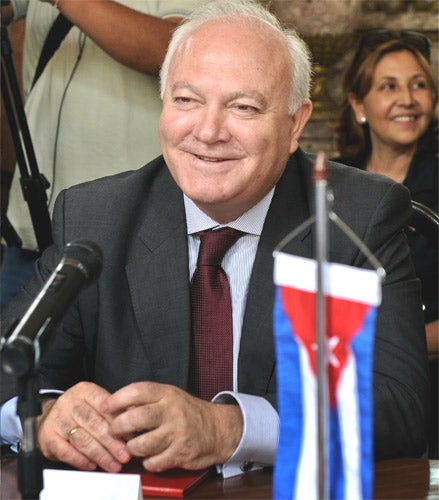
The Spanish Foreign Minister yesterday told his country's parliament that Cuba would soon release "all" political prisoners and suggested that the EU and US could respond by softening longstanding sanctions against the communist island nation.
Miguel Angel Moratinos's speech marked a step beyond the previous promise that 52 more dissidents would be freed in the next four months following negotiations with the Catholic Church hierarchy in Cuba. Some 11 have already been released.
Mr Moratinos, who helped broker that historic release while pushing to soften EU policy toward Cuba, cited a statement by Ricardo Alarcon, head of the Cuban parliament.
"All of the political prisoners in Cuba will be liberated," he said during a routine parliamentary session. "Even those who don't want to leave Cuba will be able to remain on the island."
The prospect of former political prisoners remaining free in Cuba contradicts the belief among Cubans abroad that the Church-brokered release to Spain amounted to "forced exile", a cynical ploy to earn foreign applause while keeping the regime's perceived troublemakers at bay.
But the Spanish Foreign Minister continued in his optimistic riff, adding that the releases, which began with the first group of 11 prisoners last week, will be followed by "political consequences". "It's not just a humanitarian gesture," he said. "It's a new stage."
Mr Moratinos, a former EU envoy to the Middle East, then predicted that the US would soon lift its historic embargo on trade, financial and diplomatic relations, first enacted in 1960, during the Cold War, after the then-spry commandante, Fidel Castro, nationalised American properties on the island.
He also said that the European Union would scrap its so-called Common Position on Cuba, which makes progress toward democracy and human rights a precondition for normal diplomatic and economic relations with the island.
The policy was spearheaded by Spain's conservative former Prime Minister, José Maria Aznar, after Mr Castro incarcerated 75 journalists in what came to be known as the "Black Spring" of 2003. Since taking office in 2004, Spain's Socialist Prime Minister, José Luis Rodriguez Zapatero, has lobbied to relax that position somewhat, and trade ties improved as the regime released small quotas of political prisoners between 2005 and 2008. Germany, France, Sweden and the Czech Republic are hesitant to drop the policy.
Ten of the 11 dissidents who landed in Madrid last week held a press conference earlier this week to express their fears that the hardline EU policy would be undeservedly lifted. "Our departure for Spain should not be considered a goodwill gesture but a desperate action by a regime in an urgent search for credit," said former political prisoner Ricardo Gonzalez, a correspondent for Reporters without Borders, reading from a statement.
"Conscious of the expressed will of some countries to modify the EU policy, we state our disagreement with such [a] measure, because the Cuban government has not shown a clear decision to advance toward democracy in our country."
But Guillermo Fariñas, the political prisoner whose 135-day hunger strike helped put pressure on the Cuban regime, shares some of Mr Moratinos's optimism.
"This is the moment to look forward," he said in a telephone interview with the Spanish newspaper El País after the first group of prisoners landed in Madrid last Tuesday. "We can't remain where we are, neither the government, nor the opposition, nor the international community: a window has opened and we have to take advantage [of it]."
He suggested relaxing EU policy "on a temporary basis, for one year" to see if the government takes further steps.
A twelfth Cuban dissident, 58-year-old Arturo Perez de Alejo, president of a human rights agency who was sentenced to 20 years in prison, arrived in Spain last Wednesday. Eight more political prisoners are expected to land at Madrid airport later this week.
The dissidents are being housed temporarily in a dreary, €25-per-night (£21) hostel on the outskirts of the city while the Red Cross and state agencies search for housing. They store their clothes in metal lockers. They and their families share one bathroom.
Join our commenting forum
Join thought-provoking conversations, follow other Independent readers and see their replies
Comments