World

Partly Sunny with Showers 12° London Hi 12°C / Lo 6°C

The Big Question: How serious is the political unrest on the Continent, and can it be calmed?
By Peter Popham


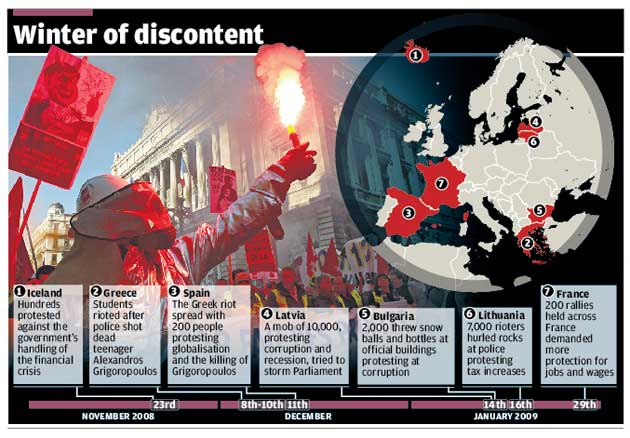
Independent Graphics

Why are we asking this now?

As the economic consequences of the credit crunch rumble across Europe, producing soaring unemployment rates and falling wages, protesters are taking to the streets in more and more countries to voice their anger.

Like where?

Yesterday saw the first mass demonstrations against the government response – or lack of it – to the economic crisis in France, where, in the biggest protests for many years, more than a million demonstrators turned out across the country, demanding that President Sarkozy do more to stanch the economic bloodletting. Public transport was drastically reduced, and one third of teachers stayed away from their schools. Factory, postal, hospital and many other workers struck. Even some staff at the Paris stock exchange joined the protests.

Why did the strike call produce such a response?

Unemployment in France is soaring at the fastest rate for 15 years, consumer spending has plummeted, and the eight unions which combined forces to stage the protest say the €26bn stimulus package that President Sarkozy announced recently is a woefully inadequate response to the crisis. Nearly 70 per cent of the French population was said be in favour of the protests.

Where did all this start?

The shooting dead of a teenager by a policeman in Athens in December unleashed weeks of violently destructive demonstrations, not only in the Greek capital but across the country. Although sparked by the killing, it became clear that what underlay the protests and made them so large and widespread was the country's galloping economic malaise.

Why was Greece affected first?

As the weakest member of the Eurozone economically, Greece is suffering disproportionately from the credit cruch and has none of the cushions of its wealthier fellow-members in northern Europe. Lacking competitive industry and agriculture, it has been heavily dependent on services, shipping and tourism – all of which have been sliding as consumers worldwide cut back on their spending. Last week Standard & Poor delivered another blow when it downgraded Greece's credit rating, arguing that the crisis had aggravated the Greek economy's "underlying loss of competitiveness."

How do these factors translate into problems for ordinary Greeks?

The protests were overwhelmingly by the young, and it is the young who have been most drastically affected, with youth unemployment rates of up to 30 per cent and many graduates forced to take menial jobs. But this week another disgruntled sector hoved into view as Greece's farmers blockaded the capital with more than 9,000 tractors to demand that the government hike its emergency support package to them of €500m.

Where else have protests broken out?

France aside, the countries affected have been small, historically weak ones which grew rapidly richer during the recent boom but are now being hit from every direction at once, with rising unemployment and wage and budget cuts, combined in the case of Latvia with tax increases mandated by the IMF. It's countries like Latvia and Lithuania that are the walking wounded of the credit crunch. Dominique Strauss-Kahn, head of the IMF, recently singled out Latvia, Hungary, Belarus and Ukraine as among the most vulnerable to turmoil.

What's the Latvian story?

During the boom its growth rates were in double figures, putting it among the champions of the EU, but last year the economy shrunk by 2 per cent and is forecast to sink by another 5 per cent in 2009, while unemployment has doubled in the past six months to 8 per cent, with three times that rate for young people.

So Latvians are angry?

Very. This is a country with little history of violent protest, but earlier this month a peaceful demonstration in the capital, Riga, by more than 10,000 people degenerated into a drunken riot in which 25 people were injured and 106 arrested. Public anger about the economy had been exacerbated in December when a leading member of the government, quizzed about the reasons for the economic crisis, told the TV interviewer, "Nothing special." The phrase infuriated many Latvians, and became an ironic slogan of the demonstrators.

What action were the protestors demanding?

Go home, and let other people take over. Government spokesmen argued in vain that the problem had its roots in reckless economic decisions made by the previous administration.

So the protests were pretty incoherent?

That's a feature of all the protests so far, and it reflects the confusion of governments at which the demonstrators are protesting. The authorities are flinging everything they can think of at the crisis, reversing years of economic wisdom and pulling every lever in sight in the hope that something might work. So far nothing has , despite the vaporisation of tens of billions of euros in the process. As panic grips Cabinet rooms across the Continent, the public is driven to fury.

But no government has fallen?

Wrong: Iceland's coalition government succumbed last week, after protests by 8,000 people were quelled by tear gas. A caretaker government is filling the breach, and elections will be held in a couple of months.

Where is all this going?

Nowhere good, is the broad consensus. Those who have long been sceptical about the validity of European Monetary Union are chortling with schadenfreude as the Eurozone's weaker members, sometimes offensively known as the Pigs – Portugal, Italy, Greece and Spain – struggle to make ends meet inside the (relatively) strengthening currency, with weakening competitiveness and ballooning deficits exposing what the sceptics see as the innate contradictions of yoking economies as different as Germany's and Greece's in a single currency.

What are they saying could happen?

Some predict that one or more of the "Pigs" could eventually be booted out of the Eurozone altogether. Even those who scorn such a scenario – pointing out that in the midst of its worst ever economic and political turmoil Iceland is actually applying to join the Euro – fear stronger economies could exact a fearsome price for continuing to entertain the weaker ones.

What sort of price?

Basically, imposing the obligation to cut their swollen deficits. For instance Jean-Claude Juncker, the prime minister of Luxembourg, has proposed that the Eurozone as a whole might take on the debts of the weaker members. In return the governments of those countries would have to submit to having their budgets drawn up in Brussels. Deep budget cuts in the depth of a severe recession in countries such as Italy, with a long history of violent street protest, could only be a recipe for further political unrest.

Will the disaffection and protest spread to more European countries?

Yes...

* Despite throwing huge sums around, no government has a clue how to stop the rot

* Online technology enables political indignation to spread across the continent like wildfire

* No longer able to devalue their way out of trouble, the weaker Eurozone economies are sitting ducks

No...

* The Eurozone will rise to the challenge and its weaker members will take their medicine calmly

* Despite spiralling problems, Germany and the UK have yet to see any serious mass protests

* The auguries of doom are inescapable, but this panic may pass sooner than we expect

Post a Comment

View all comments that have been posted about this article.

Offensive or abusive comments will be removed and your IP logged and may be used to prevent further submission. In submitting a comment to the site, you agree to be bound by the Independent Minds Terms of Service.

Comments

Who wants it to be calmed?
[info]coyote06 wrote:
Friday, 30 January 2009 at 06:32 am (UTC)
It's time we quit this capitalism gig. It's old news, boring and deadly. And don't you Stalinists think we're getting on your boat either. This is the future, babe. No capitalists, no politicians and no bureaucrats either.
Eveeryone to the pumps - including you!?
[info]jona123 wrote:
Friday, 30 January 2009 at 08:33 am (UTC)
From unbridled Capitalism we are in danger of falling into an unbridled controlled economy with subsidies, quotas and a large dose of rationing all topped by retreatism, social control on a vast scale, protectionism and an impossible situation in respect of the greater problem of controlling climate change The larger and wealthier at least have a duty of care with respect to those poorer nations who have been party to the global consumrerism that has enabled the bubble to grow and the rich nations to stay wealthier than their brethren even after the bubble has burst.
Look at the moon, not my finger
[info]freegib wrote:
Friday, 30 January 2009 at 08:59 am (UTC)
Any excuse is good to attack the Euro. A "greve" in France? Blame the Euro. A riot in Greece? Blame the Euro. But nothing happens in Ireland, Italy, Spain, Portugal, Luxembourg, Belgium, Holland, Austria, Germany, Slovenia, Malta, Finland, Cyprus, Andorra and Monaco. Are you trying to hide your own disaster pointing the others?
[info]ourmaninferney wrote:
Friday, 30 January 2009 at 09:47 am (UTC)
The euro sceptics talk about the contradictions in yoking disparate economies (such as Germany and Greece) under one currency and interest umbrella, yet fail to mention that such disparities exist (and perhaps more so) in the US. You just have to compare median incomes, house prices and so on in states such as Massachussetts, California, Arkansas, Alabama... to see this in action. Ratios of ten to one, or even higher, are common. If you move down to the city level, you could make a similar comparison between Manhattan and any rustbelt city.

Yet, despite this, there is no talk of states "pulling out of the dollar" or "leaving the Union".
Iceland has not applied to join the euro
[info]hjortur_j wrote:
Friday, 30 January 2009 at 12:00 pm (UTC)
One correction, Iceland has never applied to join the euro.
Pigs?
[info]drar3g wrote:
Friday, 30 January 2009 at 12:09 pm (UTC)
Using the term 'pigs' is not only deeply offensive in any context, it's also completely inadequate to explain the current situation. Comparing the economies of Greece, Portugal, Italy and Spain is like comparing pears and apples. Italy and Portugal economic woes predate the current crisis, while Spain had been performing well until now. In many ways, Spain problems seem more related to those of the UK: real state bubble, excesive dependency on services particularly those financial, plunging industrial output, etc. Of course this is something eurosceptics or nordicists won't like to admit.
Keep it classy, Popham
[info]2009_30_01 wrote:
Friday, 30 January 2009 at 12:40 pm (UTC)
The entire tone and much of the content of this article - infantilizing and dismissing the strikers and demonstrators - is a demonstration of the ideas that have led Britain to have the crappiest living standards in the northwest of Europe.

Maybe if Brits hit the streets half as effectively as the French did, they'd have half the benefits and services, instead of a fraction. But it's easier to whine, I suppose, and bash Europe, and pretend things are better here because the unemployment rate is a few percentage points lower for the moment, whilst forgetting how poorly paid and precarious so many of those jobs are. If the Independent was any kind of paper, it'd be encouraging its readers to protest themselves, because things are getting worse in front of our eyes and nothing is being done.

"Pigs" indeed. Get your own nose out of the trough of chauvinistic Euro-bashing and encourage your people to think bigger for themselves. It's a better long-term market.
lack of insight
[info]oliandco wrote:
Friday, 30 January 2009 at 12:43 pm (UTC)
The massive demonstration that we saw yesterday in France is hard to understand for foreign people, because its reasons are various. And as a matter of fact, I would not link it too directly to the economic crisis. When you look at the people slogans, you see that the major common point between the demonstrators is their shared hate of Sarkosy, and the economic crisis gave them a cheap excuse to express this hate (which I would define as irrational...)
France is in a far better position than most of the other European countries, but you don't imagine the resentment towards Sarkosy, and the most astonishing is that this resentment is not due to its reforms (which are not as strong as one could have expected, and not that partisan either), this resentment has been going on since long before his election, loads of people are simply are allergic to him
It is difficult to find a proper name to define this hate, when you look at it in details, it reminds of some of the darkest hate behaviours during the 20th century...
[info]dennis_mundo wrote:
Friday, 30 January 2009 at 01:01 pm (UTC)
How serious is the political unrest on the continent? What!? A strike in France where half the country comes to a standstill with some younger people getting a bit edgy after dark?
As far as I am aware that happens at least once a year, it's part of the European routine as much as clogged up autoroutes down south in summer and complaining about the Eurovision voting in May.
Riots in chaotic Greece? Wow, unheard of.
When I watched the german news last night the protests in France were reported in the second half of the news programme in a calm way. On BBC 10 o'clock it was the first news with a stern looking news reporter announcing the end of Europe while the dramatic start up music was still drumming in the back ground.
If there is one thing that continental Europeans probably have in common it's the mentality of tolerating people going up the ceiling quickly and calming down just as quick. Without seeing a drama.
Besides I have not really seen a wide debate in the media of the Eurozone that seriously talks about the collapse of the Euro. Strangely it seems that is an english discussion. Reminds me of the introduction of the Euro, where citizens in 11 EU countries awaited the arrival of the Euro. They had certainly a wide range of feelings about it but the only really emotional protest I remember to have seen on the news was an Englishman dressed from top to toe in Union Jack clothing, burning Euro notes.
Why do you discuss matters that you're not involved in so emotionally?
When last thursday on Question time a Daily Mail reporter said joyfuly that the mediteranean economies would soon collapse and the Euro would be dead there was some cheerful applause from the audience at the anticipated terrible fate of our southern european friends and partners. It probably wasn't too serious but I couldn't help but detect wishful thinking and ill will in it as well.
Rather than get me thinking about the Euro and european protests all I think about in regards to recent media coverage is the english way of emotionally dramatising things and looking at the rest of the world from a "we or them" point of view. It's sometimes so tiring. And so unfriendly.
A response to an undemocratic World
[info]unlikelylad wrote:
Friday, 30 January 2009 at 04:59 pm (UTC)

Democracy is no fun when you are denied a voice. So many people, young and old, feel out of kilter with the poltical systems. Governments are run by big business for big business. Take the sleaze that has infiltrated every aspect of our lives. Public servants being paid to change laws, nebutism without justification, salaries for public sector employees that dwarf any sense of reality. Why wouldn't you take to the streets, why wouldn't you try to get your voice heard above the sound of politicians gorging themselves.
Re: A response to an undemocratic World
[info]ourmaninferney wrote:
Friday, 30 January 2009 at 06:57 pm (UTC)

"salaries for public sector employees that dwarf any sense of reality"... Say what? Care to provide a few figures, rather than a Daily Mail editorial? All the public sector employees that I know work for ridiculously low salaries.

As for the French strike, it's part of the French culture and about flexing muscle. They vote for change every election and then protest when their elected representatives try to effect said change. It must also be remembered that unions in France only represent about 8% of the workforce - far below the UK and German levels - but wield quite a bit of power within companies thanks to mandatory consultation, employees' committees etc. They are also heavily involved with the administration of the social security system. France has a good social safety net, tough employment legislation (it's very difficult to fire someone), and a high standard of medical coverage. All of which means that the average Frenchman is quite well off in reality. (Yes, there are exceptions, such as the famous banlieux of Paris.)

To underline the political posturing nature of French strikes, you'll note that they rarely occur once the weather turns warm. Do the problems mysteriously go away for part of the year?
And now in the UK
[info]weejonnie wrote:
Friday, 30 January 2009 at 10:48 pm (UTC)
It seems that the spark to light the tinder has now reached the UK

Now where did the Government put those 30,000 tasers?
Orwellian UK Presses
[info]jann111 wrote:
Saturday, 31 January 2009 at 01:18 pm (UTC)
Some english journalists act like psychopaths. What are you talking about ? Britain is the only place where such a purposes are running in the press. Please retain the sense of reality. The will of people in the continent is in plain opposite direction to all this apocalyptical orwellian messages you enjoy in the UK. Taking a strike in France as a first sign of collapse is all but accurate : it is a regular social expression and part of the french political life. The riots in Greece and Latvia are regretable, but they are called now to improve their financial policies, instead of "leaving the euro". And Iceland have not certainly applied to join the EU, but social-democrats in the country, now in the goverment, suggested 2011. As long as you fear troubles in the UK you'll be pointing out right to the others. Can I suggest we are all in the same ship ?

Most popular in Europe

Article Archive

Day In a Page

Sun | Mon | Tue | Wed | Thu | Fri | Sat

Select date