The Big Question: Why does the conflict between Russia and Chechnya show no sign of ending?
Why are we asking this now?
On Monday, 39 people died after two female suicide bombers, believed to be from Russia's troubled North Caucasus, blew themselves up on the Moscow underground. Russian intelligence believes that other suicide bombers, members of the same group, are out there, waiting to launch equally bloody and symbolic attacks on prestigious sites close to the Kremlin. Their leader, Doku Umarov, claimed responsibility.
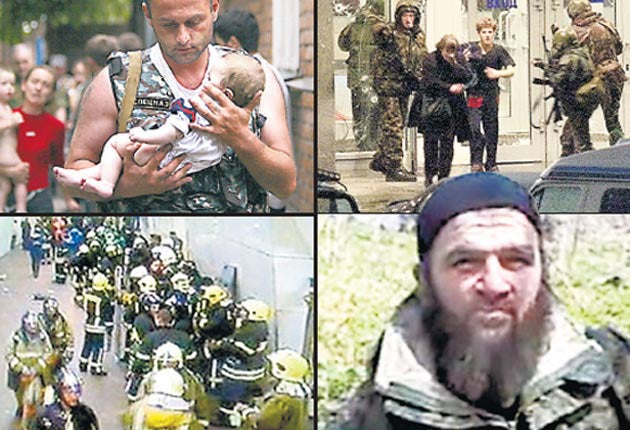
On Wednesday, meanwhile, a spate of car bombings in Dagestan, near Chechnya, in the North Caucasus, killed at least 14 people, mainly police officers, and the Chechen Islamists who promptly claimed responsibility for these attacks are assumed to be closely linked to the Moscow bombers, if only because their attacks appear closely co-ordinated in timing. Among the atrocities linked to Chechnya are the Beslan school siege of 2004 and the Moscow theatre siege of 2002.
Was anyone expecting this?
If the Kremlin's security services were, the public was not. Russians have been fed a line that the Kremlin's macho tactics in crushing separatist movements in the North Caucasus, especially in Chechnya, have paid off and that the region has more or less settled down under the local rule of Kremlin appointees.
Is there an al-Qa'ida connection?
If there is one, it is not a key part of the jigsaw. The public in the West is so preoccupied by Osama bin Laden and his cohorts that people often forget the existence of equally militant but quite unrelated Muslim movements in other parts of the world that have nothing to do with the Middle East and which share with al-Qa'ida only a general feeling of resentment to what they see as Western, or European, imperialism. The militants from Chechnya and other neighbouring parts of the North Caucasus, such as Dagestan, have their own specific, historic grudges against Russia, even if the language that they use against the Kremlin can echo the Islamist lexicon that al-Qa'ida deploys against the United States and its allies.
Why might Chechens want to blow up Moscow?
The Chechens are not just another of Russia's grumbling subject nationalities. Tiny though their homeland is, the decision of the local leaders to demand all-out independence in the 1990s triggered the Russian military's worst conflict since the Soviet Union invaded Afghanistan. A ferocious and protracted war ensued, pitting a mountain guerilla force against a huge but lumbering and ill-disciplined Russian army. For the Kremlin, total victory became essential: it was to be the proof that post-communist Russia remained a great power, following the recent loss of eastern Europe. Were Chechnya to go, the fear was Russia itself might then unravel and Moscow be reduced to a city-state. But Russia's then leader, Boris Yeltsin, had no idea what forces he was unleashing.
The drawn-out nature of the war inflicted horrendous damage on Chechen society. Their capital, Grozny, was almost flattened before the Russian flag was raised over the city in February 2000. Society had fragmented in the meantime as mafia-like warlords took control. Meanwhile, Chechnya's suffering became a lightning rod for Wahhabi militants and other Islamist groups in the Arab world and who became increasingly drawn in. Their radical religious rhetoric began to find a receptive audience in the traumatised, half-destroyed country as a result of which the separatist movement has since taken on an increasingly religious dimension.
Russia also suffered from the war, not only in terms of the number of soldiers' coffins. The war encouraged and revivified all the forces opposed to Russia's brief flirtation with liberal democracy. There was a return to heavy-handed media censorship and the persecution of supposedly unpatriotic elements worsened. The power of the military and security apparatus grew. Russia emerged a less democratic country. Meanwhile, it has become clear that Russia's victory had a pyrrhic character, and that while Chechnya was bound and gagged for a while, its desire for revenge has remained.
Is this a blow to the Kremlin?
The Russian leadership is furious, and not simply because the attacks in Moscow are clearly intended to show nothing is beyond the militants' reach, not even the Kremlin. The present Prime Minister, Putin, rose to power on the back of the Chechen war, which catapulted him from the little-known head of the security services to Yeltsin's anointed successor. His initial appeal rested on being the man who gave the Chechens a bloody nose and thereby informed not only the tribal world of the North Caucasus but the rest of the world that Russia wasn't going to give up a centimetre of territory. His continuing authority, even now Dmitry Medvedev is President (Putin's old job), is linked to his having not only delivered Russia a degree of prosperity but also the "order" to which many Russians instinctively rally, which underpins the popular cult of tough tsars like Ivan the Terrible, not to mention Stalin (incidentally the creator of the Moscow underground). Putin knows he must convince Russians that he can handle any recrudescence of the threat from Chechnya and the other disaffected parts of the North Caucasus.
What does he do now?
That's the hard part. It was one thing to conquer Grozny in 2000 and install your own chieftain in power over a shell-shocked society. It's less clear what to do when the threat is more diffuse and not geographically containable. Like all capitals of large empires, Moscow is a multi-national city, and no amount of mob hostility to dark-skinned people using the underground or milling around in crowded markets is going to rid the city of a large non-Russian population.
Security has been stepped up in such places – but it is far from certain that the terrorists, if they intend a third strike, will go for such obvious sites. As the bomb attacks in Dagestan show, they can play cat-and-mouse, switching back and forth from Moscow to targets thousands of miles away. Were they to strike again, the location might be completely different. Putin must be hoping he has enough double agents and defectors at his disposal to infiltrate the terrorists. But again, the success of that strategy presumes the existence of a single operations centre, which is unlikely. This isn't the IRA, or Putin's own KGB, but a dispersed movement. The various militants may be united by a vague Islamic ideology but beyond that they are also rivals for power.
Does the West have anything to fear?
This is Russia's mess, not ours – a legacy of the Tsars' expansionists wars with the Ottoman Empire in the 18th century and of Russia's failure since then to fully co-opt or assimilate the tribal society that they conquered. The Chechen militants do not look kindly on the Western powers, which turned a blind eye to the Russian army's well-reported gross violations of civil rights in the conflict. Chechen fighters pop up as members of various Islamic terrorist groups around the world. But these men are essentially pirates and freelancers. The Chechens are not interested in taking on the world; rather, they want to settle scores with their Russian foes.
Is this conflict all about faith?
Yes...
* The militants claim Islam is one of their chief sources of inspiration
* Their paymasters include extreme Wahhabists more commonly associated with the Middle East
* Rightly or wrong, they see Russia as a 'Christian' foe
No...
* Historically Chechen Muslims have been a secular people
* To sceptics and opponents, their new-found Islamism appears to be slightly opportunistic
* Despite what many observers say, their real aim is simply independence
Join our commenting forum
Join thought-provoking conversations, follow other Independent readers and see their replies
Comments