The march of Mussolini into Italy's mainstream
After carrying the dictator's torch for 60 years, the far-right National Alliance is to merge with Silvio Berlusconi's party. So is this the end of fascism in Italy? Quite the reverse. Peter Popham reports
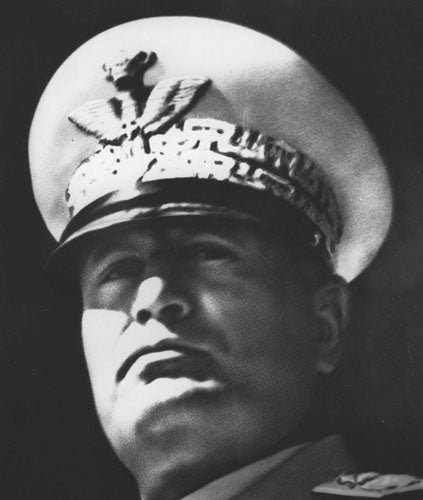
The flames are going out all over Italy. Tomorrow, the flame which for more than 60 years has been the symbol of neo-Fascist continuity with Mussolini, will disappear from mainstream politics. The National Alliance, the last important home of that inheritance, is "fusing" with Silvio Berlusconi's People of Freedom party to give the governing bloc a single identity and a single unchallenged leader.
The change has been a long time coming – 15 years and more. Mr Berlusconi broke the great taboo of Italian post-war politics after he won his first general election victory in 1994 and incorporating four members of the National Alliance into his coalition.
Embracing the Fascists and neo-Fascists was taboo for good reason. For one thing, their return after they had led the nation to ruin in the war was banned by the new Constitution, whose Article 139 states, "the re-organisation, under whatever form, of the dissolved Fascist party, is forbidden."
That veto had been honoured in the breach rather than the observance since 1946, when Giorgio Almirante, the leader of the Italian Social Movement, picked up the baton of Mussolini where he had left it at his death and led the new party into parliament. But the neo-Fascists remained in parliamentary limbo, far from power. Berlusconi blew that inhibition away.
Under the wily leadership of Gianfranco Fini the "post-Fascists" have been gaining ground since. Tall, bespectacled, buttoned up, the opposite of Berlusconi in every way, the Alliance's leader impressed the Eurocrats with his democratic credentials when he was brought in to lend a hand at drafting the EU's new Constitution.
He leaned over backwards to break his party's connection to anti-Semitism, paying repeated official visits to Israel where he was photographed in a skull cap at the Wailing Wall. On one visit, in 2003, he went so far as to condemn Mussolini and the race laws passed in 1938 which barred Jews from school and resulted in thousands being deported to the death camps.
"I've certainly changed my ideas about Mussolini," he said at the time. "And to condemn [the race laws] means to take responsibility for them." Statesmanlike: the word stuck to him like lint. Party hardliners such as Alessandra Mussolini, the glamorous granddaughter of Il Duce, were furious and split away to form fascist micro-parties of their own. But Mr Fini's strategy prevailed. Under Mr Berlusconi's patronage, he became foreign minister then deputy prime minister and now speaker of the lower house, a more prestigious job than its British equivalent. As Berlusconi's unquestioned number two in the new "fused" party, he is also his heir-apparent.
The puri e duri, the hardcore fascist elements, have been gritting their teeth and screaming defiance. One group wanted to stage a ceremony to mark the extinguishing of the flame at the "Altar of the Nation", the wedding cake-like symbol of Italy that towers over Piazza Venezia in Rome. The city's mayor, ironically himself a lifelong "post-Fascist", banned it.
But the puri e duri will not give up. "The National Alliance dies, the Right lives!" declares a flyer scattered about by one of the hard-right parties, whose symbol sports an oversized flame.
"Today, with the betrayal of our ideas, of our story and our identity," roars one of their leaders, Teodoro Buontempo, the national president of The Right party, "we have the duty to make clearer than ever that our party was born to assure the continuity of our ideals ... [Join us] to scream your indignation against a ruling class of trimmers and nobodies."
Black Bands, an investigative book into the hard right by Paolo Berizzi published in Italy this week, claims "at least 150,000 young Italians under 30 live within the cults of Fascism and neo-Fascism. And not all but many in the myth of Hitler." Five tiny registered parties account for 1.8 per cent of the national vote, between 450,000 and 480,000 voters. These are significant numbers, yet even combined they are not nearly enough to reach the 4 per cent threshold to break into parliament.
By this reading, the Fascist element in Italy is no more significant than the BNP in Britain: an embarrassing irritant that can make noise and win insignificant victories, but nothing more.
Despite the claims of the loony right to the contrary, the going out of the Fascist flame does not mean Fascist ideas have disappeared from the Italian political scene. Quite the reverse. Fifteen years after Mr Berlusconi brought the neo-Fascists in from the cold, their impact on politics has never been more striking, never more disturbing.
According to Christopher Duggan, the British author of Force of Destiny, an acclaimed history of modern Italy, the fusion of the two parties does not mark the disappearance of Fascist ideas and practices but rather their triumphant insinuation. "This is an alarming situation in many, many ways," he says.
"The fusion of the parties signifies the absorption of the ideas of the post-Fascists into Berlusconi's party ... the tendency to see no moral and ultimately no political distinction between those who supported the Fascist regime and those who supported the Resistance. So the fact that Fascism was belligerent, racist and illiberal gets forgotten; there is a quiet chorus of public opinion saying that Fascism was not so bad."
One example of the way things are changing is the treatment of the veterans of the Republic of Salo, the puppet Fascist state ruled by Mussolini on the shores of Lake Garda in the last phase of the war. Under the thumb of Hitler and responsible for dispatching Jews to the death camps, Salo was seen by Italians after the war as the darkest chapter in the nation's modern history.
But steadily and quietly it has been rehabilitated in the Italian memory. The latest step, before parliament, is the creation of a new military order, the Cavaliere di Tricolore, which can be awarded to people who fought for at least six months during the war – either with the Partisans against the "Nazi-Fascists", with the forces of the Republic of Salo on behalf of the Nazis and against the Partisans, or with the forces in the south under General Badoglio.
In this way, says Duggan, the idea of moral interchangeability is smuggled into the national discourse, treating the soldiers fighting for the puppet Nazi statelet "on an equal footing morally and politically with the Partisans".
Duggan contrasts the post-war process in Italy with that in Germany, where the Nuremberg trials and the purge of public life supervised by the Allies produced a new political landscape. Nothing of the sort happened in Italy.
"There was never a clear public watershed between the experience of Fascism and what happened afterwards. It's partly the fault of the Allies, who after the war were much more concerned with preventing the Communists from coming to power.
"As a result very senior figures in the army, the police and the judiciary remained unpurged. Take the figure of Gaetano Azzariti, one of the first presidents, post-war, of Italy's Constitutional Court, yet under Mussolini he had been the president of the court which had the job of enforcing the the race laws. The failure of the Allies to put pressure on Italy also reflects a perception that still exists: that the Fascist revival is not to be taken seriously because Italy is 'lightweight'. Whereas if the same thing happened in Germany or Austria, you'd get really worried."
The widespread defiance of the anti-Fascist Constitution can be seen in the profusion of parties deriving inspiration from Mussolini; in the thousands who pour into Predapio, Mussolini's birthplace, to celebrate his march on Rome on 20 October every year; in shops and on market stalls doing a lively trade in busts of Il Duce and other Fascist mementoes of every sort.
Far more alarming, Duggan says, is what is happening out of the spotlight to the national temper, where the steady erosion and discrediting of state institutions is playing into the hands of a dictatorial elite, just as it did in the 1920s.
"What is so disturbing is not just the systematic rehabilitation of Fascism but the erosion of every aspect of the state, for example justice, with the result that people have the urge to throw themselves into the arms of the one man who they believe can sort things out.
"You create very personalised relations with the leader, so that in Mussolini's case, he received 2,000 letters a day from people pleading with him to help. If the state doesn't work, you trust in one man to pick up the phone and sort things out. This is how liberalism disappeared in the 1920s, with the steady discrediting of parliament so that in the end there was no need for Mussolini to abolish it, he merely ignored it. Something very similar is happening in Italy today."
Join our commenting forum
Join thought-provoking conversations, follow other Independent readers and see their replies
Comments
Bookmark popover
Removed from bookmarks