The unholy legacy of Pius XII
The man who presided over the Vatican during the war stands accused of turning a blind eye to the Holocaust. And his reputation is still a source of division between Catholics and Jews. Peter Popham reports from Rome
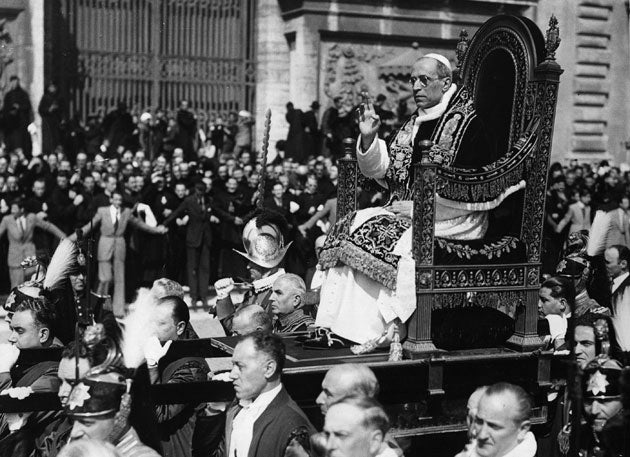
The "Pius Wars" that have long raged over the Vatican's desire to declare Pope Pius XII a saint flared up again over the weekend when the Jesuit priest in charge of the canonisation process declared that Pope Benedict XVI could not visit Israel until a disputed panel in Jerusalem's Holocaust museum, which refers disparagingly to Pius, is removed.
Pius XII, the austere, bespectacled Vatican diplomat who reigned from 1939 to 1958, has long been regarded by conservative Catholics as one of the greatest of modern popes. His claim to sainthood was opened by Pope Paul VI, "with the same sort of urgency and certainty", the Vatican journalist Robert Mickens said yesterday, "as when John Paul II opened the case for Mother Teresa".
But the Pius XII depicted in the Yad Vashem Holocaust Museum is a very different figure. Included among the "Unjust", those responsible directly or indirectly for the Holocaust, he is castigated on a large panel in the museum for his failure "to leave his palace, with crucifix high, to witness one day of pogrom". "When reports of the massacre of the Jews reached the Vatican," it goes on, "he did not react with written or verbal protests. In 1942, he did not associate himself with the condemnation of the killing of the Jews issued by the Allies. When they were deported from Rome to Auschwitz, Pius XII did not intervene."
"As long as that panel remains in the museum," Father Peter Gumpel said, "Benedict XVI cannot go to Israel because it would be a scandal for Catholics. The Catholic Church is doing everything possible to have good relations with Israel, but friendly relations can only be built if there is reciprocity."
A spokesman for the Israeli foreign ministry skirted the museum issue in his reply. "If Benedict XVI would like to visit Israel he would be a welcome and beloved guest," said Yossi Levy. "Pope Ratzinger has already been officially invited and whether he accepts or not depends entirely on his will."
But Sergio Itzhak Minervi, a former Israeli ambassador to Brussels and a historian, commented: "No moral entity, and least of all Yad Vashem, can treat these historical questions as if they were in a market, as Father Gumpel would wish: 'unless you cancel those phrases I don't come'. Let us be serious. History has need of proof, of documents, which the church would be well to show to the world."
At the crux of the dispute, as the museum caption states, is the failure of Pope Pius to make a protest of any kind, either verbally or in writing, as millions of Jews all over Europe were taken to the gas chambers. By the end of 1942, he had received reports of the ongoing murder of Jews from at least nine different countries where the Holocaust was under way, including Poland, Slovakia and Croatia. The British envoy to the Holy See, Sir D'Arcy Osborne, practically a prisoner inside the Vatican after the Nazi occupation of Rome, wrote in his diary late in 1942: "The more I think of it, the more I am revolted by Hitler's massacre of the Jewish race on the one hand, and, on the other, the Vatican's almost exclusive preoccupation with the ... possibilities of the bombardment of Rome."
By the following year, the Holocaust had arrived under the Pope's nose: in October 1943, more than 1,000 Roman Jews had been rounded up and were being processed for extermination in a military school a few hundred yards from the Pope's window. The Pope was personally warned by an Italian princess, Enza Pignatelli, who had managed to force a way into his study, about the imminent assault on the city's ancient Jewish community. "You must act immediately," she had told him. "The Germans are arresting the Jews and taking them away. Only you can stop them." He told her: "I will do all I can."
On 18 October, the day the 1,000 Jews were dispatched to Auschwitz in cattle cars, Osborne was received by the Pope. Pius remarked that "until now the Germans have always behaved correctly," respecting Vatican neutrality, but he hoped they would put more police on the streets.
Supporters of Pius claim that his silence was necessary: to protest would have exposed the church and Catholics across Europe to Nazi attack and made the Pope himself vulnerable. Thousands of Jews, they point out, were hidden and protected by individual priests and nuns. They also insist that Pius's canonisation is a purely internal matter for the Church. "For Benedict and other conservatives in the Church," says Mr Mickens, "Pius XII has for a long time been an iconic figure, a figure of reason and stability. They also like the fact that he was a staunch anti-Communist. They say that, if he had spoken out against the Nazis, he would have put even more lives in jeopardy."
But Robert Katz, author of several narrative histories of Rome during the Nazi occupation, said: "They argue that a lot of worse things would have happened if he had spoken. But what worse could have happened than did happen?"
He went on: "It's true that he did what he could to protect the Vatican, and it's true that there were many individual acts by Catholics to save Jews. But these were not ordered by the Vatican. If they made him a saint he would become a role model for Catholics worldwide. His deeds would be singled out for imitation and veneration; virtue would be found in a passivity that was sometimes indistinguishable from complicity before the acts of perpetrators of crimes against humanity."
The new row over Pius emerges exactly 50 years after his death. "His supporters are extremely frustrated," said Mr Mickens. "They were hoping that his canonisation would have happened by that anniversary." Instead even Pope Benedict, one of Pius's ardent admirers, is now calling for a truce. The issue of the museum caption was "important but not decisive," said his spokesman, Father Federico Lombardi. And regarding Pius's canonisation, the Pope "maintains that a period of deeper study and reflection is opportune."
Join our commenting forum
Join thought-provoking conversations, follow other Independent readers and see their replies
Comments