Troops gather on Georgian border
Less than a year after the enclave of South Ossetia erupted in war, this tinder box of the Caucasus is primed to flare up again, writes Shaun Walker
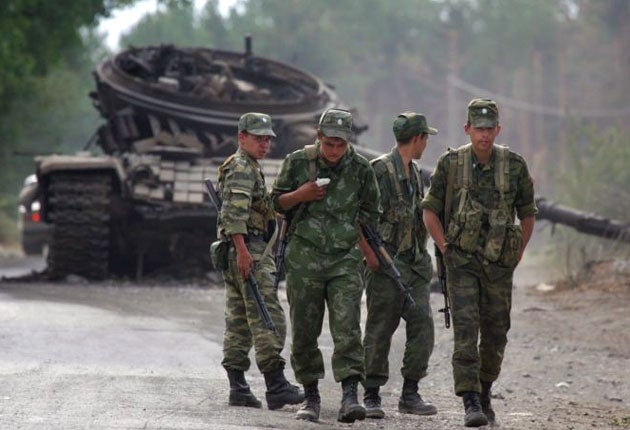
It's easy to see how things could spiral out of control: the two sides are braced for combat. At Ergneti on Georgia's border with South Ossetia, Georgian military police stand guard behind high barricades made of sandbags and two metre-high slabs of concrete. Out of sight barely 20 metres away, the forces of South Ossetia and Russia are mustered behind barricades of their own, their national flags fluttering.
The tranquility of the rolling green fields and lush vineyards belie it, but many fear that another summer war between Russia and Georgia like the one 11 months ago which killed hundreds of civilians is no more than a stutter of automatic gunfire away from breaking out. And if it happens, this standoff at Ergneti could be the flashpoint.
In the valley below is Tskhinvali, the South Ossetian capital. Today it shimmers in the heat but last August it was the epicentre of the war as the forces of the Russian Federation punished the Georgian army for asserting its right to rule the ethnically distinct entity of South Ossetia on its northern edge.
The tension is palpable. And the fear today is that this time, the Russian forces may carry out what last year they only threatened and topple the regime of the Western-leaning Georgian President, Mikheil Saakashvili.
Russian troops this week embarked on large-scale war games in the North Caucasus, just a few dozen miles away, preparation for "potential conflict situations in the region," the generals say. Similar exercises preceded the war last summer.
The mood at the Ergneti checkpoint is tense and the Georgian soldiers say there is absolutely no human contact between the two sides, despite the proximity. With the exception of a mangy stray dog, which wanders freely between the two posts, nobody is allowed to cross the border.
Locals need no reminding of how deadly a new war would be. In Ergneti itself, which before the war was home to about 200 people, only a few villagers have returned. Many houses here, and in other villages on the way to the Georgian city of Gori 20 miles away, suffered heavy damage from Russian aerial bombardment last August. The houses that remained standing were ruthlessly looted and torched by marauding Ossetian militias.
"I lost absolutely everything," says Gia Cheladze, 42, who has lived his whole life in Ergneti. With his family he escaped to Gori during the war. When he returned, he found his two-story house was a charred wreck. The windows and roof had been destroyed and everything of value looted. "I've worked hard all my life and in a couple of weeks it was all destroyed," he says.
He now lives with his elderly parents in a shack, beside the shell of his old house, a constant reminder of the threat of war. The money he received from the Georgian government was not enough to rebuild the house, and he claims that European aid distributed in the region was appropriated by a few families and then put up for sale.
Now, says Mr Cheladze, the villagers fear that their lives will be disrupted by war once again. "Everyone here is tense," he says. "This morning there was a huge explosion, I don't know where it came from. People say that 6 July is the day that something might happen. Maybe we'll leave for a few days around then; I can't bear yet another war."
Some Russian analysts dismiss the theory that Russia is looking for a new war and suggest that the Caucasus war games were a response to Nato military exercises which took place in Georgia recently and infuriated Moscow. There are some, however, such as Andrei Illarionov, a former adviser to Vladimir Putin, who say that Russia is looking to oust Mr Saakashvili permanently and may launch an invasion of the country on 6 July, the date that President Barack Obama makes his much-hyped first official visit to Moscow.
Mr Putin, now the Russian Prime Minister and still widely seen as the most powerful person in Russia, has a deep personal hatred of Mr Saakashvili and has expressed a desire to see him "hung by the balls".
"For Moscow it's quite galling to see that Saakashvili is still in power nearly a year after losing the war," says Lawrence Sheets, from the International Crisis Group in Tbilisi. "The statements coming out of Moscow with increasing regularity look very ominous."
Mr Sheets says the Georgian tactics in the event of an invasion by the Russian army are likely to revolve around guerrilla warfare and a defence of the capital, Tbilisi.
In a worrying sign, the Organisation for Security and Co-operation in Europe (OSCE), which has had a mission in South Ossetia for more than a decade and had been monitoring the border region since last summer's war, was forced to close its mission in Georgia this week. Russia had insisted that for the mission to continue, it must recognise South Ossetia's independence. Apart from Russia, only Nicaragua has recognised South Ossetia and Abkhazia – Georgia's other breakaway zone – as independent countries, with the rest of the world still insistent that they are separatist territories that are officially part of Georgia.
Unwilling to change the mission's status, the OSCE has had to shut down shop and its Finnish head of mission left the country for good on Tuesday morning. For the same reason, a UN mission in Abkhazia is closing down.
The departure of the OSCE is "hugely important symbolically and psychologically," says Mr Sheets. Georgian officials fear that without international observers in place, it will be easy for the Russians to launch an attack in response to supposed Georgian provocations. Russia has stationed thousands of troops in South Ossetia since last summer.
With the situation volatile, even if Russia is not actively seeking a new war, a minor spat or a stray bullet could lead to disastrous consequences in the region.
"I don't think people in Europe and the US really understand just how dangerous this situation is," says Mr Sheets. "It's very scary and very explosive."
In an interview with The Independent yesterday, Mr Saakashvili expressed his concern about the situation. "Of course I'm worried," he said. "The idea of invasion looks crazy if you apply normal political logic... but [the Russians] operate with the logic of a street bully."
Join our commenting forum
Join thought-provoking conversations, follow other Independent readers and see their replies
Comments
Bookmark popover
Removed from bookmarks