Why Sarkozy won't let Camus rest in peace
France's right-wing leader stands accused of political bodysnatching with a plan to move the author's remains to the Panthéon – burial place of the country's establishment
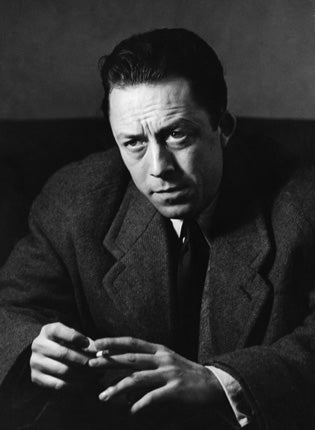
Albert Camus had the anguished good looks of a doomed film star, not a writer or philosopher. He died a doomed film star's death, aged 47, when his powerful car skidded on an icy road 100 miles south of Paris and struck a tree on 4 January 1960. Fifty years on, Camus – writer, resistance hero, philanderer and goalkeeper – remains one of the most popular of non-populist writers in the world, and one of the hardest to define. Leftist or libertarian? Novelist or existentialist philosopher? Courageous humanist or heartless womaniser?
Like the protagonist of one of his best-known books (L'Etranger), Albert Camus remains an outsider, and any attempt to interpret or categorise him can still cause trouble.
President Nicolas Sarkozy, an avid Camus reader since his youth, has blundered into this difficult territory. He wants to claim Albert Camus for the nation, by moving his body to the Panthéon in Paris, the last resting place of great Frenchmen (and of one great French woman). The suggestion has raised a wonderfully French intellectual storm. How dare a right-wing President try to snatch the body of a left-wing hero? (Camus, unlike his sometime friend Jean-Paul Sartre, was never truly a hero of the French left, but no matter). How dare the anti-intellectual President become an intellectual grave-digger and place the Great Outsider inside the secular temple of the Officially Great and Good?
Another, more moderate, storm may break over a television movie about the last decade of the writer's life, which will appear on the state-owned channel France 2 tomorrow. The film has had excellent advance reviews but has already irritated some Camus lovers by looking at the great humanist mostly through the prism of his tortured and often heartless relationships with women. (These ranged from his beloved, illiterate mother, to his suicidal wife, to his official mistress. They also included several other, simultaneous girlfriends).
The film-makers have consulted, amongst others, Olivier Todd, author of one of the best biographies of Camus and known to the over-sixties in Britain as a dashing BBC TV Paris correspondent in the 1960s. Todd believes that Camus should be remembered as the complex and contradictory man that he was: not as a humanist icon or symbol of a "noble soul" or even a philosopher.
Todd insists that Camus was "first and foremost" a writer, "a great craftsman", who sought to express the absurdity and mystery of life.
"At one point, he tried to express a very French, very literary kind of philosophy. He soon changed his mind. Very early on, he said: 'I am not an existentialist'."
Albert Camus remains, nonetheless, bracketed in the world's mind with Jean-Paul Sartre, who was for over a decade his rival, his friend and occasional companion in the then smoke-filled rooms of Paris Left Bank brasseries. Both men embraced, broadly speaking, the view that there was no absolute morality or truth, only those values or freedoms which human beings created for themselves.
The friendship broke up violently when Camus ridiculed, in print, the habit of French intellectuals, including Sartre, of equating "liberty" with communism.
Camus, born into a poor white family in Algeria, also angered the French left by refusing to take the side of the violent anti-colonial movements in the 1960s. He did not support the violent white colonists either, but called, perhaps naively, for the French army and the Arab independence movements to fight to the death while leaving civilians in peace.
Camus has become, especially outside France, a kind of anti-Sartre. Where Jean Paul was ugly, Albert was handsome. Where Jean-Paul wrote books during the Nazi occupation, Albert joined the Resistance. Where Jean-Paul pursued (and then dropped) the strange gods of Stalinism, Maoism and political violence, Albert remained steadfastly anti-totalitarian and anti-violence.
Within France, until relatively recently, leftish-dominated intellectual thought has preferred Sartre to Camus. The Centre Albert Camus in Aix-en-Provence, which holds the writer's papers, attracts far more foreign researchers than French ones.
Camus remains one of the most-read writers in France, but he was – until recently – patronised in academic circles as a "teenage" writer, a source of "set books" for schoolchildren rather than a subject for advanced study.
Marcelle Mahasela, who runs the Camus centre, says that the problem was that he was too much of a free thinker for the alleged left-wing free thinkers. "He did not defend the accepted system of thought," she said. "He upset the French rationalism of the day and could not be placed in a clear category."
There are signs, however, that he is finally being taken seriously in France, not as a philosopher but, as Todd suggests, a great writer. The 50th anniversary of his death has produced a land-slip of academic books and also – the final apotheosis in France – a bande-dessinée (cartoon book) on his life.
Camus was born in Mondovi in what was then French Algeria in 1913. His father was killed the following year in the Battle of the Marne. His illiterate and partially deaf mother worked as a cleaner.
Albert's talent was recognised by a teacher and he went on to study at the University of Algiers, where he played in goal for the university football team. He later declared, to the disgust of anti-sporting intellectuals, that he learnt everything that he knew about life and humanity while standing in the goalmouth.
After working as a journalist and then joining the Resistance during the war, he became a writer. His reputation is largely based on three novels, L'Etranger (The Stranger or the Outsider, 1942), La Peste (The Plague, 1947) and La Chute (The Fall, 1956).
The question of whether the Outsider should become one of the ultimate Insiders of French life remains unresolved. The decision on whether his body should be removed to the Pantheon rests with his family and especially his daughter Catherine Camus, who manages his literary estate. She said this week that she had not yet decided. She complained, however, that those people who accused Mr Sarkozy of "using" her father were also "using my father as an anti-Sarkozy missile".
On the whole, she suggested, she could see no reason why Albert Camus should not be honoured as one of the great French storytellers, alongside Victor Hugo and Emile Zola. "My father is a very approachable writer. People feel close to him," she said. "He asks the questions which are at the heart of our existence."
Join our commenting forum
Join thought-provoking conversations, follow other Independent readers and see their replies
Comments
Bookmark popover
Removed from bookmarks