A coup for Maliki and a secular Iraq
Voters have rebuffed religious parties – and cemented the power of the country's Prime Minister, reports Patrick Cockburn
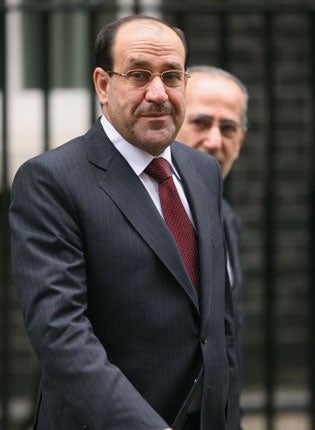
The Iraqi Prime Minister, Nouri al-Maliki, who seemed weak and isolated a year ago, appears to have won a sweeping victory in the Iraqi provincial elections that will strengthen his hold on central government. For the first time since the fall of Saddam Hussein, according to preliminary results, Iraqi voters chose secular and nationalist parties over their religious rivals.
Mr Maliki's Dawa party is predicted to emerge at the top of the poll in Baghdad and Basra, Iraq's two largest cities, as well as in most of the overwhelmingly Shia south of Iraq. The largest Shia party, the Islamic Supreme Council of Iraq (ISCI), hitherto one of the main powerbrokers in the country, suffered heavy losses in all the provinces where it has been in charge for the past four years. "According to initial information, Maliki's list has come first in Basra with 50 per cent of the vote. Ours took 20 per cent," said Furat al-Sheraa, the head of ISCI in Basra.
The outcome of the election, which will probably be repeated in the parliamentary elections in December, marks a sea-change in Iraqi politics, with both the Shia and Sunni communities punishing the religious parties which flourished after the US occupation in 2003. The results are a clear endorsement of Mr Maliki who has managed to displace the militia of the Shia cleric Muqtada al-Sadr, negotiated the withdrawal of 142,000 US troops during the next three years and confronted the Kurds. By stressing his nationalist credentials and success in improving security, Mr Maliki has gained the allegiance of the majority Shia community.
The disillusionment with overtly religious parties among the Shia has been mirrored in the Sunni Arab community where the Iraqi Islamic Party had apparently been defeated by other Sunni parties in two Sunni bastions, Mosul in northern Iraq and Anbar province in the west. Many Iraqis blame the religious parties for fostering sectarian differences between Shia and Sunni and taking an active part in the sectarian civil war in 2005-7.
A further sign of a shift towards secularism and nationalism is that preliminary reports of the poll show that the former prime minister Iyad Allawi, whose party is overtly nationalist, has done well in both Sunni and Shia provinces in all parts of the country. In the last election in January 2005, Mr Allawi, although Prime Minister at the time, did poorly despite being in control of the government.
Mr Maliki has used his control of the state machinery to garner political support through patronage and subsidies. He funnelled money to tribal councils in southern Iraq in return for votes and used government-controlled media to support Dawa. But this would not have been enough to win the election so decisively if many Iraqis had not thought the Prime Minister was restoring order.
Mr Maliki's success resembles that of Vladimir Putin when he was first elected Russian President by an overwhelming margin in 2000. Mr Putin was seen as a strong nationalist who would end the chaos of the Yeltsin era after the collapse of the Soviet Union. Iraqis are likewise eager to see central government authority restored so they can have personal security, jobs, electricity and water. The Iraqi state is also similar to Russia in its reliance on oil revenues which pay the salaries of some two million government employees. The ability to dole out jobs to supporters will have played an important role in Mr Maliki's success.
The provincial elections have led to significant changes in the balance of power in other parts of Iraq. In Nineveh province, whose 2.7 million people are mostly Sunni Arabs, the Kurds make up between a quarter and a third of the population but have been in effective control since a Sunni uprising in 2004. They also had a majority on the local council because the Sunni boycotted the poll in the January 2005 election. But the winner on Saturday was al-Hadba, a nationalist and tribal coalition, whose leader claims to have won 60 per cent of the vote. This Sunni success will make it more difficult for Kurdish parts of the province to join the near-independent Kurdish autonomous region.
In Anbar province, the cities and towns along the Euphrates river appear to have voted for the Awakening Movement, made up of former insurgents against the US occupation who switched sides in order to fight al-Qa'ida, though this is contested. In general, Iraqi voters want to get rid of those who they see as having misruled them at a local level since the last election.
The survivor who outran Saddam
Nouri Kamal al-Maliki is nothing if not lucky. He belongs to a political party, Dawa, many of whose members were executed by Saddam Hussein. He was one of the few survivors. When he became Prime Minister in April 2006, the US embassy was not even sure of his real name. Written off by many as ineffectual, he held on to office largely because no suitable replacement could be found. But in 2008 he saw off most of his domestic rivals and the US in a series of confrontations, and now seems set to turn his personal popularity into victory at the polls.
Mr Maliki was born in 1950 in the town of Abu Gharaq, south of Baghdad, the son of a teacher. He joined Dawa, the underground Shia political party, but it was savagely persecuted by Saddam and he was forced to flee to Syria in 1979. He remained there until 2003, becoming head of the party's Damascus branch, but had good relations with Iran.
On his return to Iraq after the US occupation, the first Iraqi prime minister, Ibrahim al-Jaafari, was removed after a year at the insistence of the US and the Kurds. Mr Maliki replaced him as a compromise candidate.
At first his government seemed to drift, but over the last year the Iraqi state was largely restored to its old strength and Mr Maliki was successively able to confront the Mehdi Army militia, the Kurds and the US.
Join our commenting forum
Join thought-provoking conversations, follow other Independent readers and see their replies
Comments
Bookmark popover
Removed from bookmarks