A massacre of arabs masked by a state of national amnesia
Sixty years on, the true story of the slaughter of Palestinians at Deir Yassin may finally come out
More than one unwitting visitor to Jerusalem has fallen prey to the bizarre delusion that they are the Messiah. Usually, they are whisked off to the serene surroundings of Kfar Shaul psychiatric hospital on the outskirts of the city, where they are gently nursed back to health.
It is an interesting irony that the patients at Kfar Shaul recuperate from such variations on amnesia on the very spot that Israel has sought to erase from its collective memory.
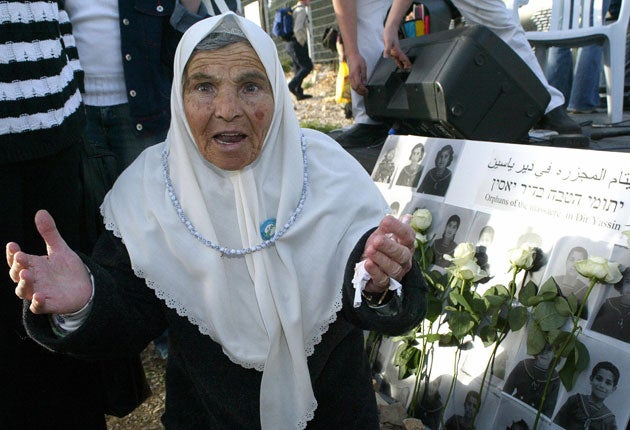
The place is Deir Yassin. An Arab village cleared out in 1948 by Jewish forces in a brutal battle just weeks before Israel was formed, Deir Yassin has come to symbolise perhaps more than anywhere else the Palestinian sense of dispossession.
Sixty-two years on, what really happened at Deir Yassin on 9 April remains obscured by lies, exaggerations and contradictions. Now Ha'aretz, a liberal Israeli newspaper, is seeking to crack open the mystery by petitioning Israel's High Court of Justice to release written and photographic evidence buried deep in military archives. Palestinian survivors of Deir Yassin, a village of around 400 inhabitants, claim the Jews committed a wholesale massacre there, spurring Palestinians to flee in the thousands, and undermining the long-held Israeli narrative that they left of their own accord.
Israel's opposing version contends that Deir Yassin was the site of a pitched battle after Jewish forces faced unexpectedly strong resistance from the villagers. All of the casualties, it is argued, died in combat.
In 2006, an Israeli arts student, Neta Shoshani, applied for access to the Deir Yassin archives for a university project, believing a 50-year embargo on the secret documents had expired eight years previously. She was granted limited access to the material, but was informed that there was an extended ban on the more sensitive documents. When a lawyer demanded an explanation, it emerged that a ministerial committee only extended the ban more than a year after Ms Shoshani's first request, exposing the state to a legal challenge. The current embargo runs until 2012.
Defending its right to keep the documents under wraps, the Israeli state has argued that their publication would tarnish the country's image abroad and inflame Arab-Israeli tensions. Ha'aretz and Ms Shoshani have countered that the public have a right to know and confront their past.
Judges, who have viewed all the archived evidence held by the Israeli state on Deir Yassin, have yet to make a decision on what, if anything, to release. Among the documents believed to be in the state's possession is a damning report written by Meir Pa'il, a Jewish officer who condemned his compatriots for bloodthirsty and shameful conduct on that day. Equally incriminating are the many photographs that survive.
"The photos clearly show there was a massacre," says Daniel McGowan, a US retired professor who works with Deir Yassin Remembered. "Those photos show [villagers] lined up against a quarry wall and shot."
In 1947, the United Nations proposed a partition plan that would divide Palestine into a Jewish and Arab state, with Jerusalem an international city. The Arabs fiercely opposed the plan and clashes broke out as both sides scrambled for territory before the British mandate expired. In April 1948, the Hagana, the predecessor of the Israeli army, launched a military operation to secure safe passage between Jewish areas by taking Arab villages on high ground above the road to Jerusalem.
Irgun and the Stern Gang, breakaway paramilitary groups, drew up separate plans to take the strategic Deir Yassin in a pre-dawn raid on 9 April 1948, even though the villagers had signed a non-aggression pact with the Jews and had stuck to it. What happened next is still under debate. In his book The Revolt, Menachim Begin, a future Israeli prime minister, recounts how the Jewish forces used a loudspeaker to warn all the villagers to leave the village. Those that remained fought.
"Our men were compelled to fight for every house; to overcome the enemy they used large numbers of hand grenades," wrote Mr Begin, who was not present at the battle. "And the civilians who had disregarded our warnings suffered inevitable casualties. I am convinced that our officers and men wished to avoid a single unnecessary casualty."
Mr Begin's account, however, is challenged by the recollections of survivors and eyewitnesses. Abdul-Kader Zidain was 22 years old in 1948, and immediately joined a band of 30 fighters from the village to fend off the surprise Jewish offensive, even though they were clearly outnumbered.
"They went into the houses and they shot the people inside. They killed everybody they saw, women and children," said Mr Zidain, who lost four of his immediate family, including his father and two brothers, in the attack. Now a frail 84-year-old living in a West Bank village, he says he remembers everything as if it were yesterday. Survivor testimonies are supported by Mr Pa'il, whose detailed eyewitness account was published in 1998. Awaiting reassignment, he went to observe the attack as part of his remit to keep the Irgun and the Stern Gang in check.
After the fighting had wound down, Mr Pa'il described how he heard sporadic firing from the houses, and went to investigate. There he saw that the soldiers had stood the villagers in the corners of their homes and shot them dead. A short while later, he saw a group of around 25 prisoners being led to a quarry between Deir Yassin and neighbouring Givat Shaul. From a higher vantage point, he and a companion were able to see everything and take photographs. "There was a natural wall there, formed by diggingy. They stood the prisoners against that wall and shot the lot of them," he said. Mr Pa'il described how Jews from neighbouring Givat Shaul finally stepped in to stop the slaughter.
In the ensuing confusion and anger over the killings in Deir Yassin, both sides released an inflated Palestinian death toll for very different reasons: the Palestinians wanted to bolster resistance and attract the attention of the Arab nations they hoped would help them; the Jews wanted to scare the Palestinians into flight.
After the dust had settled, Mr Zidain and the other survivors counted the missing among them, and concluded that 105 Palestinians had died in Deir Yassin, not the 250 often reported. Four Jews were killed. But the damage was already done. The reports from Deir Yassin led to a total collapse of morale, and many historians regard the incident as the single biggest catalyst for the Palestinians' flight. By UN estimates, 750,000 Palestinians had fled their homes by the end of the 1948 War of Independence, roughly 60 per cent of Palestine's pre-war Arab population.
Mention Deir Yassin these days to most young Israelis and it will fail to register. Not far from the Kfar Shaul hospital, two teenage boys shake their heads at a question on Deir Yassin. Never heard of it, they say.
"Most Israelis treat the subject with total silence," says Professor McGowan. "They no longer deny it, they just don't talk about it."
The decision on whether that silence will now be broken remains in the hands of Israel's courts. "This was a big and important event in our history here. It was the first village we took and has a lot of meaning in the war that came after," says Ms Shoshani. "We have to deal with our past for our own sake."
Join our commenting forum
Join thought-provoking conversations, follow other Independent readers and see their replies
Comments