'Ahmadinejad has enough uranium to go whole way'
Senior US official says secret facility is right size to make 'bomb or two a year'
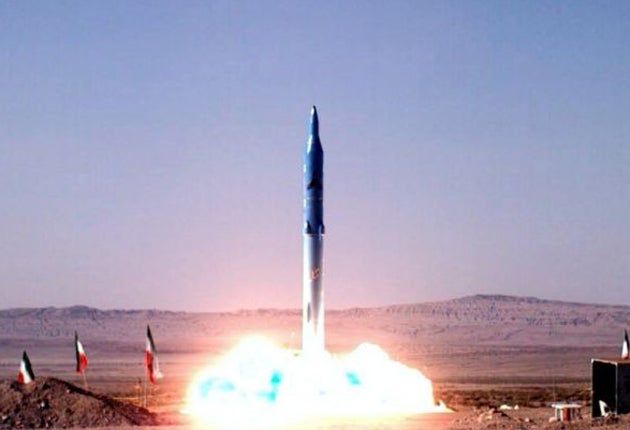
The crisis in relations with Iran escalated ominously yesterday after the leaders of the US, Britain and France accused the regime in Tehran of operating a secret uranium enrichment facility buried deep in a mountain bunker near the ancient religious city of Qom. Barack Obama called Iran's activity "a direct challenge" to the international community.
The accusations were made public in an extraordinary joint statement by the US President, flanked by Gordon Brown and the French President, Nicolas Sarkozy before the start of the G20 economic summit in Pittsburgh.
Iran had previously insisted that its plant at Natanz, which is open to international inspection, was the only one involved in enrichment. The new revelation sharply raises the stakes at a time when Israel has been signalling that military strikes against Iran are on the table.
Iran's first response was one of familiar defiance. "If I were Obama's adviser, I would definitely advise him to refrain from making this statement because it is definitely a mistake," President Mahmoud Ahmadinejad said in an interview with Time magazine in New York.
Western sources said the plant at Qom, 120 miles south-west of Tehran, is not yet operational. But it is designed to hold about 3,000 centrifuge machines, which would provide the uranium needed to produce one atomic bomb a year. "Iran has enough uranium to go the whole way," one Western diplomat said. A senior US official said that number of centrifuges could not produce enough uranium to make sense commercially for power generation. "But if you want to use the facility to produce a small amount of weapons-grade uranium, enough for a bomb or two a year, it's the right size."
He stressed that making a bomb was "still some way off" but that the plant gives Iran "more options." French officials said the secret plant was in a "heavily protected" area under the control of the Revolutionary Guards loyal to Ayatollah Khamenei and President Ahmadinejad.
If nonplussed that the plant's cover has been so dramatically blown, Iran's President insisted his government was in compliance with the rules of the International Atomic Energy Agency. "This does not mean we must inform Mr Obama's administration of every facility that we have," he said. Mr Obama's claim "simply adds to the list of issues to which the United States owes the Iranian nation an apology over".
Later, Mr Ahmadinejad softened his tone telling reporters that Iran was in fact ready to give international inspectors access to the Qom facility. "We have no fears," he said.
Yet for Mr Obama, the revelation will bolster the case for tougher sanctions on Iran, if its regime does not bend now to calls for enrichment to stop. It also ratchets up tensions significantly on the eve of talks scheduled next Thursday in Geneva between the regime and six world powers, including Britain, the US and Russia.
"The Iranian government must now demonstrate through deeds its peaceful intentions or be held accountable to international standards and international law," Mr Obama said. His French and British peers portrayed even deeper indignation. "The level of deception by the Iranian government and the scale of what we believe is a breach of international commitments, will shock and anger the whole international community and it will harden our resolve," Mr Brown said, adding that it was time to "draw a line in the sand". He went on: "This is the third time they have been caught red-handed, not telling the truth."
Mr Sarkozy set a deadline of December for Iran to put everything on the table and provide proof that it is not attempting to weaponise nuclear technology. New sanctions could include a ban of the sale of refined petrol to Iran, which could seriously harm the regime but also hurt much of the population
British intelligence agencies played a "big part" in uncovering the plant, working closely with their American and French counterparts, diplomats said. The intelligence has been shared with Israel, but British sources are playing down the prospect of military action. One said: "We are a long way from that. We have no interest in a military operation against Iran or anybody undertaking such an operation."
Even as Mr Ahmadinejad was speaking to Time, his officials in Tehran were acknowledging the plant's existence. "In order to preserve its definite rights [in] the peaceful use of nuclear energy, Iran has taken a successful step and created a semi-industrial plant to enrich nuclear fuel," Ali Akbar Salehi, its nuclear energy agency chief, said in a statement.
Iran insists its enrichment programme is for civilian purposes and other countries have no right to interfere. But Western governments have long doubted this. British sources said the intelligence on Qom specifically suggests it is not consistent with plans for electricity generation.
US officials said that Western intelligence had found out about the Qom plant several months ago and that Mr Obama had been briefed on it even before he took office. Exactly how they cracked the wall of secrecy erected by Iran around it has not been divulged.
Iran itself then became aware that the West had got wind of the concealed plant. On Monday, it sent a cryptic letter to the IAEA in Vienna in which it spoke for the first time of a "pilot uranium enrichment plant" in addition to the one at Natanz. It added that additional information would be furnished to the agency in due course.
All this off-stage drama was unfolding just as world leaders were gathering first for the UN General Assembly in New York and then in Pittsburgh for the G20 summit. Mr Ahmadinejad, last night cancelled a press conference he had been scheduled to give at the UN before leaving New York.
The game had already moved on after the Russian President, Dmitry Medvedev, signalled that Moscow was dropping its opposition to new sanctions against Iran. The switch was attributed to Mr Obama's decision a week ago to drop the US anti-missile shield in eastern Europe. But a senior US administration official revealed that the information about Qom was shared by Mr Obama with President Medvedev during a bilateral meeting in New York on Wednesday. That may have helped modify Mr Medvedev's thinking.
Iran fights back: President tells US it's making 'a big mistake'
President Mahmoud Ahmadinejad fought back against claims of illegal concealment last night, saying that it was the United States that should be apologising to Iran and that Barack Obama was making a big mistake which would ultimately play into the Islamic Republic's favour.
In an interview with Time magazine, which took place as the US President was ratcheting up pressure on him from Pittsburgh, Mr Ahmadinejad shrugged off accusations of a secret underground second nuclear facility. "If I were Obama's adviser, I would definitely advise him to refrain from making this statement because it is definitely a mistake. It would definitively be a mistake," he told Time editors in New York, where he had been attending the UN General Assembly.
"We have no secrecy, we work within the framework of the IAEA [International Atomic Energy Agency]," he added. "This does not mean we must inform Mr Obama's administration of every facility that we have."
Far from seeming contrite, Mr Ahmadinejad went on the offensive saying that by bringing up the uranium facility, the US President, "simply adds to the list of issues to which the United States owes the Iranian nation an apology over. Rest assured that this will be the case. We do everything transparently".
Mr Ahmadinejad also hinted that the attack by the US, France and Britain might be just the thing around which his deeply fractured nation might rally.
Join our commenting forum
Join thought-provoking conversations, follow other Independent readers and see their replies
Comments