Aid group condemns armed raid on its Bahrain offices
Police raided the MSF office in Manama because it was running an unlicensed medical centre
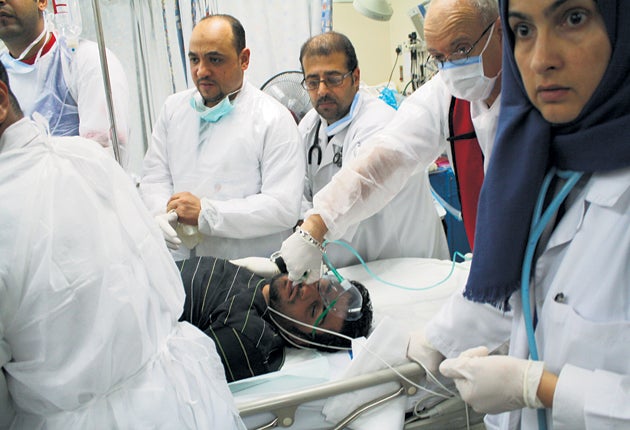
The Bahraini authorities have defended an armed raid on the offices of Médecins Sans Frontières, saying that it lacked the required permission to work in the capital, Manama. The respected aid group has condemned the raid as "unwarranted and unacceptable". One of its employees was arrested in the search, and its medical equipment and supplies were all confiscated.
The raid will raise questions over MSF's ability to continue operating in the tiny Gulf island kingdom, home to 1.2 million people, where the government has been accused of systematically targeting medical professionals in retaliation for helping people injured in the month-long pro-democracy protests earlier this year.
Protesters, most of them members of the country's Shia majority, took to the streets in mid-February, calling for political reform and an end to discrimination by the ruling Sunni minority. Troops were brought in from neighbouring Saudi Arabia to help the Bahraini authorities quash the protests.
The unrest rattled the Sunni monarchy, which cracked down on Shia civilians, laying siege to hospitals and clinics, razing mosques and arresting hundreds of alleged activists. But it has so far largely refrained from turning its ire on international aid bodies. In an angry missive, MSF claimed that armed security forces stormed its offices on 28 July, damaging property, confiscating computers, medical supplies and equipment, and files.
Saeed Mahdi, a volunteer driver and translator for the organisation, was arrested for calling the emergency services a day earlier to send an ambulance for a man with a serious head injury who had walked into the office. An MSF doctor provided first aid on the spot.
Bahrain's health ministry claimed that the organisation was running an unlicenced medical centre. MSF countered that it had always been entirely open with the authorities regarding its activities in the country.
The authorities also claimed that Mr Mahdi had tried to conceal his affiliation with the aid group, initially by claiming to be a bystander. He faces charges of supplying false information to the police and providing medical services without a licence.
The crackdown on medical professionals has left relations with the authorities increasingly strained, and many protesters who require urgent medical attention have avoided Manama's hospitals for fear of arrest.
MSF said it had treated around 200 people since February who, if they had gone to a state hospital, would probably have been arrested on suspicion of going on protests. "Hospitals have become a place to be feared," John Whittall, the head of MSF's mission in Bahrain, told The Independent in June. "The situation was so bad some people didn't dare come to the hospital – in some cases, people had no access to healthcare."
In March, the military seized control of the main hospital, Salmaniya, which had become a rallying point for protesters. Injured patients suspected of demonstrating were taken to a separate floor, where they were repeatedly interrogated and beaten, staff claimed. Doctors also claim that some of patients subsequently disappeared.
For medical staff, the situation has been equally fraught, and doctors working at Salmaniya have been particularly singled out. Some of the staff enraged the government by apparently sympathising with the protesters' cause and telling the press about their injuries.
In June, 24 doctors and 23 nurses from the hospital were put on trial, and in a lengthy charge sheet, were accused of "hijacking" the building, hiding weapons, exacerbating the injuries of the wounded, refusing to treat Sunni Muslims, and inciting protests against the regime. Families of the defendants claimed the doctors were tortured to extract their confessions, a claim the authorities denied.
International censure of Bahrain, home to the US Fifth Fleet, has so far been muted compared with that of other Middle-Eastern regimes which have suppressed dissent. Nevertheless, Bahrain's ruler, King Hamad bin Issa al-Khalifa, recently bowed to pressure to appoint an independent commission to investigate the unrest. It must present its findings to the king by the end of October.
Who are Médecins Sans Frontières
Médecins Sans Frontières (Doctors Without Borders) was founded in 1971 by a group of French doctors and journalists in the wake of the Nigerian civil war. Frustrated by governmental interference in humanitarian aid efforts, they sought to provide an independent, secular and impartial medical service for victims of conflicts and natural disasters.
Around 27,000 doctors, nurses, epidemiologists, lab technicians, mental health professionals and administrators work for MSF in 60 countries. Work in the field is often dangerous; five MSF workers were assasinated in Afghanistan in 2004, three were killed by a road bomb in Somalia in 2008 and two more died in Pakistan a year later.
Some 90 per cent of MSF's funding comes from private patrons. In 2008, it had around 3.7 million donors. In 2010, it raised around $138m for its Haiti earthquake relief efforts alone. MSF launched its first large-scale medical programme when Cambodians began fleeing the Khmer Rouge regime in 1975, and has since worked in Lebanon, Afghanistan, Gaza, Haiti, Iraq and Somalia among many others. It was awarded the Nobel Peace Prize in 1999.
Enjoli Liston
Join our commenting forum
Join thought-provoking conversations, follow other Independent readers and see their replies
Comments
Bookmark popover
Removed from bookmarks