Al-Sadr holds key to power in Iraq
Shia cleric leads referendums that could see Nouri al-Maliki deposed as PM
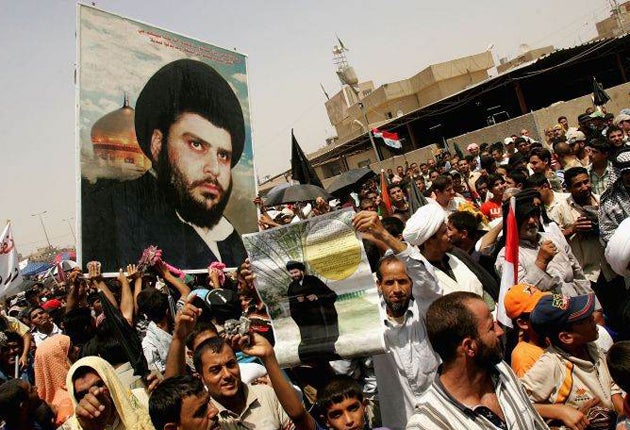
In a demonstration that the Shia cleric Muqtada al-Sadr is Iraq's new political kingmaker his supporters are holding a referendum today and tomorrow to choose the next Iraqi prime minister.
The referendum has no legal standing but it shows the confidence of the Sadrists after they unexpectedly won at least 39 seats in the 325-member Iraqi parliament. They have demanded that prime minister Nouri al-Maliki step down as the price of their support for a government led by his party.
People are being asked to cast their votes in al-Sadr offices, mosques and other sites, but balloting is only likely in places where the Sadrists are strong. The movement has its core support among the urban Shia poor, particularly in Sadr City with a population of two million in east Baghdad.
The decision to hold the referendum shows that Mr Sadr is more guileful and politically astute than his critics give him credit for. "It's symbolic and populist and trying to display a measure of strength," Michael Hanna, an Iraq analyst based in New York, told the Associated Press. "[It says that] our position is a reflection of the will of the people," said Mr Hanna.
Mr Sadr's promise that his movement would be bound by the result in its choice of prime ministerial candidate marks it out as more democratic than the other parties, which are notorious for the secret negotiation of deals to divide up the spoils of office.
The election result proved that Mr Sadr retains his support in the working class Shia slums and was able to get them to the polls. His success showed that his popularity had recovered from military defeat in 2008 when his Mehdi Army militia was crushed in its strongholds of Baghdad, Basra and Amara by the Iraqi army backed by American forces.
Mr Sadr, who is still only 36, has always been a wild card in Iraqi politics, less because of personal or political volatility than the tendency of his opponents to underestimate him. He appeared to come from nowhere in 2003 when his followers seized much of southern Iraq in the wake of the US invasion that he adamantly opposed.
His political strength at this stage sprang from the reverence with which the al-Sadr family is regarded by Shia – as martyrs who died for their faith in opposing Saddam Hussein. His father Mohammed Sadiq al-Sadr launched a mass movement in the 1990s which combined religion, nationalism and populism. When he became too powerful he and two of Mr Sadr's brothers were assassinated by the regime's gunmen in Najaf in 1999.
Though Mr Sadr is often described as a "maverick" and "firebrand cleric" by foreign media he has always shown himself politically cautious and astute. He survived the years after his father's murder by persuading Saddam Hussein that he posed no threat. He was the only important Shia leader overtly to oppose the American occupation from the beginning and when the US authorities threatened to arrest him in 2004 he responded with an uprising led by his Mehdi Army militia which seized most of southern Iraq. His forces twice fought bloody battles with US troops for control of the Shia holy city of Najaf.
The Mehdi Army became an umbrella organisation for Shia gunmen and gangsters of all sorts during the savage Sunni-Shia civil war in 2006-07. Mr Sadr admitted that he scarcely controlled its activities and in 2007 called a ceasefire. He himself retreated to the Iranian holy city of Qom to pursue religious studies, and said his movement would in future be political rather than military.
Much criticised by his own followers for not resisting the Iraqi army more forcibly in 2008, Mr Sadr appears to have realised that Iraqis were fed up with ill-disciplined militiamen ruling the streets. He has also been careful since the battles for Najaf in 2004 to avoid a direct confrontation with American forces, though he continually demands their withdrawal.
Showing great political flexibility Mr Sadr last year entered a political coalition called the Iraqi National Alliance with his traditional rivals, the Islamic Supreme Council of Iraq. ISCI has usually represented the Shia mercantile and shopkeeper class. Mr Maliki's political calculations were based on the assumption that the INA would fail in the elections, and rejected an Iranian-backed alliance with them. In the event the INA won 70 seats, a clear majority going to the Sadrists while ISCI did humiliatingly badly.
Mr Sadr so far shows no signs of going back to Iraq. His aides say he will not return until the last US troops have left at the end of 2011. His political rebirth means that any delay in the US departure, never likely, can now be ruled out. His success also means an increase in Iranian influence in Iraq, though the Sadrist family tradition is to treat Iran warily.
It would be difficult for the Sadrists to reach an accommodation with Iyad Allawi and his Iraqiya bloc because it is mainly Sunni and only 15 out of his 91 members of parliament are reported to be Shia. At the same time Mr Sadr is eager to live down his movement's reputation among Sunni for being a glorified Shia death squad. Senior aides have said that Mr Allawi should have a senior position within any new government. Not surprisingly ever since the election Iraqi ministers have been scurrying to pay court to Sadrists whom they were previously trying to jail.
Join our commenting forum
Join thought-provoking conversations, follow other Independent readers and see their replies
Comments