Arab Spring claims its third despot
Sanaa, Yemen 05.06.11 - Thousands throng streets as President flees and regime totters
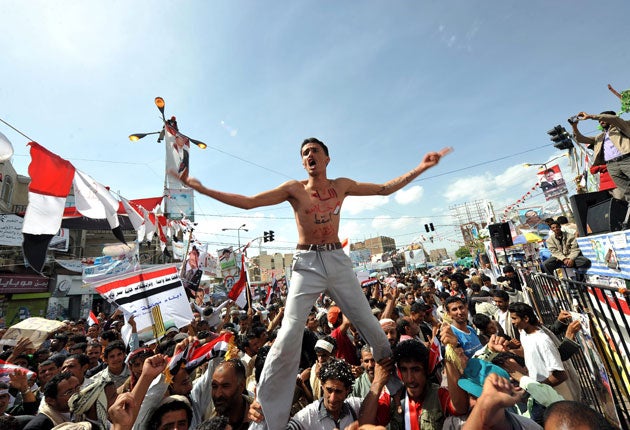
The uprisings sweeping the Arab world appeared to have won their third victory over authoritarian rule by overthrowing President Ali Abdullah Saleh of Yemen after 33 years in power. He left for Saudi Arabia on Saturday to be treated for injuries received in an explosion in his presidential palace and is unlikely to return.
Thousands of people danced and sang and slaughtered cows in the streets of the capital Sanaa yesterday as news spread that Yemen had joined Tunisia and Egypt in ousting a widely detested leader who had controlled the state for decades. Anti-Saleh demonstrators held up signs saying "Yemen is more beautiful without you" and "Name: A Free Yemen. Date of birth: June 4, 2011".
Women in black joined swelling numbers of jubilant demonstrators. One placard carried by them read: "The oppressor is gone, but the people stay." Soldiers joined in the dancing and singing and were hoisted on to the shoulders of the crowds. President Saleh, in power since 1978, has not formally ceded power, but it is unlikely that the forces he commanded will hold together without his presence or that Saudi Arabia will let him return. There are unconfirmed reports that senior government ministers and top officials close to him were trying to board flights out of the country from Sanaa airport.
A senior official from the ruling party said Mr Saleh would be back within "days" amid reports he had awoken from successful surgery to remove shrapnel from his chest, but the roaring crowds were disinclined to believe him. "If Saleh comes back, we'll be ready for him," shouted Abdul Muein Asbahi, as he fired confetti into the air.
The uprising in Yemen started on 27 January inspired by pro-democracy anti-government demonstrations in Tunisia and Egypt and took over a square in the capital. The government organised counter-demonstrations and repression became increasingly violent. On 18 March, government snipers shot dead 52 protesters leading to the defection of senior army officers and important tribal leaders, who pledged to defend the protesters.
Saudi Arabia and the US have been trying to arrange a smooth transition and prevent a vacuum of power which Washington fears might be used by al-Qa'ida in the Arabian Peninsula (AQAP) to expand its influence. President Saleh had been deft in publicising the presence of AQAP fighters to extract financial aid and weapons, though his critics said he exaggerated and manipulated the Islamic fundamentalist threat. He agreed three times to a US-backed Gulf Arab mediation under which he would step down but reneged on the deals.
There has been growing violence in Sanaa, the second city Taiz and other Yemeni cities in recent weeks between pro and anti-Saleh forces that threatened to develop into a civil war. But last night, the acting president Abdel Rabbo Mansour Hadi, who took over after President Saleh left the country, agreed a day-long truce with the so-called Ahmar group, which is part of the powerful Hashid tribal federation. Government troops are to withdraw from Sanaa, where the Ahmars have their headquarters.
A civil war may be avoided because, although a power vacuum may develop, the state has been traditionally feeble in Yemen and leaders are used to coping with the lack of government authority. The 24 million people are said to own about 60 million weapons, which means small-scale fighting is common, but so too are truces.
The success of the pro-democracy protests in Yemen would not have happened if the political elite was not itself split. Until the end, President Saleh had the loyalty of military units commanded by his close relatives. These are now negotiating to see how far they will have a role in any new regime.
The departure of President Saleh, who is in his late 60s, came after a devastating explosion in a mosque in the presidential compound where he was attending Friday prayers. He is reported to have been hit in the chest by pieces of wood, but the exact nature of his wounds is still unclear. The blast killed 11 of his bodyguards and wounded five senior officials. The government said his wounds were light, but his failure to appear on television led to speculation that they were severe. When he did finally speak it was on radio when he claimed, in a weak voice, that tribal rivals were behind the attack.
It was first announced that a rocket had struck the mosque but there is speculation in Sanaa that it is more likely that such a precisely targeted explosion was the result of a bomb planted by insiders within the regime.
Though President Saleh's presence in hospital in Riyadh decapitates the regime politically, his son Ahmed, commander of the presidential guard, remains in Sanaa, as do two nephews and two half-brothers, also commanders of elite units. They are strong enough to defend themselves, but without President Saleh's presence are unlikely to be able to maintain their grip on government.
Join our commenting forum
Join thought-provoking conversations, follow other Independent readers and see their replies
Comments
Bookmark popover
Removed from bookmarks