Bahrain and Yemen declare war on their protesters
With 42 killed in Sanaa, regimes show they will keep power at any cost
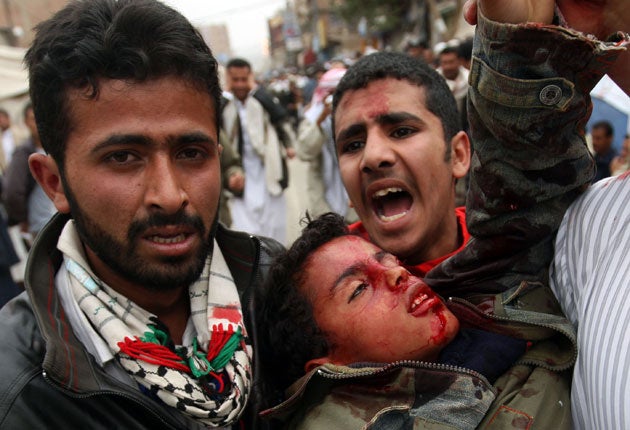
Abrutal counter-revolution is sweeping through the Arabian Peninsula as Bahrain and Yemen both declare war on reform movements and ferociously try to suppress them with armed force.
In Yemen police and snipers on rooftops opened fire on Friday on a mass demonstration outside the main university, killing at least 42 people. The government has since declared martial law and set up checkpoints throughout the capital, Sanaa.
In Bahrain repression began a few days earlier, when King Hamad bin Isa al-Khalifa called for military support from other Gulf monarchs and 1,000 troops from Saudi Arabia crossed into the island kingdom. "This was the green light for our army to kill people," says Ali Salman, the leader of al-Wefaq, the main opposition party.
As decisively as in Yemen the Bahraini al-Khalifa royal family has rejected reform and showed that it intends to hold power by armed force. Serried ranks of riot police advancing behind a cloud of tear gas and backed by armoured vehicles and helicopters cleared protesters from Pearl Square, which has been the gathering point for protesters. The 300ft-high monument commemorating the pearl fishers of the Gulf, a rallying point for protesters, has been torn down by the army. "It was a bad memory," said the Bahraini Foreign Minister, Khalid bin Ahmed al-Khalifa.
"There are 80 people still missing that we don't know what happened to," said Mohammed al-Maskati, an opposition activist, in a telephone interview. He added that there was no information on the whereabouts of the seven reform leaders who have been detained, but they have been charged with "incitement to kill" and being in communication with a foreign power. Mr Maskati did not think there was much that the pro-democracy protesters could do in the face of the army and police.
"They have made clear that they will stop any demonstration by brute force," he said. He added that the opposition have called on people to go to the roofs of their houses between 4.30 and 5.30 pm and wave the red-and-white Bahraini flag. They were also asked to shout "God is great" at set times.
The most visible sign of popular protest in Bahrain is at the funerals of those killed when the army moved in. The funeral of Ahmed Farhan, a 29-year-old unemployed fisherman, took place in the Shia town of Sitra on Friday and was attended by thousands of mourners.
King Hamad and President Ali Abdullah Saleh of Yemen, who has ruled for 32 years, have chosen their moment well to try crush the reformers. The US and its allies are absorbed by the likelihood of armed conflict with Libya and need the support of the Gulf monarchies to give an Arab gloss to Western military intervention there. The United Arab Emirates and Qatar have promised to supply some of the forces needed.
In Bahrain the reformers are dependent on their numbers to make their voice heard. The Shia, who have been marginalised for 200 years by the al-Khalifas and the Sunni ruling elite, make up 70 per cent of the 550,000 population., The 30,000-strong army is entirely Sunni and the police and security, which are of similar size, contain many Sunni from Pakistan, Jordan, Syria and Yemen. The Shia say that these foreign Sunni have also been made citizens to change the demographics of Bahrain.
The reformers denounce the government for playing on sectarian differences and claiming that the struggle is purely one between Shia and Sunni. But there is no doubt that the Saudis have always seen the struggle for power in Bahrain largely in sectarian terms and are fearful that it will spread to their own largely Shia Eastern Province. There were protests calling for the release of pro-democracy leaders in Qatif, the largest centre in this region of Saudi Arabia, on Friday with demonstrators chanting: "One people – Qatif and Bahrain." The Saudi King Abdullah made one of his rare appearances on television to promise $93bn (£57bn)for extra benefits in addition to $37bn already promised.
The repression in Bahrain has been denounced in Tehran, Baghdad and Beirut, but leaders there can do little about it. Any action by Iran will be swiftly used by the al-Khalifas as evidence that there has been an Iranian hand behind the disturbances. Leaked cables from the US embassy say there has been no evidence for this in the past but the accusation will find believers in the US Congress.
The US has important strategic interests in supporting the status quo in Bahrain This is the headquarters of the US Navy Fifth Fleet and a vital base for the US in any future confrontation with Iran. After the dispatch this week of Saudi troops to Bahrain the island looks even more like a Saudi protectorate than before. With the fall of President Mubarak, America is even more reliant on the Saudis and averse to offending them.
The crackdown in Bahrain and Yemen means that the Arabian Peninsula, where so much of the world's oil reserves are located, is becoming a zone of conflict. Mr Salam says that whatever the government does "it will not solve the political problems of Bahrain". Minority rule by the Sunni al-Khalifas means the little kingdom will remain unstable in the long term.
In Yemen even short-term stability is not likely. President Saleh faces a host of well-armed enemies in his impoverished country where 40 per cent of the population try to survive on $2 a day. In addition to pro-democracy reformers, there is a powerful independence movement in the south of the country and rebels barely restrained by a truce in the north.
The struggle in Arabia in future will be on several levels: between kleptocratic ruling elites and disenfranchised and impoverished masses; between Sunni and Shia; and between regional powers such as Saudi Arabia and Iran and the US. The price for last week's counter-revolutions is long-term crisis and instability.
Around the region: Deaths, protests and bribery
Morocco Thousands are expected to attend an Amnesty International protest across the country today, amid fears that authorities could resort to violence. It comes after dozens of people were injured last week when riot police used truncheons to break up a peaceful rally in Casablanca.
Syria Mourners accused the authorities of treason at the funeral of two protesters killed by security forces in the southern city of Deraa. Both were killed on Friday when protests broke out in four cities, Syria's first large-scale demonstrations since the Arab pro-democracy uprisings began. Brutal police crackdowns followed, leaving six people dead and scores injured.
Saudi Arabia Hundreds of Shia Muslims in the eastern part of the kingdom protested peacefully on Friday in support of Shias in Bahrain, as King Abdullah of Saudi Arabia offered $93bn more in benefits and strengthened his security and religious police forces.
Tunisia The government ruled itself out of military intervention in Libya after the US Secretary of State, Hillary Clinton, visited the region to persuade Arab countries to play a direct role. A government spokesman, Taieb Bakouch, said any joint military operation against Libya's leader, Muammar Gaddafi, that involved Tunisia would be "out of the question".
Join our commenting forum
Join thought-provoking conversations, follow other Independent readers and see their replies
Comments