Bloodbath at the Iraqi reconciliation summit
Suicide bomber kills 33 in Baghdad gathering of Sunni and Shia Iraqis
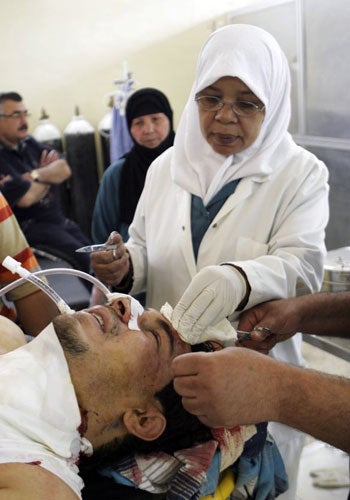
A suicide bomber disguised as a policeman blew himself up in the middle of a group of tribal leaders, army officers and officials leaving a reconciliation conference, killing 33 people. The action puts into doubt recent claims that security is improving in Baghdad.
The attack on those attending a meeting intended to reconcile Sunni and Shia yesterday took place in the market of Abu Ghraib, a Sunni neighbourhood in west Baghdad, near the notorious prison. Among the dead were two Iraqi journalists and seven officers from the al-Muthanna Brigade stationed at Abu Ghraib.
The suicide bombing comes three days after a similar attack killed 28 people near the police academy in east Baghdad. Taken together, the bombings show that al-Qa'ida in Iraq, which almost certainly carried them out, still has the ability to recruit, equip and direct suicide bombers, though not in the same numbers as it did during the height of the sectarian violence during 2006 and 2007.
The officers and journalists were accompanying Sunni and Shia tribal leaders on a tour of the run-down market in Abu Ghraib. Shakir Fizaa, the mayor of Abu Ghraib, said the tribal leaders had just left his office and were talking to people in the market when the bomb went off. "This terrorist attack was aimed at stopping reconciliation and the improvement in security," he said.
The Iraqi government and US officials emphasise the continuing improvement in security in Baghdad and central Iraq since the second half of 2007. But this still leaves Iraq as one of the most dangerous places in the world. In addition to spectacular suicide bombings there are continual assassinations and "sticky bombs" attached to the underside of vehicles.
The popular police chief of Mansour district in central Baghdad was killed recently by a bomb so powerful that no remains of the body could be found.
Abu Ghraib, on the western entry to Baghdad, is a Sunni town with a reputation for sectarianism. It is garrisoned by the al-Muthanna Brigade, recruited from tough Shia working-class districts in Baghdad. Its checkpoints are much-feared by Sunni entering the capital from Anbar province to the west. The commander of the brigade, Colonel Murad Kareem, was among those injured by the blast. His brother, along with another regimental commander, was killed.
In the aftermath of the explosion onlookers said insurgents opened fire on survivors, killing several of them. It is difficult to tell the source of gunfire after bombings because the police often fire into the air in the belief that this contributes to restoring order.
Al-Qa'ida has never recovered from the tribal revolt against it, supported by the US Army, but it retains a network of committed supporters willing to attack Sunni tribal leaders and Shia targets. It is strong in the northern city of Mosul, where a suicide bomber killed three people, including a policeman, yesterday.
The upsurge in violence is unlikely to delay the planned withdrawal of US and British troops. Britain will begin pulling out its 4,000 combat troops at the end of March and will have completed the withdrawal by the end of July, a British military spokesman in Basra said. The US will send 900 military police to Basra to train Iraqi police. The Iraqi government is unlikely to ask any US troops to stay on after the agreed withdrawal date at the end of 2011, the US commander in Iraq, General Ray Odierno, has confirmed.
Join our commenting forum
Join thought-provoking conversations, follow other Independent readers and see their replies
Comments