Bomb blast blamed on Israel and US kills Iran nuclear scientist
Furore in Tehran after co-ordinated bomb attacks by motorcycle assassins
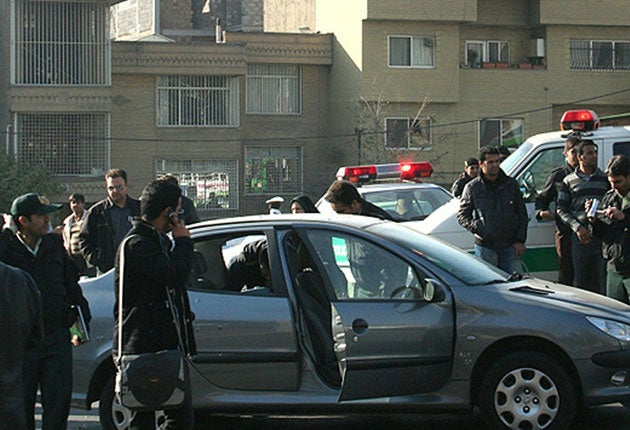
Iran has accused Israel and the US of orchestrating bomb blasts yesterday morning in Tehran that killed a prominent nuclear scientist and injured a colleague.
Assailants on motorbikes stuck magnetic explosives to the cars of two Iranian scientists as they drove to work. Dr Majid Shahriari, a prominent nuclear expert, was killed in one of the attacks, and his wife injured. In a second car Dr Fereydoun Abbasi-Davani and his wife escaped with injuries. The surviving scientist is on a UN list of individuals under sanction for suspected links to secret nuclear activities.
The Iranian regime immediately pointed an accusing finger at foreign enemies for the attacks. A defiant President Mahmoud Ahmadinejad said that, "undoubtedly, the Zionist regime and Western governments are involved in the assassination. When the time will come for holding them to account, their file will be very thick."
Israel, which has a policy of neither denying nor confirming such reports, declined to comment.
The death of Dr Shahriari, an academic at Shahid Beheshti University, is a heavy loss to Iran's nuclear research, analysts said. State news agencies said he was involved in developing the country's new generation of reactors. It remains unclear if he worked on Iran's uranium enrichment programme, which the West believes is a cover to build a nuclear bomb.
Iran's nuclear chief, Dr Ali Akbar Salehi, said that Dr Shahriari was "in charge of one of the country's great projects" at Iran's Atomic Energy Agency, but did not elaborate, according to the state-run news agency IRNA.
Dr Abbasi-Davani, who works at the same university as his murdered colleague, is said to be an expert in lasers and one of the country's top specialists on nuclear isotopes. He is also understood to have close connections to the country's Iranian Revolutionary Guard.
Within hours of the attacks, Iranian officials vented their fury, accusing the West of waging a covert war on its nuclear programme, which Tehran has maintained is for civilian use.
"Don't play with fire," Mr Salehi warned his country's foes. "The patience of the Iranian nation has limits. If it runs out of patience, bad consequences will await enemies."
The Interior Minister, Mostafa Mohammad-Najjar, directly accused Mossad, Israel's intelligence agency, and the CIA of planning the attacks, saying that they have "constantly tried to sabotage our technological progress".
Israel has been one of the loudest critics of Iran's nuclear programme, repeatedly warning Washington that the military option must remain on the table in case sanctions do not work. Senior Israeli officials have repeatedly said that the window of opportunity for a military strike is fast closing.
But Meir Javedanfar, an Israeli analyst of Iranian origin, cautioned that the killings might have been engineered by those close to the Iranian regime, as some reports have linked Dr Shahriari to Iran's "green" opposition movement. Since last year, the Iranian government has launched a heavy crackdown on dissenters. "It's possible that ... the regime wanted to get rid of them in a way that could be blamed on foreign elements," said Mr Javedanfar. "Iran has become a very unstable place since last year's elections."
Professor Massoud Ali Mohammadi, another nuclear scientist, was killed in a similar attack last January. As in this case, Iran accused Israel, although an opposition website later claimed that that the scientist supported the opposition presidential candidate Mir-Hossein Moussavi in last summer's disputed elections.
Dr Shahriari's killing brings the tally of murdered scientists to at least three. A fourth, Dr Ardeshir Hosseinpour, died from mysterious gas poisoning three years ago.
Israel is also suspected by some of involvement in developing a cyber worm that is believed to have attacked Iran's industrial-nuclear complex. Mr Ahmadinejad admitted for the first time yesterday that malware had affected "several" uranium enrichment centrifuges, creating problems on a "limited basis". "Our specialists stopped that and they [the attackers] will not be able to do it again," he added.
The attacks on the scientists come just hours after Wikileaks released thousands of secret US cables revealing that Saudi Arabia had "repeatedly" urged Washington to take military action to curb Iran's nuclear ambitions. Israel said yesterday that the cables vindicated its concerns over the threat posed by the Iranian nuclear programme.
Join our commenting forum
Join thought-provoking conversations, follow other Independent readers and see their replies
Comments
Bookmark popover
Removed from bookmarks