Crossing the divide: Cooking with the enemy
Take two chefs, one Israeli and one Palestinian, and you have the recipe for a groundbreaking TV drama that is helping to break down barriers in the Middle East. Donald Macintyre reports
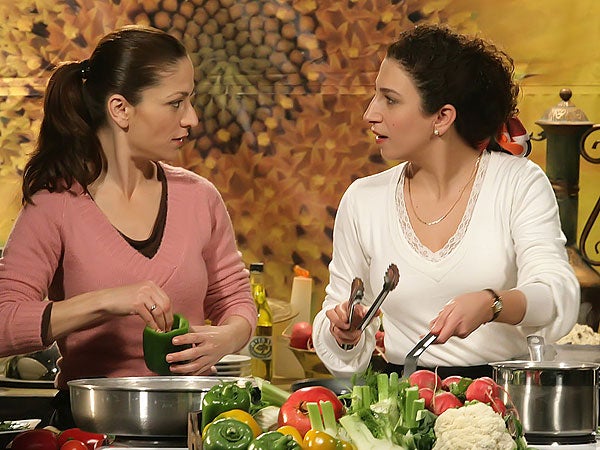
There's a moment when one of the two strong women at the centre of Good Intentions, a ground-breaking television drama series showing at prime-time on Israel's Channel Two, leaves a voicemail for the other, who is preparing to drop her son off at the induction camp for the first day of his compulsory army service. "I only wanted to wish you good luck for your son," she says. "I hope he will be safe."
That would be unremarkable. Except that the woman making the call is Amal, a Palestinian from Ramallah whose brother is paralysed from the waist down after being shot by an Israeli army patrol; has just passed through a hated military checkpoint on her way home from work; and is struggling to protect her own daughter from the perils and pressures of life under Israeli occupation.
Both women are chefs recruited for the series' show within a show, a TV cookery programme with the – in the sceptical eyes of the unnamed channel's bosses – outlandish idea of being co-presented by an Israeli and Palestinian. The developing bond between them is strengthened by the implacable opposition each faces from among her nationalistic friends and family. Tami's husband, who once shot an unarmed Palestinian during his army service, is angry and embarrassed at her cooking in public with the enemy; the woman she runs a restaurant with, whose husband was killed on military service, leaves for a rival concern in protest at her doing the show; and her son says that by working with a Palestinian she "weakens me as a soldier".
Across in the West Bank, Amal is facing problems as daunting and as intimately portrayed. Her embittered brother regards his sister as a collaborator for working with the enemy even though she has taken the job to help provide for him. "Is it co-existence food?" he dismissively asks her as he angrily refuses a meal she has prepared for him. Her 12-year-old daughter is beaten up by her classmates. "They said mother was co-operating with the Israelis and they have to kill her," she tells her grandfather.
Mainly in Hebrew and Arabic – with subtitles in both – Good Intentions is what director Uri Barabash, the Oscar-nominated Israeli movie-maker who trained at the London Film School under Mike Leigh in the 1970s, justly calls a "breakthrough" for peak-time Israeli TV. Although the popular Arab Work programme was recently aired on Channel Two, it was a sitcom in which the Arabs are Israeli citizens and the Israel-Palestinian conflict is wholly absent. In Good Intentions it is omnipresent. And with a steadily darkening storyline, scripted by the Israeli writer Ronit Weiss-Berkovich, this is no comedy.
But, says Barabash: "What is really important is that the most mainstream Israeli channel you can think of is showing at prime time once a week a drama series in which half the action is set in Ramallah, in Arabic and about a Palestinian family. I'm very happy and proud about it."
As with the fictional cookery show, the channel's network company Reshet took some persuading to run Good Intentions. The inspiration for it came from the Parents Circle-Families' Forum (PCFF), a joint grassroots organisation of Israeli and Palestinian families bereaved by the conflict. One of its most prominent members is Robi Damelin, whose 28-year-old army reservist son, David, was killed by a Palestinian sniper in 2002.
Ms Damelin, who believes "the occupation is killing the moral fibre of Israel" has for several years travelled widely at home and abroad presenting the PCFF's message of mutual understanding in partnership with Ali Abu Awwad, a jailed Palestinian veteran of the first intifada, whose brother, Yousef, was shot dead by an Israeli soldier at a checkpoint and is now an advocate of non-violent resistance.
She regards Good Intentions as "a very unusual opportunity for Israelis to get a glimpse of the other side and vice versa, to see the human side of the so-called enemy".
At one point the circle dashed off a proposal to USAID for a grant towards making a drama series. "You can imagine how surprised we were when they said yes," she says. But while the US development aid contribution of about $750,000 (£380,000) – between a third and half of the show's total budget – certainly helped Reshet's decision, Ms Damelin still believes it was "incredibly brave" of the network to air the show.
The PCFF also brought the cast to a meeting at which eight bereaved Palestinians and eight Israelis told their stories. For Clara Khoury, the rising 31-year-old Arab Israeli actress who co-stars as Amal, this was "really touching and powerful". She was especially affected by a young Palestinian woman from the West Bank, Shireen, whose civilian brother was shot and killed by Israeli forces. "This person, so strong, gave me this encouraging power to get into this character," she says, adding that even before that "I loved the idea of this series. I accepted without reading it".
The secret has been to set what producer Haim Sharir calls a "trap" for Israeli viewers who would normally switch off anything conflict-related – by making the story so emotionally involving that they are drawn into "understanding the other side".
But while he and Barabash are irritated that putting it up against Euro 2008 kept the audience for the first five episodes down to around 600,000, it has stuck by the eminently exportable series.
On the question of how far it can also penetrate the Palestinian audience, Khoury says the feedback she has had has been positive – including from friends in Ramallah. And Al Jazeera has now expressed interest in airing the show – which would create a huge potential audience for it in the Arab world.
Sharir believes the story is one that the satellite channel "could live with if they are willing to show the other side just as we are".
Join our commenting forum
Join thought-provoking conversations, follow other Independent readers and see their replies
Comments
Bookmark popover
Removed from bookmarks