Did British bomb attacks in Iran provoke hostage crisis?
Abduction of computer expert and bodyguards in Iraq were an act of revenge by Tehran, source reveals
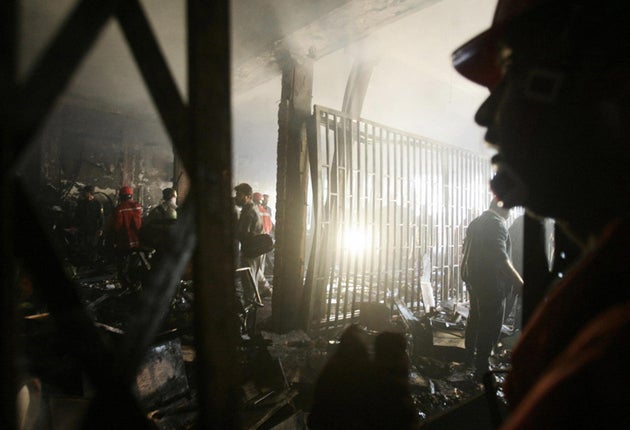
The abduction of the British computer expert Peter Moore and his four bodyguards was carried out partly in revenge for deadly bomb attacks in south-west Iran which Iranian officials blamed on Britain, according to a well-placed source in Baghdad.
The five men were abducted by an Iranian-backed group in 2007 and it is now believed four of them have been killed. The fate of Mr Moore remains unclear. The Iranians orchestrated the abduction through an Iraqi proxy, the Asaib al-Haq, which they largely controlled, the source said.
Their main motive was to obtain prisoners to be used as a bargaining chip to secure the release of Qais al-Khazali, the leader of Asaib al-Haq, and other imprisoned militants who had split from the movement led by the Shia anti-American cleric Muqtada al-Sadr.
But the Iranians had a second motive for targeting the British, says the source who, as a member of Mr Sadr's movement, is well-informed about Asaib al-Haq and its supporters. He says Iran was convinced Britain was backing Arab separatist groups in the Iranian oil province of Khuzestan which had made a series of bomb attacks on civilian targets, killing 28 people and wounding 225 in the two years before the kidnapping of the five Britons in Baghdad. Khuzestan has an Arab minority of two million.
These bombings attracted little attention outside Iran, but were taken very seriously by the Iranians who furiously denounced the US and Britain for supporting small gangs of anti-government militants planting the explosives. The attacks included four blasts in a single day in Ahvaz, the Iranian city across the Shatt al-Arab waterway from Basra, on June 2005, which killed 11 people and wounded 87.
The bombs were planted near government offices and a television station. Targets were evidently chosen without regard for civilian casualties. Iran blamed Britain, and British forces in Basra in particular, for the bombings in Ahvaz. These incidents have never really stopped, the latest being the discovery in May this year of an explosive device in the toilet of an Iranian plane flying out of Ahvaz with 131 people on board which was defused before it blew up. After two bombs exploded in Ahvaz in October 2005, killing six people and wounding at least 100, Iran's Deputy Interior Minister, Mohammed Hossein Mousapour, said: "Most probably those involved in the explosion were British agents who were involved in the previous incidents in Ahvaz and Khuzestan." The Foreign Office publicly denied any British involvement for which Iran produced no evidence.
But at the time Mr Moore and his four security guards were kidnapped, America was escalating its own covert war against Iran. It was revealed last year by the US newsletter Counterpunch that President George W Bush had asked Congress for $300m (£180m) to destabilise Iran by funding dissident groups.
"The covert activities involved support of the minority Ahwazi Arab and Baluchi groups and other dissident organisations," added the journalist Seymour Hersh in The New Yorker magazine. He said US special operations forces had been conducting cross-border operations into southern Iran during 2007, seizing members of the al-Quds, the commando arm of the Iranian Revolutionary Guard, and bringing them back to Iraq for interrogation.
The fate of Mr Moore and the four British men working for the Canadian security company GardaWorld may have been affected by this tit-for-tat secret war between the Americans and the Iranians. "The Iranians did not want to provoke the Americans into an all-out war, so Britain was a useful target as America's main ally," said one former Iraqi official. He quoted the old Iraqi saying: "If you don't dare fight your neighbour, you beat his dog."
The Foreign Office has been blamed for its conduct of negotiations with the kidnappers, but its officials were faced with a uniquely complicated situation. They had to deal not only with Asaib al-Haq, but with its shadowy Iranian backers and with the Americans, who actually had Qais al-Khazali and other militant leaders in prison.
It is unlikely that Mr Moore was abducted in order to suppress evidence of corruption in the finance ministry whose information service he was seeking to upgrade. Ali Allawi, the former Iraqi finance minister, says the idea is "far-fetched", though bureaucrats in the finance ministry were opposed to a new system of financial management which would have made the flow of government money more visible. Mr Allawi says that official resistance in the finance ministry was sufficient to kill off the scheme.
The abduction by men dressed as interior ministry forces was not out of the ordinary in Baghdad at the time, where there was no clear boundary between police and death squads.
Join our commenting forum
Join thought-provoking conversations, follow other Independent readers and see their replies
Comments
Bookmark popover
Removed from bookmarks