Don't interfere, Ahmadinejad tells Obama
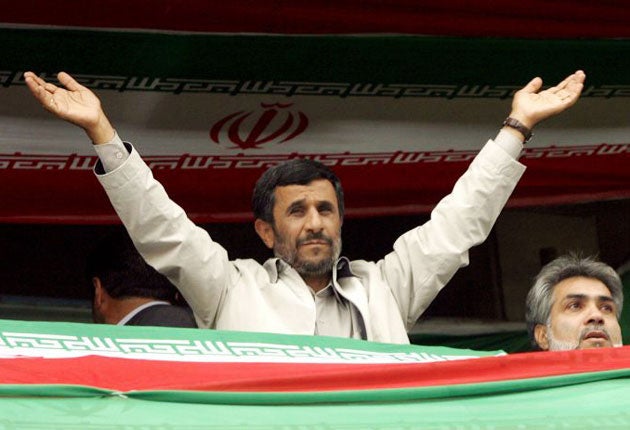
President Mahmoud Ahmadinejad accused President Barack Obama of behaving like his predecessor on Iran and called on him to apologise for what he called US interference following the Iranian elections.
Obama has ramped up his previously muted criticism, saying he was "appalled and outraged" by a crackdown on protests which followed Ahmadinejad's disputed re-election.
"Mr Obama made a mistake to say those things ... our question is why he fell into this trap and said things that previously (former US President George W.) Bush used to say," the semi-official Fars News Agency quoted Ahmadinejad as saying.
About 20 people have been killed in the demonstrations, but police and militia have flooded Tehran's streets since Saturday, quelling the majority of protests after the most widespread anti-government unrest since the 1979 Islamic revolution.
The turmoil has dimmed prospects for Obama's outreach to Iran over its nuclear programme, with Tehran blaming Britain and the United States for fomenting violence.
"I hope you avoid interfering in Iran's affairs and express your regret in a way that the Iranian nation is informed of it," Ahmadinejad said.
Iran's reformist opposition leaders have vowed to press on with legal challenges to an election they say was rigged.
The wife of opposition leader Mirhossein Mousavi, who says he won the poll, said it was a "duty to continue legal protests to preserve Iranian rights".
Mousavi supporters said they would release thousands of balloons on Friday imprinted with the message "Neda you will always remain in our hearts" - a reference to the young woman killed last week who has become an icon of the protests.
Riot police swiftly dispersed a group of about 200 demonstrators with teargas on Wednesday, but the protest was a far cry from marches last week that attracted tens of thousands.
Protest cries of Allahu Akbar were heard from Tehran rooftops again overnight, although they were much more short-lived than on previous evenings in the capital.
The unrest has exposed unprecedented rifts within Iran's clerical establishment, with Supreme Leader Ayatollah Ali Khamenei, who normally stays above the political fray, siding strongly with Ahmadinejad.
"My personal judgment is that this is a country deeply split and emotionalised," a Western diplomat in the region said. The protests had shown how dissatisfied some parts of society were with the way Iran was run - to the chagrin of its leadership.
"I think they are deeply shocked," the diplomat said. The authorities had managed to impose outward stability, but had paid a heavy moral price, he added.
Khamenei has upheld the result of the June 12 presidential poll and has warned opposition leaders they would be responsible for any bloodshed.
Iran's top legislative body, the Guardian Council, has also ruled out a call from Mousavi to annul the election.
A spokesman for the council, which must approve the poll, said it had looked into all complaints but found no major fraud or irregularities, state Press TV reported on Thursday.
The spokesman said the vote was "among the healthiest elections ever held in the country" since the revolution.
The crackdown on the protests has stalled US efforts to reach out to Tehran both over its nuclear programme and to seek its help in stabilising Afghanistan.
The United States withdrew invitations to Iranian diplomats to attend US Independence Day celebrations on July 4.
It was the first time since Washington cut diplomatic ties with Tehran in 1980 that Iranian diplomats had been invited to the embassy parties, but the move to withdraw the invites was largely symbolic as no Iranians had even responded.
"The president's policy of engagement is obviously delayed, but we are going to have to deal with the government of Iran," Senator John Kerry, chairman of the influential Senate Foreign Relations Committee, told Reuters.
The best US option for pressuring Iran, the world's fifth biggest oil producer, was to drive down crude prices by reducing America's dependence on imported energy, Kerry said.
Mohammad Marandi, who is the head of North American Studies at Tehran University, said mistrust of the United States and Britain was rife, partly due to the "very negative" role of US- and British-funded Persian-language television stations.
"They are working 24 hours a day spreading rumours and trying to turn people against each other," he told Reuters.
"In the short term relations will definitely get worse, but in the long term the US really has to re-think its policy and to recognise that regime change is not possible in Iran."
Join our commenting forum
Join thought-provoking conversations, follow other Independent readers and see their replies
Comments