Exclusive: ‘We believe that the USA is the major player against Syria and the rest are its instruments’
Assad's Foreign Minister gives his first interview to a Western journalist since the conflict began
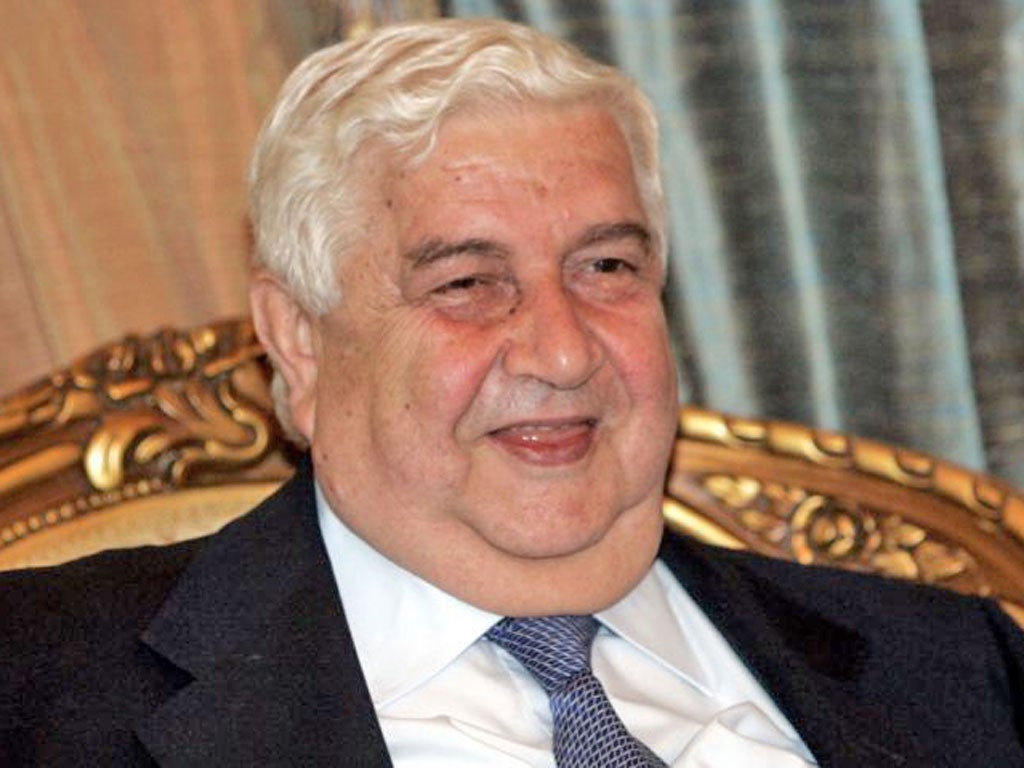
The battle for Damascus could be heard inside the Foreign Minister's office yesterday, a vibration of mortars and tank fire from the suburbs of the capital that penetrated Walid Muallem's inner sanctum, a dangerous heartbeat to match the man's words.
America was behind Syria's violence, he said, which will not end even after the battle for Aleppo is over. "I tell the Europeans: 'I don't understand your slogan about the welfare of the Syrian people when you are supporting 17 resolutions against the welfare of the Syrian people'. And I tell the Americans: 'You must read well what you did in Afghanistan and Somalia. I don't understand your slogan of fighting international terrorism when you are supporting this terrorism in Syria'."
Walid Muallem spoke in English and very slowly, either because of the disconcerting uproar outside or because this was his first interview with a Western journalist since the Syrian crisis began. At one point, the conflict between rebels and government troops in the suburbs of Douma, Jobar, Arbeen and Qaboun – where a helicopter was shot down – became so loud that even the most phlegmatic of Foreign Ministers in a region plagued by rhetoric glanced towards the window. How did he feel when he heard this, I asked him?
"Before I am a minister, I am a Syrian citizen, and I feel sad at seeing what's happening in Syria, compared with two years ago," he said. "There are many Syrians like me – eager to see Syria return to the old days when we were proud of our security."
I have my doubts about how many Syrians want a return to "the old days" but Muallem claims that perhaps 60 per cent of the country's violence comes from abroad, from Turkey, from Qatar and Saudi Arabia, with the United States exercising its influence over all others.
"When the Americans say, 'We are supplying the opposition with sophisticated instruments of telecommunications', isn't this part of a military effort, when they supply the opposition with $25m – and much more from the Gulf and Saudi Arabia?"
A year ago, I told Muallem, I lunched with the Emir of Qatar, and he was enraged at what he called Bashar al-Assad's lies, claiming that the Syrian President had reneged on a deal to allow Muslim Brotherhood members to return home.
Muallem nodded. "If you met the same Emir two years ago, he was praising Assad, and considered him a dear friend. They used to have family relations, spending family holidays in Damascus and sometimes in Doha. There is an important question: what happened? I met the Emir in Doha in, I think, November 2011, when the Arab League started their initiative [resulting in the sending of League observers to Syria] and we reached agreement … The Emir told me: 'If you agree to this initiative, I will change the attitude of Al Jazeera and I will tell [Sheikh] Qaradawi [a popular prelate with a regular slot on the television chain] to support Syria and reconciliation, and I have put down some billions of dollars to rebuild Syria…' .
Of America's power, Walid Muallem had no doubt. The Americans, he says, succeeded in frightening the Gulf countries about Iran's nuclear capabilities, persuaded them to buy arms from the US, fulfilling Franklin Roosevelt's 1936 dream of maintaining bases for oil transportation.
"We believe that the US is the major player against Syria and the rest are its instruments." But wasn't this all really about Iran? I asked, a dodgy question since it suggested a secondary role for Syria in its own tragedy. And when Muallem referred to the Brookings Institution, I groaned.
"You are laughing, but sometimes when you are Foreign Minister, you are obliged to read these things – and there was a study by the Brookings Institute [sic] called The Road to Tehran, and the result of this study was: if you want to contain Iran, you must start with Damascus…
"We were told by some Western envoy at the beginning of this crisis that relations between Syria and Iran, Syria and Hezbollah, Syria and Hamas are the major elements behind this crisis. If we settle this issue, they [the Americans] will help end the crisis. But no one told us why it is forbidden for Syria to have relations with Iran when most if not all the Gulf countries have very important relations with Iran."
For the Syrian Foreign Minister, the crisis started with "legitimate demands" subsequently addressed by "legislation and reforms and even a new constitution". Then along came "foreign elements" who used these legitimate demands "to hijack the peaceful agenda of the people".
There followed a familiar tale. "I don't accept as a citizen to return back centuries to a regime which can bring Syria backwards. In principle …no government in the world can accept an armed terrorist group, some of them coming from abroad, controlling streets and villages in the name of 'jihad'."
It was the duty of the Syrian government to "protect" its citizens. Assad represents the unity of Syria and all Syrians must participate in creating a new future for Syria. If Syria falls, its neighbour countries will fall. Muallem travels to the non-aligned summit in Iran tomorrow to burnish what he calls their "constructive efforts" to help Syria.
I asked about chemical weapons, of course. If Syria had such weapons, they would never be used against its own people, he said. "We are fighting armed groups inside Aleppo, in the Damascus suburbs, before that in Homs and Idlib and this means fighting within Syrian cities – and our responsibility is to protect our people."
And the infamous Shabiha militia blamed for atrocities in the countryside? Walid Muallem doesn't believe in them. There might be local unarmed people defending their property from armed groups, he says. But pro-regime, paid militiamen? Never. No war crimes charges against the Syrian Foreign Minister, then. But the guns still thunder away outside his windows.
Join our commenting forum
Join thought-provoking conversations, follow other Independent readers and see their replies
Comments