Fault line that allows al-Qa'ida to flourish in Yemen
Two decades of unification have failed to heal a regional rivalry that has hindered the country's efforts to root out the extremists. Donald Macintyre reports from Aden
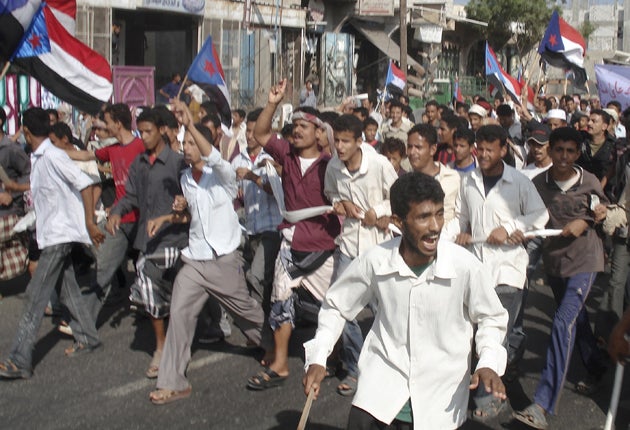
The devout and grave-faced men pouring out of prayers yesterday at the al Rihaab Mosque in Aden were at once keen to speak about their government, seven hours' drive to the north, and guarded in their choice of words.
But most left little doubt about the deep vein of discontent that runs through the port city the British left over 42 years ago. Yes, there was corruption, said Sami Samir, a 24-year-old support teacher. He added carefully that President Ali Abdullah Saleh is himself "good" but: "Under him the government is playing with the country. We need a government that is more democratic and keeps by the law."
Speaking in English learnt in his three years studying business and marketing in Slough, he added: "The northern tribes get the good jobs and good salaries and we don't."
A 40-year-old former regular soldier was blunter. "In the south we are living under injustice. We live as second- or third-class citizens." The south was "under occupation", the man claimed. He gave his name but even before he could be drawn on whether he supported the increasingly secessionist Southern Movement, said: "If someone is heard talking like this, he will go to prison."
There is nothing new about south-north hostility, of course. Aden still bears the marks of the long British presence: the storage bunkers built in the steep rock, the unmistakeably English church overlooking the port, the pillar boxes – now painted yellow – and the plaque on the old city gate commemorating the 1892-93 campaign of the 2nd Battalion, Welsh Borderers. But from Britain's withdrawal from East of Suez in 1967 until the collapse of the Soviet bloc in 1990, North and communist-led South Yemen, with Aden as its capital, were two countries. Then it was unified and has remained so despite a north-south civil war in 1994.
But now Yemen's US-urged efforts to dislodge an apparently resurgent al-Qa'ida of the Arabian Peninsula from its bases in the country are being complicated by the sense of grievance in the south. For almost two decades it has felt itself a marginalised section of what is already the poorest country in the Arab world, seeing the Sana'a government as exploiting revenues from southern oil for the north and discriminating against southerners in public service jobs. The government, which is fighting a Shia rebellion in the north of the country, has been preoccupied, its critics charge, with combating the increasingly secessionist Southern Movement rather than dealing with the grievances that feed it.
At the same time, some opponents of both al-Qa'ida and the secessionists have attempted, with only limited success, to claim a link between the two, focusing in part on Tariq al-Fadhli, a former jihadist who fought against the Soviets in Afghanistan – and was used by President Saleh in his fight against the communists in 1994 – and who has now become a prominent secessionist. Southern Movement spokesmen adamantly deny any connection, saying that the President tries to discredit the movement by planting fake al-Qa'ida adherents in it. Indeed, they argue that the government's belligerent stance towards the region's concerns can only strengthen al-Qa'ida.
An illustration of that stance can be found round the corner from this mosque in Crater, the old port district of Aden, at the headquarters, locked and pockmarked by gunfire, of Al Ayyam, the highly popular and fiercely independent Southern newspaper. Closed for six months during British rule, and then again through most of the communist period, it was closed again in May last year by the government, allegedly for inciting separatism. A series of demonstrations in its support culminated early this week in a stand-off between police, soldiers and 36 supporters in front of the building, which ended with a policeman and one of the office's security guards being killed, and the editor and owner of the paper, 66-year-old Hisham Bashraheel, arrested. He is still in police custody, triggering sharp protests from Reporters Without Borders. While the police say they took possession of arms from inside the building – not a surprise in this weapon-rich country – the Yemen Times this week quoted Mr Bashraheel as telling the journalists' organisation before his arrest that the battle had been started by security forces firing on demonstrators.
Two male members of the Bashraheel family – who live in the newspaper compound – underlined the tensions here when they walked from it yesterday towards their car. As qat-chewing policemen maintained a guard on the building, still fortified by sandbags, from 40m away, one of the editor's relatives said: "We can't say anything at the moment, you must understand that. You must wait."
But the paper's many supporters argue that rather than promote secession, Al Ayyam merely reports a wide range of political strands. "It is the only paper that speaks in the tongue of the people," says Hagea Ali al Jehafi, one of its currently laid-off journalists. The local deputy police chief, Colonel Rida abu Zeida, says wryly that some of the paper's articles "make you think that the last day is coming". But even he says that the "paper is loved by the local people" and that he and his colleagues are regular readers. The closure of the paper and the arrest of its editor appears to have perturbed the majority of yesterday's worshippers. "We are very upset about the situation at Al Ayyam," said one.
Aden was where al-Qa'ida launched its attack on USS Cole in 2000. And while Colonel Abu Zeida, 47 – who proudly shows the mark of his childhood smallpox vaccination under British rule – says initially that al-Qa'ida is not now an issue in Aden and that he is confident that local forces have the capacity to maintain security, he admits to being "worried" about the fact that the organisation's reported stronghold of Abiyan is only two hours away.
There was no evidence of any support for the organisation among those leaving al Rihaab Mosque yesterday. "It's a problem," said Mr Samir, "They give Europe and America a bad picture about Islam." But despite the fears that intelligence agents might have been listening in the small crowd that had gathered, there was no lack of the economic and political grievances which some analysts believe the extremists can exploit, especially among the young. "You cannot get a job and the cost of life is very high," Mr Samir added. He said he does not even personally seek secession. "I do not want separation," he adds, "but we need the government to be more democratic and we need an end to discrimination." One worshipper, Hussein Haddad, 60, says there was more "justice" under the British and that he does not rule out a repeat of the 1994 war.
"I don't like the government much but I do want Yemen to be one country." Muhammed Hussein, 40, a customs officer in the port, said. "But I do want the government to make the situation better."
Join our commenting forum
Join thought-provoking conversations, follow other Independent readers and see their replies
Comments