Iran scientist: CIA offered me $50m to lie about nuclear secrets
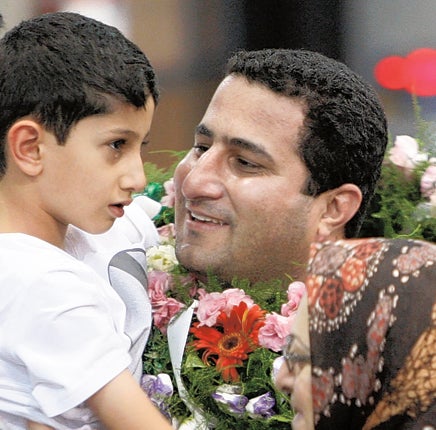
An Iranian scientist who says he was abducted and taken to the United States by the CIA returned to Tehran yesterday to a hero's welcome and claimed that he had been pressured into lying about his country's nuclear programme.
Shahram Amiri said that he was on the hajj pilgrimage when he was seized at gunpoint in the city of Medina, drugged and taken to the US, where he says Israel was involved in his interrogation. In the US, officials were reported to have admitted that Mr Amiri was paid more than $5m (£3.2m) by the CIA for information about Iran's nuclear ambitions.
The US claims to have received useful information from him in return for the money, but is clearly embarrassed by his very public return to Iran. The offer of a large bribe is reportedly part of a special US programme to get Iranian nuclear scientists to defect.
Flashing a victory sign, Mr Amiri returned to Tehran International Airport to be greeted by senior officials and by his tearful wife and seven-year-old son, whom he had not seen since he disappeared in Saudi Arabia during a visit 14 months ago. Iran said it was demanding information about what had happened to him.
The US says that he entered the US of his own free will and had relocated to Tucson, Arizona. The US is claiming that Mr Amiri, who had worked for Iran's Atomic Energy Organisation, re-defected because pressure was placed on his family back in Iran, something he denied yesterday. Officials suggested that Iran had used his family to get him to leave the US.
"Americans wanted me to say that I defected to America of my own will, to use me for revealing some false information about Iran's nuclear work," Mr Amiri said at Tehran airport.
"I was under intensive psychological pressure by [the] CIA... the main aim of this abduction was to stage a new political and psychological game against Iran."
Iran and the US have been engaged in a semi-covert war involving defections, seizures and kidnappings in recent years, of which the case of Mr Amiri is only the latest example.
It reached its peak in Iraq in 2007 when the US abducted Iranian consular officials from the northern city of Arbil and Iran seized a British navy patrol boat in the Gulf. Last year, Iran seized three Americans hiking in the mountains of Iraqi Kurdistan, claiming they had strayed over the Iranian border, while other accounts said they had been forced into Iran at gunpoint.
Mr Amiri had appeared in three contradictory videos; in the first he claimed to have been kidnapped and tortured and in the second, he said he had come to the US to write his PhD.
In a third video he denounces the second one. On Monday he arrived unannounced at the Iranian interest section of the Pakistani embassy in Washington and asked for an air ticket to return to Iran.
At his press conference at Tehran airport, Mr Amiri stressed that he had acted under compulsion. "Israeli agents were present at some of my interrogation sessions and I was threatened to be handed over to Israel if I refused to cooperate with Americans," he said. "I have some documents proving that I've not been free in the United States and have always been under the control of armed agents of US intelligence services."
He says he was offered $50m to stay in the US. Mr Amiri denied that he had ever had any information about the Iranian nuclear programme. "I am an ordinary researcher... I have never made nuclear-related researches. I'm not involved in any confidential jobs. I had no classified information."
Mr Amiri had worked at Iran's Malek Ashtar University, an institution closely connected to the country's elite Revolutionary Guards.
US officials said that Mr Amiri may not be able to access his $5m, because of sanctions on Iran. The Washington Post said yesterday that the Iranian scientist had been working with the CIA for a year and officials were "stunned" by his request to go home this week. The officials added that he had provided useful information, though not directly on whether Iran was trying to make a nuclear device.
Join our commenting forum
Join thought-provoking conversations, follow other Independent readers and see their replies
Comments