Iranian ships could join wave of flotillas to Gaza, says Hamas chief
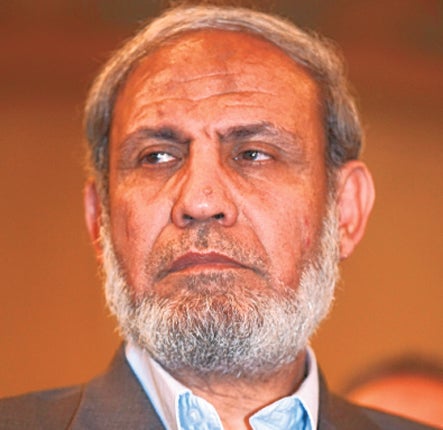
A top Hamas leader has warned Israel to expect more Gaza-bound pro-Palestinian flotillas over the next two months, including vessels "from the Gulf". Mahmoud Zahar, often seen as the dominant figure in Hamas's political leadership in Gaza, said that he had been informed by "people ... from the Gulf states" that "after the Mondial [World Cup] at least eight ships will come from the Gulf".
Dr Zahar did not name the states involved but when asked if they included Iran he replied: "Why not?" It is over four weeks since a Turkish-led flotilla was halted by a lethal Israeli commando raid which led to the deaths of nine activists and provoked an international outcry.
In an interview with The Independent, the Hamas leader also accused the Israeli government of reneging on a prisoner swap agreement which he insisted could have led to the release of captive Israeli soldier Gilad Schalit. "Up to this moment, the Israeli intention is not to have an agreement," he claimed.
Dr Zahar said that those in Hamas's military wing presumed to be holding Sgt Schalit were still refusing to allow the Red Cross or any other independent humanitarian organisation to visit him, "I asked that to the people concerned and they said to me it [a visit] was impossible." Asked whether it was believable that the Red Cross would use a humanitarian visit to pass details of the abducted sergeant's whereabouts to Israel, he said: "I trust nobody."
The Hamas leader insisted that during the last negotiations, brokered by a German mediator, the Israeli Prime Minister, Benjamin Netanyahu, had agreed to a first list of 325 Palestinian prisoners to be released and on the principle that another 125 would be nominated by the Islamic faction and approved by Israel. But "everything changed" after a meeting of the Israeli Cabinet. Dr Zahar declined to answer a question about whether the German mediator was still active.
Claiming that there would be more flotillas "than in your expectations", he said that he also expected further vessels to set out for Gaza during Ramadan, the Muslim month of fasting, which begins this year on 11 August. On the possibility that Egypt might prevent a flotilla from the Gulf passing through the Suez Canal en route to Gaza, he said; "They have the right in international law to go as the Israelis go. Egypt will never be able to stop such a campaign." And on the possibility that Iran might sponsor a vessel or vessels, he said: "I ask you about morality. Where is your morality if Iran is going to give food and drugs? What justifies preventing that? Give me the basis [for that] from your bible."
The Hamas co-founder was bitterly critical of Western policy towards Hamas and Gaza over the four and half years since the Islamic faction won the last Palestinian elections. "Why did the Western people boycott Hamas after the election?" he asked. "Because they want a new Karzai in Palestine". He was equally contemptuous of Western support for the blockade imposed by Israel when Hamas seized control in a short but bloody civil war with its Fatah rivals and coalition partners in June 2007. He claimed the closure of Gaza conformed to Western definitions of "terrorism" by using "violence" to change the attitudes of its victims. "I am asking you, why did you accept this process four years ago?"
But he appeared to derive considerable satisfaction from recent pressure put by the international Quartet of the US, UN, EU and Russia on Israel to relax the blockade – "a big change" which he attributed to popular discontent within the Western states that he claimed was exemplified by the flotillas. Lamenting that the change of heart had followed what he said were 2,000 Palestinian deaths in "two wars" against Gaza – one after the seizure of Sgt Gilad Schalit in 2006 and the other the winter offensive of 2008-09, he said: "Everybody is fed up with this policy. The politicians in the West don't have a heart, they have a dry morality. But the people – and this was proved drastically – were ready to sacrifice their lives [to force a change of policy]."
Asked whether there had been close ties between Hamas and the main Turkish organisation involved in organising the flotilla, he replied derisively. "It's a big mistake to have such a linkage with Turkey, which is Muslim? A linkage between Turkey which is Muslim and Israel which is Jewish is honey but one between Muslim and Muslim is a mistake, a crime?"
But Dr Zahar, who survived an Israeli assassination attempt which killed his son in 2003, was as uncompromising as ever in rejecting the three pre-conditions imposed by the Quartet for ending its boycott of contacts with Hamas – recognition of Israel, adherence to past agreements with Israel and renuciation of violence. "What is the real border of Israel? What about the occupation of Jerusalem what about the occupation of the Golan Heights? I ask Israelis to renounce violence," he said. "I ask your country and then the Americans to renounce violence in Afghanistan and Iraq and Pakistan and then we are going to speak about renouncing violence."
He also roundly blamed Fatah – which he said had a past history of "100 per cent" corruption – for the lack of progress in talks on reconciliation between the two factions. He said Fatah needed to rescind what he claimed was its "refusal" to recognise the 2006 election result.
Dr Zahar strongly defended the executions of those identified as collaborators, or "spies" for Israel, while acknowledging that "not many" ex-collaborators offered an amnesty which is due to end next month had come forward. He sought to brush aside persistent criticisms that the regime in Gaza – as well as the Fatah dominated one in the West Bank – had acted repressively against politicial opponents. He also said that Hamas had eliminated kidnapping of foreigners since its success in freeing the BBC correspondent Alan Johnston.
Join our commenting forum
Join thought-provoking conversations, follow other Independent readers and see their replies
Comments